Table of Contents
Yoakum County Courts, TX *

Yoakum County is located just south of the Texas Panhandle, and, like many Panhandle counties, it is a perfect square. The county is located along the border with New Mexico, and its population is around 7,500, which means Yoakum County accounts for less than 0.02% of Texas's population.
Citizens of Yoakum County must understand the county's court system. It is essential to know where to access court records and how to find court cases to complete the transactions that citizens make daily. People in the county may need records for a child custody change, a traffic ticket history, to file a small claims case, or even a property line dispute over ranch land. Everyone in Yoakum County needs to know how the court system works.
Overview of the Yoakum County Court System
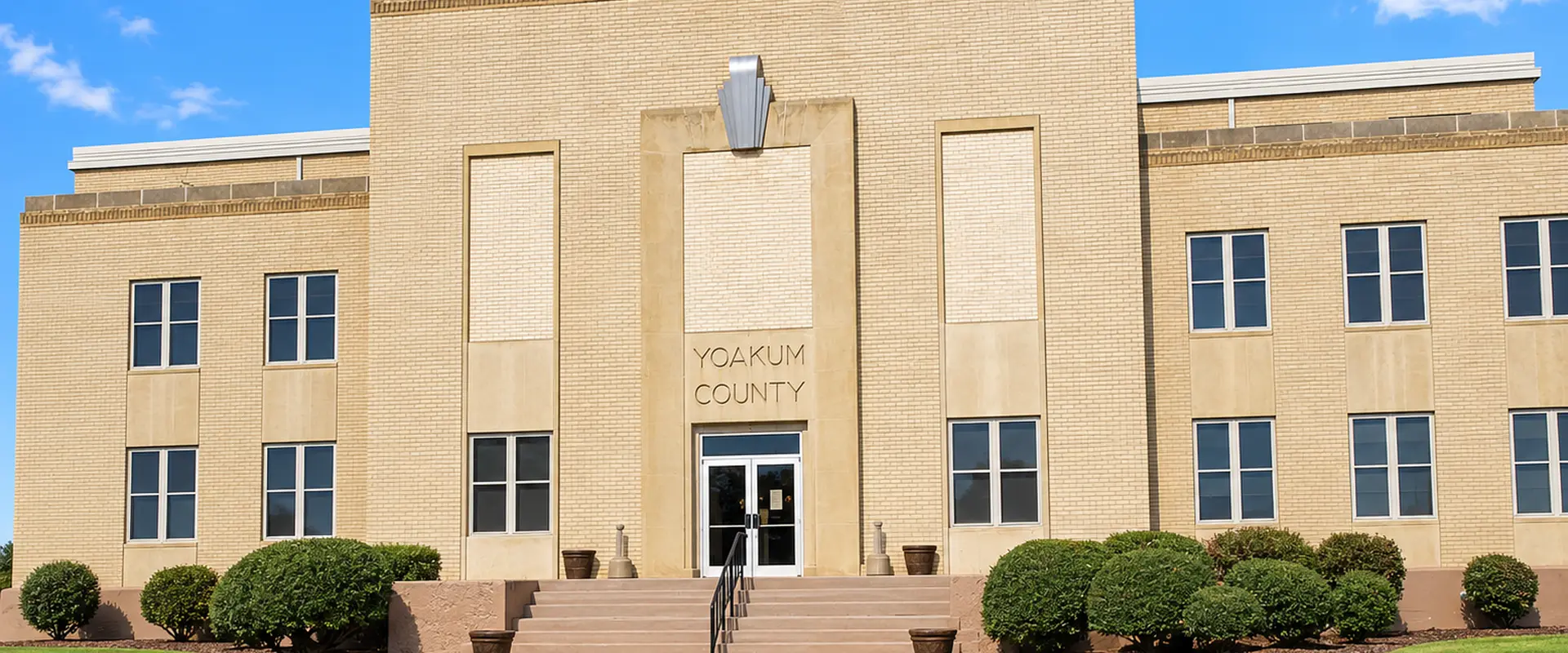
Several court systems exist in Yoakum County. There is one municipal court, located in the county seat of Plains. Yoakum County has two Justices of the Peace, one County Court, and one District Court that serve the county. The Denver City Municipal Court is located in the Denver City City Hall. The other courts are held in the Yoakum County Courthouse. Yoakum County is in the Texas 7th Court of Appeals, which is located in Amarillo. The county sits in the 5th U.S. Circuit Court of Appeals, which is headquartered in New Orleans.
Types of Courts in Yoakum County, Texas

All of the Yoakum County courts have their own jurisdictions, rules, and regulations. It is important that residents of the county understand how each court works.
 District Court
The 121st District Court hears cases from Yoakum and Terry Counties in the Yoakum County Courthouse. District courts represent the highest level of trial courts in Texas. The District Court hears major civil trials and felony criminal cases.
Jurisdictions:
- Felonies
- Felony juvenile cases
- Large civil cases
- Contested divorces
- Disputes over land or titles to land
- Election disputes at the municipal or county level
District Courts have jurisdiction over detailed legal procedures, such as felony cases and civil cases with large amounts. District cases involve multiple hearings and motions, frequent status hearings, and strict filing requirements. Because of that, these cases usually take longer in the district court compared to the lower courts.
 County Court
The County Judge in Yoakum County has a heavy schedule as they act as the administrator for the county, approve the county budget, manage the county's finances, and represent the county as the emergency manager. The County Judge presides over the county commissioners and oversees the county hospital and the senior living center, both county-owned. The County Judge and the court as a whole represent the intermediate level of Texas's court system. They exist between the higher-level district court system and the lower-level Municipal Court or Justice of the Peace system.
Jurisdictions:
- Higher-level (A and B) misdemeanors
- Misdemeanor juvenile cases
- Preliminary felony hearings
- Appeals from Justice of the Peace and Municipal Courts
- Child abuse and neglect cases
- Child support and custody
- Divorces that are uncontested or self-represented
- Civil Cases with damages between $500 and $200,000
- Probate, trusts, and estates
County courts handle large caseloads within Texas's court system. They hear the majority of cases that affect the daily lives of citizens in Yoakum County.
 Justice of the Peace
There are Justices of the Peace (JP) Court precincts in Yoakum County. Precinct 1 is located within the Yoakum County Courthouse in Plains. Precinct 2 is located in Denver City. The JP and municipal courts represent two sides of the same coin, both at the lowest level of the court system in the county. The Denver City Municipal Court hears minor violations and infractions but only within the city limits of Denver City, while JP courts handle infractions occurring outside Denver City, but within the unincorporated areas of Yoakum County.
Jurisdictions:
- Issue search and arrest warrants
- Lowest level of misdemeanors (Class C)
- Municipal code violations/infractions
- Suspensions of driver's licenses
- Parking and traffic violations
- Small claims
- Evictions
- Inquests
JP courts are important in Yoakum County. JPs can administer oaths of office to public officials, perform marriages, and hold formal death investigations (inquests) into a death in the county.
Municipal Court
Yoakum County has one municipal court, located in Denver City, the county's most populous city. Each municipal court system in Texas hears violations that occur within its city limits.
Jurisdiction:
- Class C misdemeanors
- Traffic or parking violations
- Building, remodeling, construction, or zoning violations
- Violations of the city health code
- Dangerous dogs
Class C misdemeanors are the lowest category of misdemeanors and carry fines but no jail time. Examples of class C misdemeanor violations include public intoxication, speeding, running a stop sign, or disorderly conduct. Zoning law violations in Denver City include public health hazards, fire safety hazards, and sanitation violations. Parking offenses in Yoakum County could include violations for parking in a no-parking zone, either commercial or residential.
How to Access Yoakum County Court Records

People who live in Yoakum County need to access court records in their daily lives, whether they need to settle a dispute with a fellow rancher or revise a child support claim.
 Online Access
It is nearly impossible to access municipal court records in Yoakum County online. The county allows residents to pay citations or tickets online, but those who want access to other municipal court records will need to visit the Denver City Municipal Court. Those who want access to records from the District Court, County Court, and JP courts online can look up records using re:SearchTX. Yoakum County also provides County Court records online through the County Clerk's page.
 Alternative Online Options
Yoakum County has several courts, and locating court records can be difficult because they are not in a single database in Texas. The availability of court records may be piecemeal at best, especially in the municipal court system. People who need records quickly may want to use a third-party database for a court records search, such as CourtCaseFinder. Third-party databases save time by quickly searching across multiple jurisdictions.
 In-Person Requests
Yoakum County residents who need court records can make in-person requests to three court clerks. Some clerks represent more than one court, and it is vital to submit records requests to the correct court clerk. The Denver City Municipal Court does not have a court clerk, but the city secretary handles in-person records requests for the city. They retrieve records of violations and infractions that occur within Denver City limits. Residents of Denver City can also phone the secretary with questions or requests. The Yoakum County Clerk maintains records for both Justices of the Peace and the County Judge at the Yoakum County Courthouse. District Court records requests are made at the District Clerk's office in the courthouse. Both the County Clerk and the District Clerk will also answer questions by phone.
 Archived Records
In Texas, archived records are court cases that have been decided or have been inactive for a period of time. Yoakum County residents can request archived records through the same court clerks or city secretaries as when making an in-person request. What if the required records are too old and not available through the clerks? Both the Texas State Library and Archives Commission and the Supreme Court of Texas Archives have access to archived records from Texas courtrooms throughout the state.
For Attorneys and Legal Professionals
Attorneys and legal professionals from outside the county may find the court layout in Yoakum County confusing. It's imperative to understand where each court is located and where court records are located, so one can save time. Legal professionals who require assistance with filing in the Justices of the Peace courts or the County Court need to contact the County Clerk's Office for help with forms or court procedures. For District Court forms or procedures, contact the District Court Clerk.
Yoakum County, like most counties in Texas, has strict rules for legal professionals. For example, attorneys and legal professionals must dress in professional business attire for courtroom proceedings and in-person appearances for records requests. Also, because Yoakum County is rural, many court appearances take place over Zoom, so ensure that one knows whether they must appear in person or via Zoom.
How to File a Case in Yoakum County

When it is time to file a case in Yoakum County, there is a specific procedure for case filings, whether it is a small-claims case or a large civil case. Here is an explanation of how to file a case in the county.
 Step 1: Choose the Correct Court
First, residents of Yoakum County must select the correct court to file a case. One would never file a case in the Denver City Municipal Court, for example, because municipal courts in Texas only hear infractions brought by government agencies, such as the police, fire, or animal control departments. Municipal courts do not hear civil disputes. The Yoakum County Justices of the Peace hear small-claims cases and evictions. County Judges handle adult and juvenile misdemeanor cases, uncontested divorces, and probate issues, while District Courts hear adult and juvenile felony cases, large civil lawsuits, and contested divorces.
 Step 2: Complete Required Forms
Each court has specific legal forms required to file a case. Yoakum County Justices of the Peace do not have the required forms available online; however, those forms are available at the Texas Justice Court Training Center. Both county and district forms are available at the Texas Judicial Branch website. Residents who have questions about filing court forms should contact the clerks of court, as they are vital sources of information and guidance on how to file them correctly.
 Step 3: File The Case
Once the court paperwork is filled out, it's time to file the case. There are a few procedures Yoakum County citizens need to know before they file. First, if citizens represent themselves in a small-claims case, they can file either online or in person. Small claims cases are always filed in a Justice of the Peace court. Check which precinct is correct before filing the case. Citizens can file County and District cases online, and the state of Texas recommends online filing at eFile Texas, which is mandatory for attorneys.
 Step 4: Pay Filing Fees
For residents of Yoakum County, filing fees can be paid in person or online, depending on how the court case is filed. Filing in person means paying the fees in person with cash, cashier's check, credit or debit card, or money order. People who file online can use a credit or a debit card on the eFile Texas website. If filing fees cause a significant financial burden, filers may apply for a fee waiver with a "Statement of Inability to Afford Payment of Court Costs."
 Step 5: Serve the Other Party
No matter what county in Texas people reside in, once someone decides to sue and files the paperwork, they must serve the other litigant with the paperwork for the court case. Under Texas law, several kinds of people can serve a litigant with court paperwork: a process server (a professional server), a clerk of court, a sheriff or constable, or an adult 18 years or older. Once the court paperwork is served on the other litigant, the court must receive a proof of service form.
 Step 6: Monitor The Case
Monitoring the case once it has been filed is simple. Citizens of the county can contact the court clerk for information on the progress of their cases. They can also track the case online via the re:SearchTX website. It is important to monitor a case to ensure no deadlines or hearings are missed.
Yoakum County Courthouse Directory
121st Texas District Court
The district court hears cases from both Yoakum and Terry County. The court is housed in the Yoakum County Courthouse.
Plains
Address: 609 Cowboy Way, Plains, TX 79355
Phone: (806) 637-7742
Website: yoakumcounty.gov/page/District.Court
Yoakum County Court
The County Court is located in the Yoakum County Courthouse in the county seat of Plains.
Plains
Address: 609 Cowboy Way, Plains, TX 79355
Phone: (806) 456-7491
Website: yoakumcounty.gov/page/County.Judge
Justice of the Peace
Both Justices of the Peace have several functions within Yoakum County. Precinct 1 is located in the Yoakum County Courthouse, while Precinct 2 is located in the Denver City Municipal Complex.
Plains
Precinct 1 Address: 609 Cowboy Way, Plains, TX 79355
Precinct 1 Phone: (806) 456-7491
Precinct 2 Address: 201-A North Main Street, Denver City, TX 79323
Precinct 2 Phone: (806) 592-3963
Website: yoakumcounty.gov/page/Justice
Municipal Court of Denver City
The Denver City Municipal Court is located in City Hall. Municipal courts handle minor infractions and violations only within the city.
Denver City
Address: 201 N. Main St., Denver City, TX 79323
Phone: 806-592-8880
Legal Help and Self-Help Resources
Anytime court paperwork is filed on a case, there may be questions. It can be difficult to know where to turn when a citizen of Yoakum County needs help with a case. One of the first places residents should contact is the clerk of the court. Clerks of court are great sources of information for people with questions about forms or the filing process. There are also resources available throughout Texas to provide legal assistance.
 Free Legal Assistance
Several legal organizations throughout Texas offer Yoakum County residents help with legal issues or questions. People with questions about cases filed with a Justice of the Peace can get help from the Texas Justice Court Training Center, which is a website specifically for Justices of the Peace in Texas. The Texas Law Library allows citizens to search for self-help topics for questions at the municipal, county, JP, or district level. There are even volunteer law library clerks who people can ask for clarification and questions about case law. Both TexasCourtHelp and Texas Law Help give citizens of the Lone Star State legal advice for free.
 Local Legal Support
Yoakum County has nonprofit groups to provide legal support at free or reduced rates. Rural Texans in Yoakum County can contact the Texas Legal Services Center, which provides legal support to those with limited legal resources because they live in rural areas. Legal Aid of NorthWest Texas provides assistance to low-income residents of Yoakum County who have questions or need help with civil cases. The Legal Aid Society of Lubbock provides Yoakum County residents with legal assistance for family law and elder law cases.
FAQs
How do I search for a criminal case in Yoakum County?
The Denver City Municipal Court hears Class C misdemeanors and municipal infractions, including tickets or citations. They are not available online, so call Denver City's city secretary or visit in person. For records from the other courts, search the re:SearchTX website. People who can't find the criminal cases they are looking for online should talk to the court clerk for the county or the district.
Are court records public in Yoakum County?
Most court records in Texas are public because Texas has a Freedom of Information Act that applies to both civil and criminal cases. Yoakum County is no exception. Juvenile cases are always sealed by a judge. Judges can also decide to seal certain records, such as adoption information.
Where can I find eviction records?
The Justices of the Peace have eviction records. Go in person to the county clerk of court or look at re:SearchTX. Eviction records are sometimes difficult to locate, so people who are having difficulty can ask the county clerk; for older records, they can search the Texas State Library and Archives Commission.
Can I file a small claims case online?
People who are filing a small claims case have the option to file online via eFile Texas or in person with the county clerk. Unsure of how to file a small claims case? There are forms and filing instructions available at the Texas Justice Court Training Center.
How long does it take to get records in Yoakum County?
Yoakum County is quite small, so getting records quickly should not be too difficult. Residents who want a record of a large case, such as a criminal trial in the District Court or a large civil case, may want to contact the clerk to determine how much time they may need to obtain the records and make copies.
Are online court record searches always accurate?
The older the court record, the more likely it is to contain errors, especially when workers manually enter the information. More current records are scanned into the system, which may make them more accurate. To improve the accuracy of a court records search, citizens need to be sure they have as much case information as possible.
When is it helpful to use a third-party records finder?
Third-party records finders like CourtCaseFinder help people access court records quickly. Even if someone isn't sure about all the information in the case filing, a third-party records finder may help cut through time and red tape. Also, aggregators can review data from multiple courts and jurisdictions to find information quickly.
What do I do if I can't find my case online?
The next stop when someone can't find their case online is to check the sources of information. A court clerk is a great place to start with questions or concerns. Court clerks are proficient at locating cases or pointing people in the right direction if the information is in another county or court.
What kind of records can I find online?
The newer the case is (after 2016), the more likely the records, hearings, and testimonies are online. This is especially true for large cases, such as felonies or large civil suits. For newer cases, citizens can find information on divorce records, name changes, evictions, traffic citations, and property or contract disputes.
Other Counties in Texas
- Anderson
- Andrews
- Angelina
- Aransas
- Archer
- Armstrong
- Atascosa
- Austin
- Bailey
- Bandera
- Bastrop
- Baylor
- Bee
- Bell
- Bexar
- Blanco
- Borden
- Bosque
- Bowie
- Brazoria
- Brazos
- Brewster
- Briscoe
- Brooks
- Brown
- Burleson
- Burnet
- Caldwell
- Calhoun
- Callahan
- Cameron
- Camp
- Carson
- Cass
- Castro
- Chambers
- Cherokee
- Childress
- Clay
- Cochran
- Coke
- Coleman
- Collin
- Colorado
- Comal
- Comanche
- Concho
- Cooke
- Coryell
- Crockett
- Crosby
- Culberson
- Dallam
- Dallas
- Dawson
- De Witt
- Deaf Smith
- Delta
- Denton
- Dimmit
- Duval
- Eastland
- Ector
- Edwards
- El Paso
- Ellis
- Erath
- Falls
- Fannin
- Fayette
- Fisher
- Foard
- Fort Bend
- Franklin
- Freestone
- Frio
- Gaines
- Galveston
- Garza
- Gillespie
- Glasscock
- Goliad
- Gonzales
- Gray
- Grayson
- Gregg
- Grimes
- Guadalupe
- Hale
- Hamilton
- Hansford
- Hardin
- Harris
- Harrison
- Hartley
- Haskell
- Hays
- Henderson
- Hidalgo
- Hill
- Hockley
- Hood
- Hopkins
- Houston
- Howard
- Hunt
- Hutchinson
- Jack
- Jackson
- Jasper
- Jefferson
- Jim Wells
- Johnson
- Jones
- Karnes
- Kaufman
- Kendall
- Kenedy
- Kerr
- Kinney
- Kleberg
- Lamar
- Lamb
- Lampasas
- Lavaca
- Lee
- Leon
- Liberty
- Limestone
- Live Oak
- Llano
- Loving
- Lubbock
- Madison
- Marion
- Matagorda
- Maverick
- Mcculloch
- Mclennan
- Medina
- Midland
- Milam
- Mitchell
- Montague
- Montgomery
- Moore
- Morris
- Nacogdoches
- Navarro
- Newton
- Nolan
- Nueces
- Ochiltree
- Orange
- Palo Pinto
- Panola
- Parker
- Parmer
- Pecos
- Polk
- Potter
- Rains
- Randall
- Red River
- Reeves
- Robertson
- Rockwall
- Runnels
- Rusk
- Sabine
- San Augustine
- San Jacinto
- San Patricio
- Scurry
- Shelby
- Sherman
- Smith
- Somervell
- Starr
- Stephens
- Tarrant
- Taylor
- Terrell
- Terry
- Titus
- Tom Green
- Travis
- Trinity
- Tyler
- Upshur
- Uvalde
- Val Verde
- Van Zandt
- Victoria
- Walker
- Waller
- Ward
- Washington
- Webb
- Wharton
- Wichita
- Wilbarger
- Willacy
- Williamson
- Wilson
- Wise
- Wood
- Young
- Zapata
- Zavala
Table of Contents
