Table of Contents
Walker County Courts, TX *

Walker County, located in the woodland hills of East Central Texas, is an important center of legal and educational activities in the region. The county has a strong legal culture, with Huntsville, the county seat, and Sam Houston State University as the major institutional players. It helps to balance the needs of an expanding population with the demands of the institutional environment. Walker County is a crucial pathway on Interstate 45 that connects Houston and Dallas.
The Walker County court system consists of multiple courts that deal with a variety of civil, criminal, family, housing, and probate issues. The judicial system is designed to provide for the resolution of all types of conflicts, from the highest-level felony trials in the District Courts, down to ordinance violations in the Municipal Courts. Identifying the appropriate court to handle a case is the first step toward resolving any legal matter.
Overview of the Walker County Court System
The Walker County courts constitute an essential element of the multi-tiered court system within the Texas Judicial Branch, which aims to render unbiased and objective justice. The Texas court system comprises several categories of courts, including District Courts, County Courts, Justice of the Peace Courts, and Municipal Courts. Their jurisdictions vary depending on the court's original and appellate jurisdiction in Walker County. The Walker County judicial system operates under the supervision of the Texas Office of Court Administration, which coordinates all court activities throughout the state.
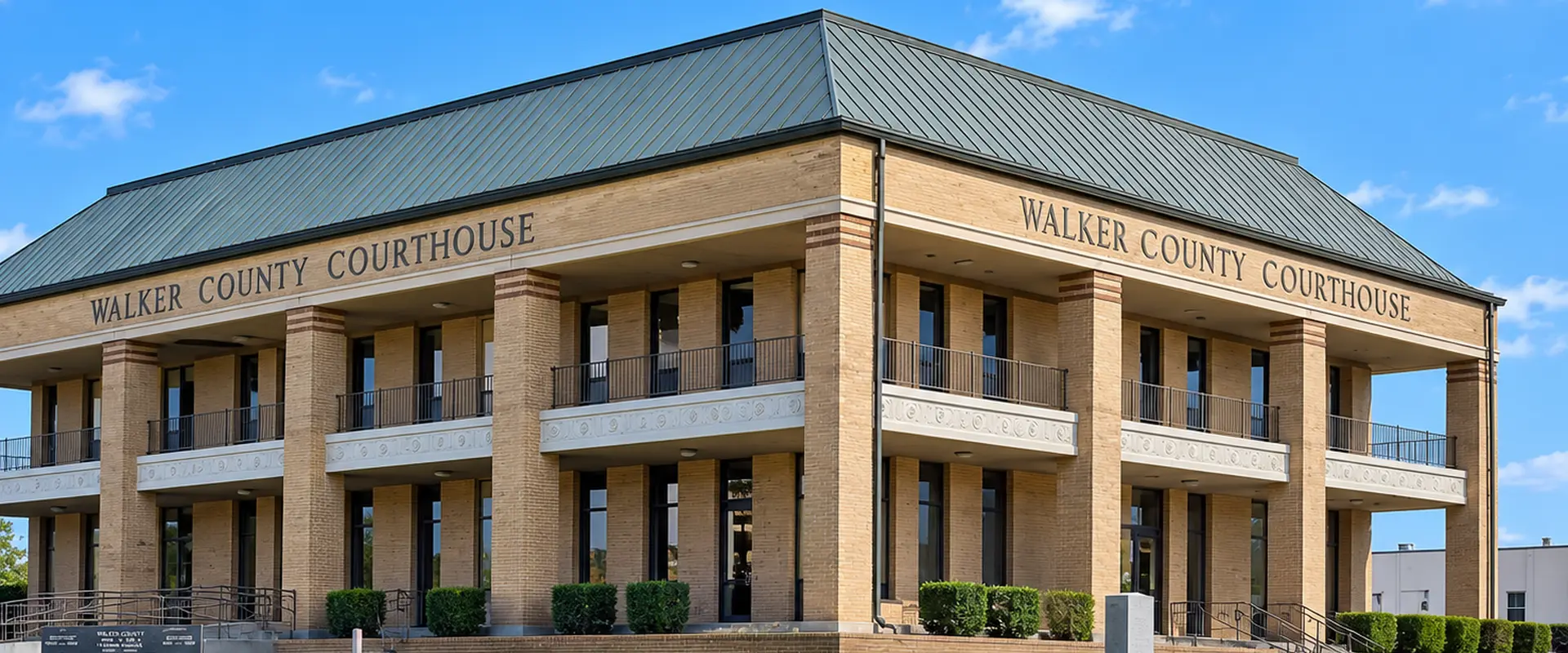
Most hearings in Walker County take place at the Walker County Courthouse in Huntsville, which is the central location for the District Court, Constitutional County Court, County Court at Law, and Probate Courts. The courthouse serves as the offices for clerks who file, maintain, and track cases. The Justices of the Peace courts exist across Walker County precincts, while the Huntsville Municipal Court hears city-related matters.
Types of Courts in Walker County, Texas

To navigate the court system effectively, one must understand the concept of "subject matter jurisdiction", which refers to a court's power to hear a particular type of case. If the filing is made with the wrong court, unnecessary delays may occur, along with other inconveniences.
 District Court
The 12th Judicial District Court of Walker County is the court of general jurisdiction that handles the most significant criminal and civil matters.
Primary location: Walker County Courthouse
Jurisdiction includes:
- Criminal matters involving felonies
- Civil suits ($200 and above)
- Matters involving family law (divorce, child custody, and adoption)
- Juvenile cases
- Disputes regarding ownership of land
The 12th District Court is the oldest in the state of Texas and has the largest case load in Walker County. At this court, the District Judge supervises cases, trials, and other proceedings to guide the court process. The docket at this court ranges from lengthy criminal sentences to large civil awards. The court cases involve attorneys representing their clients, but pro se appearances are also possible.
 Constitutional County Court
The Texas Constitution provides for the Walker County Constitutional County Court, with the elected County Judge as its presiding judge. It has a separate jurisdiction from the statutory County Court at Law and has both judicial and administrative duties different from those of the constitutional county court system in Texas.
Primary location: Walker County Courthouse
It has jurisdiction over:
- Probate and Guardianship cases
- Mental health hearings, such as admissions to state hospitals
- Work permits for youths and temporary guardianship for special purposes
- Hearings for beer and wine licenses
- Appeals over cases from the Justice of the Peace courts
- Administrative control of county government as presiding officer of the Commissioners Court
Constitutional County Courts deal with probate and guardianship cases, mental health and commitment cases, as well as the bulk of the county's misdemeanors. Besides judicial functions, the County Judge heads the five-member Commissioners Court, the county's administrative governing board, giving them executive powers.
 County Court at Law
Walker County's County Court at Law is a court of record by statute to relieve the caseload for District and Constitutional County courts. It's a general court that has a lot of local litigation.
Primary location: Walker County Courthouse
The County Court at Law deals with:
- Misdemeanor criminal cases (Class A & B)
- Civil matters between $200 and $250,000
- Probate issues and estate administration
- Guardianship and Mental Health cases
- Appeals of cases heard in the Justice of the Peace courts
Many consider the County Court at Law to be the "face of the judiciary", as it handles matters ranging from the probate of a loved one's estate to domestic disputes to even misdemeanors. In this manner, there is an essential link between Walker County's community and its judicial system at a larger level. It also acts as an appellate court for the courts of the Justice of the Peace. The filing of cases in the County Court at Law is done through the office of the Walker County Clerk.
 Justice of the Peace Courts
The Justice of the Peace (JP) Courts form the most basic of courts within Walker County, and they have jurisdiction for minor offenses. These are four precincts in Walker County.
Primary location: Walker County Courthouse
Cases include:
- Civil suits in which the claim does not exceed $20,000
- Class C misdemeanors (traffic offenses and city ordinance violations)
- Forcible detainer/entry cases
- Truant cases
The majority of individuals would come into contact with the law through the JP courts. These courts strive to be convenient, and most cases do not require legal assistance. Additionally, they are quicker compared to the higher courts. JP judges will also act as magistrates and sign warrants and officiate weddings, among other roles.
 Municipal Court
The Huntsville Municipal Court has the authority to determine cases that happen inside the city of Huntsville.
Primary location: Huntsville Municipal Court
Jurisdiction includes:
- Violations of city ordinances
- Stealing a car or motorcycle without causing any harm or danger to individuals
- Class C misdemeanors
- Animal control violations and building code violations
This specialized court has limited jurisdiction to implement city ordinances and other local laws. This court is of record; hence, all its activities may be reviewed in the County Court at Law.
How to Access Walker County Court Records

The vast majority of the court records in the state of Texas are accessible to all because the law makes them public. The Texas Public Information Act is an example of a law that makes court records public. Some records will be sealed to protect privacy, especally that of juvenile and family court proceedings.
 Online Access
Texas Court Records is the official website where one can find court records for Texas. Apart from that, there is also re:SearchTX that contains files for civil suits that have been filed by parties in District and County Courts across Texas. Researchers should provide as much information as possible about the case in question because the more details that are known, the more likely one is to find the desired records.
 Alternative Online Options
State government websites are sometimes difficult because of their technical nature. Sites such as CourtCaseFinder provide an easy-to-use means for individuals to find court records, whether for divorce or any other criminal case. If one does not know which court holds a case, this online source should prove more convenient to deal with.
 In-Person Requests
To get a certified copy or an original record not digitized, one will have to visit the clerk's office in person. Felony and higher-level civil records fall under the jurisdiction of the County District Clerk, while misdemeanor, probate, and property records are managed by the County Clerk. Request the Clerk's Office to assist in locating:
- Physical case files
- Historical documents archived in storage
- Copies needed for official or legal verification purposes
During the visit, remember to bring identification and any useful information to help the clerks locate the records, such as filing dates and the names of the lawyers involved. Clerks cannot provide legal counsel, but they know their way through archives and databases.
 Archived Records
Earlier court documents may not be available in electronic form but might only exist in hard copy. Such documents can be archived at a facility separate from the courthouse or within an archive room at the courthouse itself. Such documents might need to be obtained specifically from the Walker County Records Management Division. Both online research and personal confirmation are required to find the best results.
For Attorneys and Legal Professionals
Attorneys in Walker County are required to file electronically using eFile Texas. In the District and County Courts of Texas, most civil actions have to be electronically filed (e-filed). If one is an attorney but from outside Walker County, then they ought to be aware of the procedures that the office of the Clerk has established through the Texas Rules of Civil Procedure.
Professionals looking for court records in Walker County should note that there are two different offices where two different systems are preserved. The Walker County District Clerk's office preserves records of the 12th District Court, including felony criminal cases, civil proceedings, and family law proceedings. On the other hand, the office of the Walker County Clerk is responsible for managing records of the County Court at Law, which are linked to probate cases, as well as county documents like deeds and marriages. These two offices are based in the Walker County Courthouse.
How to File a Case in Walker County

Filling of a case is a formal procedure that demands utmost caution in completing the details. There are rules of procedure and jurisdiction, which, if not followed, can cause the case to be dismissed.
Step 1: Choose the Correct Court
Cases will be filed based on the nature of the case and the amount in controversy. For civil cases where the amount in controversy is below $20,000, as well as Class C misdemeanors, the appropriate court would be the Justice of the Peace courts of their respective precincts. For civil cases where the amount in controversy exceeds $250,000, felonies, divorce cases, and probate cases, the proper place to file the case would be the 12th District Court. County Courts fall in the middle, hearing, for example, misdemeanor criminal cases (Class A & B) and civil matters between $200 and $250,000.
 Step 2: Complete Required Forms
For common issues such as divorce, changing one's name, eviction, and small claims court cases, Texas Law Help provides free fillable forms from the courts. In case of any doubt, the Walker County District Clerk and County Clerk offer guidance on how to access the correct forms depending on the case. Completing the correct form for a particular case and following the instructions given will increase the chances of acceptance.
 Step 3: File the Case
After completing the forms, the documents are submitted to the clerk of the respective court. In the case of District and County Courts of civil suits, the documents can be submitted electronically using the eFile Texas system, allowing both attorneys and non-attorney litigants to do so without having to visit the court personally. Alternatively, the documents can be filed at the Walker County Courthouse.
 Step 4: Pay Filing Fees
The filing fee in Walker County depends on the level of court involved and the type of filing. For civil filings in District Court, the filing fee usually ranges between $250-$350, whereas the filing fees for the Justice of the Peace and County Court at Law cases will be less expensive. The filing fees are payable when the filing is made. If an individual feels that filing the fees is difficult for them, they may apply for a waiver through a Statement of Inability to Afford Payment of Court Costs.
 Step 5: Serve the Other Party
For any case to proceed further, the other party involved needs to be served with the lawsuit through the procedure called service of process. It is the duty of a private process server or a constable in Walker County to serve the other party in this manner. After service is completed, a proof of the execution of the service must be filed with the clerk of the court.
 Step 6: Monitor the Case
In regard to monitoring the status of a case, parties involved can use the Walker County Online Portal to track docket entries and other hearings related to the matter using the case numbers. It is essential to follow the docket entries since failure to do so may result in a default judgment if one misses their day in court. Individuals can also reach out to the Walker County District Clerk and the County Clerk for case updates.
Walker County Courthouse Directory
Walker County Courthouse
The main judicial building in the county. Home to the 12th District Court, Constitutional County Court, County Court at Law, Justice of the Peace courts, and the District and County Clerks' offices.
Address: 1100 University Ave, Huntsville, TX 77340
Main Phone: (936) 436-4900
12th District Court
Phone: (936) 436-4915
Website: 12th District Court
Constitutional County Court — County Judge
Phone: (936) 436-4900
Website: Constitutional County Court — County Judge
County Court at Law
Phone: (936) 436-4919
Website: County Court at Law
Walker County District Clerk
Phone: (936) 436-4972
Website: Walker County District Clerk
Walker County Clerk
Phone: (936) 436-4922
Website: Walker County Clerk
Justice of the Peace — Precinct 1
Phone: (936) 436-4966
Website: Justice of the Peace — Precinct 1
Justice of the Peace — Precinct 2
Phone: (936) 436-4977
Website: Justice of the Peace — Precinct 2
Justice of the Peace — Precinct 3
Phone: (936) 436-4988
Website: Justice of the Peace — Precinct 3
Justice of the Peace — Precinct 4
Phone: (936) 435-8750
Website: Justice of the Peace — Precinct 4
Huntsville Municipal Court
Responsible for violations of city ordinances, traffic infractions, and municipal misdemeanors that happen within the city of Huntsville. It is independent of the county courts.
Huntsville
Address: 1212 Ave M, Huntsville, TX 77340
Phone: (936) 291-5480
Website: Huntsville Municipal Court
Legal Help and Self-Help Resources
Going through a legal matter can be intimidating, but some local and state resources can help navigate the system and provide some assistance.
 Free Legal Assistance
Groups such as Lone Star Legal Aid offer free civil legal assistance to those in Walker County with a low to very low income. Their work is in domestic violence issues, housing, and public benefits. The Texas State Law Library has a variety of online resources and a "Ask a Librarian" legal research service.
Local county clerks can help with legal forms that are standardized and procedures. But keep in mind, clerks are barred from giving legal advice. They may be able to tell someone how to file, but they can't tell one what to write or how to win the case.
 Local Legal Support
If individuals don't meet the requirements for legal aid, but they can't afford to hire a full-service lawyer, the State Bar of Texas has a lawyer referral service. Also, the College of Criminal Justice at Sam Houston State University provides community resources and legal literacy programming from time to time. Volunteer attorney programs offered through the Houston Volunteer Lawyers organization and law school clinics are also available to Walker County residents for family law, small claims, and housing issues. Self-representation can be wholly feasible for small issues. However, professional legal assistance is strongly recommended for contested custody battles, criminal charges, or contested substantial assets.
FAQs
How do I search for a criminal case in Walker County?
For criminal case lookups, please go to the Walker County Online Records page. One can search by the defendant's name or the cause number. The case will be heard by the District Clerk if a felony, or by the County Clerk if a misdemeanor. Commercial search sites such as CourtCaseFinder may be useful to get a general sense of the number of records that exist from other jurisdictions.
Do Walker County courts make their records public?
Yes, most of the court records in Walker County are public, as per the Texas Public Information Act. This allows the general public to gain access to all civil cases, criminal cases, judgments, and probate. However, records containing private information, such as those involving minors, adoptions, or any court-ordered sealing of records, cannot be accessed.
Where can I find eviction records?
Eviction records are available in the files of the Justice of the Peace Court for the particular precinct in which the rental property is located. Evictions can be researched by locating a particular office of the precinct and launching an investigation there.
Can I file a small claims case online?
Texas is transitioning to a system of e-filing, but many Justice of the Peace courts in Walker County still receive the majority of their filings on paper from "pro se" (self-represented) litigants. Please check with the individual JP office in the precinct to determine whether filings are available via eFile Texas or whether the petition needs to be mailed or hand-delivered to the JP office.
How long does it take to get records in Walker County?
Typically, digital records are available immediately via the online platform. Certified copies or getting a record from the physical records may take up to 24 hours or several business days. If the records are very old and kept in a different location, it may take longer for staff to find and retrieve the records.
Other Counties in Texas
- Anderson
- Andrews
- Angelina
- Aransas
- Archer
- Armstrong
- Atascosa
- Austin
- Bailey
- Bandera
- Bastrop
- Baylor
- Bee
- Bell
- Bexar
- Blanco
- Borden
- Bosque
- Bowie
- Brazoria
- Brazos
- Brewster
- Briscoe
- Brooks
- Brown
- Burleson
- Burnet
- Caldwell
- Calhoun
- Callahan
- Cameron
- Camp
- Carson
- Cass
- Castro
- Chambers
- Cherokee
- Childress
- Clay
- Cochran
- Coke
- Coleman
- Collin
- Colorado
- Comal
- Comanche
- Concho
- Cooke
- Coryell
- Crockett
- Crosby
- Culberson
- Dallam
- Dallas
- Dawson
- De Witt
- Deaf Smith
- Delta
- Denton
- Dimmit
- Duval
- Eastland
- Ector
- Edwards
- El Paso
- Ellis
- Erath
- Falls
- Fannin
- Fayette
- Fisher
- Foard
- Fort Bend
- Franklin
- Freestone
- Frio
- Gaines
- Galveston
- Garza
- Gillespie
- Glasscock
- Goliad
- Gonzales
- Gray
- Grayson
- Gregg
- Grimes
- Guadalupe
- Hale
- Hamilton
- Hansford
- Hardin
- Harris
- Harrison
- Hartley
- Haskell
- Hays
- Henderson
- Hidalgo
- Hill
- Hockley
- Hood
- Hopkins
- Houston
- Howard
- Hunt
- Hutchinson
- Jack
- Jackson
- Jasper
- Jefferson
- Jim Wells
- Johnson
- Jones
- Karnes
- Kaufman
- Kendall
- Kenedy
- Kerr
- Kinney
- Kleberg
- Lamar
- Lamb
- Lampasas
- Lavaca
- Lee
- Leon
- Liberty
- Limestone
- Live Oak
- Llano
- Loving
- Lubbock
- Madison
- Marion
- Matagorda
- Maverick
- Mcculloch
- Mclennan
- Medina
- Midland
- Milam
- Mitchell
- Montague
- Montgomery
- Moore
- Morris
- Nacogdoches
- Navarro
- Newton
- Nolan
- Nueces
- Ochiltree
- Orange
- Palo Pinto
- Panola
- Parker
- Parmer
- Pecos
- Polk
- Potter
- Rains
- Randall
- Red River
- Reeves
- Robertson
- Rockwall
- Runnels
- Rusk
- Sabine
- San Augustine
- San Jacinto
- San Patricio
- Scurry
- Shelby
- Sherman
- Smith
- Somervell
- Starr
- Stephens
- Tarrant
- Taylor
- Terrell
- Terry
- Titus
- Tom Green
- Travis
- Trinity
- Tyler
- Upshur
- Uvalde
- Val Verde
- Van Zandt
- Victoria
- Waller
- Ward
- Washington
- Webb
- Wharton
- Wichita
- Wilbarger
- Willacy
- Williamson
- Wilson
- Wise
- Wood
- Yoakum
- Young
- Zapata
- Zavala
Table of Contents
