Table of Contents
Taylor County Courts, TX *

Taylor County, found in West Texas, has a strong legal system that plays a central role in ensuring access to legal services to residents, visitors, and businesses, as it is a regional hub for commerce with a growing population. It has multiple courts that oversee a wide range of legal matters, handling everything from minor disputes to complex felony cases and high-value civil matters.
The county's legal system offers resources and information, including court records, that are valuable for managing legal issues with clarity. Every individual should understand how the local court system operates, as this can significantly affect access to legal services.
Overview of the Taylor County Court System
The Taylor County court system focuses on serving the needs of residents while maintaining checks and balances within the state judicial framework. It consists of local courts, local rules, and administrative offices, with each court in Taylor County having distinct jurisdiction; together, they form a system that addresses cases efficiently and fairly.
The main county courthouse is the central hub for most court proceedings in Taylor County. The District Courts, County Courts, Commissioners Court, and administrative offices, including the offices of the county and district clerks, are located within the main courthouse; however, other local courts, including the Justice of the Peace Courts, are in various parts of the county, designed to provide access to legal services and resources.
Types of Courts in Taylor County, TX

Taylor County has different types of courts, including trial courts, specialized courts, and local courts. These courts have different jurisdictions; therefore, individuals should determine which court handles their case to ensure smooth processing. Filing in the wrong court can lead to setbacks in the case, such as delays, dismissal, and additional court costs.
 District Courts
The 42nd, 104th, 326th, and 350th Judicial District Courts serve Taylor County. They are the highest trial courts in the county, handling the most serious cases.
The jurisdiction of these courts includes:
- Major civil disputes involving $ 200 minimum amount in dispute
- Family law matters like divorce
- Felony criminal cases
- Land title disputes
- Juvenile cases
The cases managed by these courts are complex and require detailed legal arguments, many hearings, and extensive documentation. Those dealing with cases handled by these courts should seek legal representation due to the complexity involved. Most of these cases are serious, especially family law matters. Court rulings have a huge impact on the parties involved.
Primary Location: Taylor County Courthouse
 County Courts at Law
Taylor County is served by County Court at Law 1 and County Court at Law 2, which are also trial courts operating at the county's main courthouse.
The type of cases they handle includes:
- Class A and B misdemeanor cases
- Civil cases with moderate financial limits of more than $ 10,000
- Probate and estate matters
- Appeals from the lower courts
The County Courts at Law serve as a bridge within the legal system of Taylor County, and their jurisdiction is concurrent with that of the District Courts, though the cases they handle are less severe. These courts are important to residents, especially for the locals dealing with estate administration.
Primary Location: Taylor County Courthouse
 Constitutional County Court
The Taylor County Court focuses on administrative and limited judicial duties.
Its responsibilities include:
- Mental health commitment matters
- Probate cases
- Certain misdemeanor offenses
- Guardianship cases
- Administrative functions of county government
This court manages county affairs and specific legal issues and is presided over by the county judge. It handles a high volume of cases; therefore, it is important for people whose cases fall under its jurisdiction to track their cases and understand its schedule.
Primary Location: Taylor County Courthouse
 Justice of the Peace Courts
 are local courts that address minor legal matters in the county.
The responsibilities of these courts:
- Perform marriages
- Class C misdemeanors
- Civil lawsuits with the amount in dispute not exceeding $20,000
- Small claims cases
- Evictions
The Justice of the Peace Courts operate in precincts 1-1, 1-2, 2, 3, and 4. Their main focus is on resolving disputes quickly while maintaining fairness. They are designed to be accessible and efficient, particularly for individuals representing themselves.
Primary Locations: Multiple precincts throughout Taylor County
 Child Protection Court
The Child Protection Court is a specialized court responsible for cases involving child welfare, and it is assigned a courtroom at the county's main courthouse.
It handles cases such as:
- Child abuse and neglect cases
- Foster care proceedings
- Termination of parental rights
The cases in this court are sensitive and often urgent, requiring careful coordination between courts, families, and state agencies. This court prioritizes the safety and well-being of children in its decisions.
Primary Location: Taylor County Courthouse
 Commissioners Court
The Commissioners Court serves as the governing body of Taylor County, and it's primarily located at the county's main courthouse.
This court is responsible for:
- County financial management
- Infrastructure planning and maintenance, such as maintaining the county courthouse
- Policy and administrative oversight, like setting tax rates
This court has a significant role in determining how the county operates and supporting the judicial system. It also sets precinct boundaries and oversees community services like parks.
Primary Location: Taylor County Courthouse
 Municipal Courts
There are four municipal courts in Taylor County, managing violations within the boundaries of the cities in which they are located. These include the Abilene, Merkel, Tye, and Buffalo Gap municipal courts.
The jurisdiction of these courts includes:
- City ordinance violations, such as animal cruelty
- Traffic offenses
- Class C criminal misdemeanors
The Municipal Courts focus on enforcing local laws, and the cases they handle are generally less serious, with fines as the primary outcome. They also serve the city's residents as an entry point into the legal system.
Primary Locations: Abeline, Buffalo Gap, Merkel, and Tye City Halls
How to Access Taylor County Court Records

Most Taylor County court records are publicly accessible, permitting people to review case details and conduct legal research. Some court records, including sensitive family matters, may have restricted access or be sealed to protect privacy. The county's court records can be accessed through online platforms and in person. There may be fees they have to pay to access the records, particularly for printed or certified records.
 Online Access
Individuals, including legal researchers, can use the re:SearchTX portal, provided by the Texas Judicial Branch, which offers free access to criminal, family, civil, and probate case records. The District & County Records search tool also provides access to local court case records. Online access is convenient, but it depends heavily on having the correct information about the records required. Before starting the search on these platforms, people must gather case details, such as the case number and filing date, to improve accuracy.
 Alternative Online Options
Whenever official court records access systems feel overwhelming or are difficult to navigate, third-party platforms, such as CourtCaseFinder, come in handy. These platforms offer compiled public records to help locate court records. They are essential, especially for new users of the county's court system or for people who don't have all the information about the case, such as the case number.
 In-Person Requests
Those who require access to certified copies or assistance with locating court records should consider paying a visit to the County Clerk or District Clerk's office in person. The staff in these offices will help them with finding:
- Physical case files
- Archived documents
- Certified copies
The clerks offer guidance through the procedure of accessing court records. People must bring as much information as possible with them to make the search for their request more efficient.
 Archived Records
To access historical or older court records in Taylor County, visiting the county archives is the best option, since these records are often stored there and may require additional processing time. The District Clerk's office holds records for older civil, criminal, and family matters, while the County Clerk's office is responsible for other court records, including land, marriage, and probate records dating back to 1878. In addition, individuals can use the Texas State Library and Archives Commission to access court records by searching by county. Residents who are unsure where to look for archived records can always ask the court clerk.
For Attorneys and Legal Professionals
Local legal professionals, including attorneys, understand the local court system and benefit from familiarity with local procedures and court expectations. This is because Taylor County has its own administrative operations that can influence how cases are managed while still maintaining the standardized framework provided by the Texas Judicial Branch.
For legal professionals and lawyers from outside the county, learning the local filing practices, deadlines, and clerk procedures is necessary because the Taylor County court system operates differently from that of their home counties. They should coordinate with the County and District Clerks for court record requests, understand the courts' schedules, and receive guidance on the filing procedures, since even small variations can affect the outcome of their cases, particularly in time-sensitive and complex matters.
How to File a Case in Taylor County

There is a step-by-step procedure to follow when filing a case in Taylor County. Filing requires attention to detail and a clear understanding of the process. Taking the right steps early can ensure the case proceeds smoothly by avoiding delays.
Step 1: Choose the Correct Court
Residents should begin by identifying which court has jurisdiction over their case. Taylor County has various courts with distinct responsibilities. They should visit the county's court system website to research all the courts serving Taylor County to understand their roles and jurisdiction. These include the District Courts, which manage cases, such as major civil disputes, family law matters like divorce, felony criminal cases, and land or title matters; and the County Courts at Law, designed to handle class A and B misdemeanor cases, civil cases with moderate financial limits, and probate and estate issues. There is also the Constitutional County Court, which focuses on the county's limited judicial and administrative responsibilities. For proper filing and to avoid dismissal, select the correct court.
 Step 2: Complete Required Forms
The next step is to obtain the necessary forms from the clerk's office, depending on the case they want to file, or through eFile Texas, the official statewide platform, and carefully complete all sections. Missing information is a common cause of delays, additional court costs, and filing rejections. Therefore, one must provide accurate and complete information in their documents. They should also ensure the forms are signed where necessary and attach all the required supporting documents. If someone doesn't understand how to fill out the forms correctly, the clerks of court can answer questions about paperwork.
 Step 3: File the Case
After completing the forms, they should submit the documents to the offices of the clerks in person at the main county courthouse. The District Clerk only receives filings for cases handled by the District Courts. Those filing small-claims cases should submit the documents to the Justice of the Peace Courts in person at the appropriate precinct or file online. Taylor County also allows individuals to e-file for civil, criminal, and family law cases, but e-filing is mandatory for attorneys. They should ensure they attach all the required supporting documents before submitting the filing documents.
 Step 4: Pay Filing Fees
Individuals may incur recording costs when filing a case in Taylor County. These fees vary by case type, and they must confirm them when filing. For instance, cases such as serious civil and felony criminal cases have high filing fees compared to minor cases handled by the Justice of the Peace Courts. They can contact the clerks' offices directly or visit the official county website to check for the costs. Individuals who are unable to afford the fees may request a waiver by completing and submitting a Statement of Inability to Afford Payment of Court Costs to the District or County Clerk.
 Step 5: Serve the Other Party
The next important step after filing the case is to notify the other party involved. The notification is made through a process known as service of process. Individuals are not permitted to serve the other party themselves; service is conducted by a private process server, sheriff, or constable. Then whoever served the paperwork has to file the proof of service with the court. Filing the proof-of-services documents is required for the case to proceed.
 Step 6: Monitor the Case
Lastly, they can now track the case's progress using the case number assigned to the case by the clerks after a successful filing. Case monitoring can be done via online systems such as re:SearchTX. The Taylor County Case Records Inquiry portal is also an online tool where an individual can view their case, as it offers access to civil, felony criminal, probate, and family cases. Contacting the clerk's office directly is another option for monitoring the case, especially if the case is not available online yet. Monitoring the case helps meet deadlines, get updates, and attend required hearings.
Taylor County Courthouse Directory
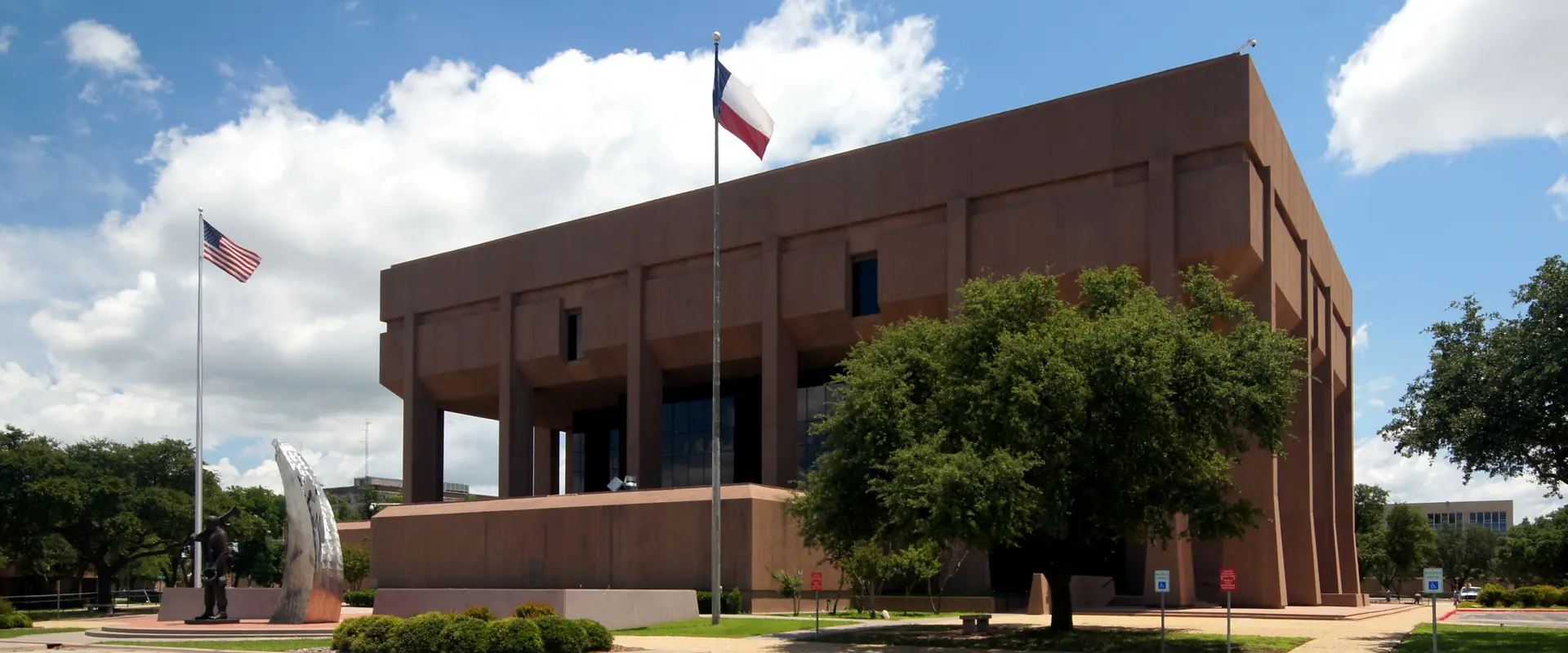
Taylor County Courthouse
This courthouse is the central hub for most legal proceedings in Taylor County. It houses the District Courts, County Courts at Law, the County Court, Child Protection Court, and the Commissioners' Court. Clerk offices located here manage filings, records, and certified document requests.
Abilene
Address: 300 Oak Street, Abilene, TX 79602
Main: (325) 674-1316
104th District Court: (325) 674-1313
350th District Court: (325) 674-1242
County Court at Law 1: (325) 674-1323
County Court at Law 2: (325) 674-1208
Constitutional County Court: (325) 674-1235
Child Protection Court: (325) 298-2030
County Clerk: (325) 674-1202
Justice of the Peace Courts
These courts are located across multiple precincts and handle small claims, evictions, and minor offenses.
Precinct 1-1
Address: 450 Pecan Street, Abilene, TX 79602
Phone: (325) 674-1338
Website: Precinct 1-1
Precinct 1-2
Address: 450 Pecan Street, Abilene, TX 79602
Phone: (325) 674-1267
Website: Precinct 1-2
Precinct 2
Address: 301 Kent St., Merkel, TX 79562
Phone: (325) 928-5114
Website: Precinct 2
Precinct 3
Address: 442 Graham St., Tuscola, TX 79562
Phone: (325) 554-7893
Website: Precinct 3
Precinct 4
Address: 155 Main St., Lawn, TX 79530
Phone: (325) 583-2341
Website: Precinct 4
Municipal Courts
Handle city ordinance violations, traffic offenses, and minor misdemeanors within the city's limits.
Abilene
Address: 4574 South First Street, Abilene, TX 79605
Phone: (325) 676-6333
Website: Abilene
Merkel
Address: 100 Kent Street, Merkel, TX 7953
Phone: (325) 928-4911
Website: Merkel
Tye
Address: 649 Scott Street, Tye, TX 79563
Phone: (325) 692-9581
Website: Tye
Buffalo Gap
Address: 709 Litel Street, Buffalo Gap, TX 79508
Phone: (325) 572-3347
Website: Buffalo Gap
Legal Help and Self-Help Resources
Taylor County residents have access to several helpful resources to help navigate the legal system. These legal assistance and self-help resources are not limited to those who cannot afford an attorney; they are also available to other residents, including veterans, seniors, researchers, and individuals handling complex cases.
 Free Legal Assistance
There are organizations such as the Legal Aid of NorthWest Texas operating in Taylor County and offering free legal advice and civil services to low-income families, and the Veterans Legal Assistance Project operating under the Texas Legal Services Center to provide legal support to veterans and their families, assisting with housing disputes, family law issues, and public benefits.
Court clerks are another valuable resource as they provide forms and guidance to help individuals manage their own cases. However, they cannot offer legal advice or legal representation in court.
 Local Legal Support
Residents of Taylor County can also access local bar associations and legal clinics, such as the Noah Project, Abilene Office, that offer legal advocacy and shelter to victims of domestic violence and sexual assaults. Also, they can access volunteer attorney programs, including the Equal Justice Volunteer Program in Abilene, which connects private attorneys with low-income individuals for pro bono representation.
FAQs
Does Taylor County allow public access to court records?
The majority of court records in Taylor County are public and can be accessed by individuals through online tools like the re:SearchTX. However, certain cases, such as juvenile matters or sensitive family law proceedings, may be sealed or restricted. They can visit the court clerks' office or contact the clerks to access these records.
Are traffic tickets in Taylor County accessible online?
Yes. Traffic ticket information is available through municipal court systems, particularly for cases addressed in the municipal courts in Merkel, Tye, Buffalo Gap, or Abilene. People can search online using the citation number or contact the municipal court directly. Those in areas that are not served by the Municipal Courts should access this information through the Justice of the Peace Courts.
What do I do if my case is not available online?
Those whose cases do not appear in online searches can contact the clerk's office or visit in person for assistance. This can happen because some newer cases may not yet be fully available online. Also, the case may be older or historical and archived in physical stores available only in physical files.
What is the duration it takes to receive court records?
The time required to obtain a court record in Taylor County depends on the type of record requested and the method used to request it. Online searches provide immediate results, while certified requests in person at the offices of the clerks may take several hours or days. Those seeking access to older archived documents should allow extra time, like days or weeks, since they take longer to retrieve.
Is it a must to have an attorney to file a case in Taylor County?
Not always. For smaller cases, such as those handled in Justice of the Peace Courts, individuals can represent themselves, as they are resolved quickly through simple procedures, including hearings rather than lengthy trials. However, for complex legal matters such as felony charges or contested family law issues, having an attorney is strongly recommended.
Are Taylor County records accessible from outside Texas?
Yes, most records are available online and can be accessed from anywhere by the public. But certain documents, especially certified copies or archived records, may require in-person requests or additional verification such as photo identification. Therefore, individuals who require such court records should contact the clerk's office to help clarify their options.
When should I use a third-party records service?
Those who are unsure where records are located or find it challenging to search across multiple jurisdictions and find it overwhelming to navigate the county's official system should consider utilizing third-party services like CourtCaseFinder. These commercial platforms simplify the process by aggregating and providing consolidated legal information from multiple sources.
What types of cases are handled in Justice of the Peace Courts?
The jurisdiction of the Justice of the Peace Courts includes small claims, evictions, the issuance of arrest and search warrants, and minor criminal offenses. These courts ensure that locals can easily access legal services, as they have simple procedures that often involve hearings rather than lengthy trials. Therefore, they are accessible and efficient, often allowing individuals to represent themselves.
Other Counties in Texas
- Anderson
- Andrews
- Angelina
- Aransas
- Archer
- Armstrong
- Atascosa
- Austin
- Bailey
- Bandera
- Bastrop
- Baylor
- Bee
- Bell
- Bexar
- Blanco
- Borden
- Bosque
- Bowie
- Brazoria
- Brazos
- Brewster
- Briscoe
- Brooks
- Brown
- Burleson
- Burnet
- Caldwell
- Calhoun
- Callahan
- Cameron
- Camp
- Carson
- Cass
- Castro
- Chambers
- Cherokee
- Childress
- Clay
- Cochran
- Coke
- Coleman
- Collin
- Colorado
- Comal
- Comanche
- Concho
- Cooke
- Coryell
- Crockett
- Crosby
- Culberson
- Dallam
- Dallas
- Dawson
- De Witt
- Deaf Smith
- Delta
- Denton
- Dimmit
- Duval
- Eastland
- Ector
- Edwards
- El Paso
- Ellis
- Erath
- Falls
- Fannin
- Fayette
- Fisher
- Foard
- Fort Bend
- Franklin
- Freestone
- Frio
- Gaines
- Galveston
- Garza
- Gillespie
- Glasscock
- Goliad
- Gonzales
- Gray
- Grayson
- Gregg
- Grimes
- Guadalupe
- Hale
- Hamilton
- Hansford
- Hardin
- Harris
- Harrison
- Hartley
- Haskell
- Hays
- Henderson
- Hidalgo
- Hill
- Hockley
- Hood
- Hopkins
- Houston
- Howard
- Hunt
- Hutchinson
- Jack
- Jackson
- Jasper
- Jefferson
- Jim Wells
- Johnson
- Jones
- Karnes
- Kaufman
- Kendall
- Kenedy
- Kerr
- Kinney
- Kleberg
- Lamar
- Lamb
- Lampasas
- Lavaca
- Lee
- Leon
- Liberty
- Limestone
- Live Oak
- Llano
- Loving
- Lubbock
- Madison
- Marion
- Matagorda
- Maverick
- Mcculloch
- Mclennan
- Medina
- Midland
- Milam
- Mitchell
- Montague
- Montgomery
- Moore
- Morris
- Nacogdoches
- Navarro
- Newton
- Nolan
- Nueces
- Ochiltree
- Orange
- Palo Pinto
- Panola
- Parker
- Parmer
- Pecos
- Polk
- Potter
- Rains
- Randall
- Red River
- Reeves
- Robertson
- Rockwall
- Runnels
- Rusk
- Sabine
- San Augustine
- San Jacinto
- San Patricio
- Scurry
- Shelby
- Sherman
- Smith
- Somervell
- Starr
- Stephens
- Tarrant
- Terrell
- Terry
- Titus
- Tom Green
- Travis
- Trinity
- Tyler
- Upshur
- Uvalde
- Val Verde
- Van Zandt
- Victoria
- Walker
- Waller
- Ward
- Washington
- Webb
- Wharton
- Wichita
- Wilbarger
- Willacy
- Williamson
- Wilson
- Wise
- Wood
- Yoakum
- Young
- Zapata
- Zavala
Table of Contents
