Table of Contents
Navarro County Courts, TX *

Navarro County lies in the northern part of Central Texas, occupying around 1,068 sq miles and bordered by the counties of Hill, Ellis, Limestone, Henderson, and Freestone. More than 52,600 people call the place home, although in 1850, there were only 2,190. The numbers grew after the Civil War and stretched on through the next century. The infrastructural development in the region is mostly thanks to the railway passing through in the 1800s.
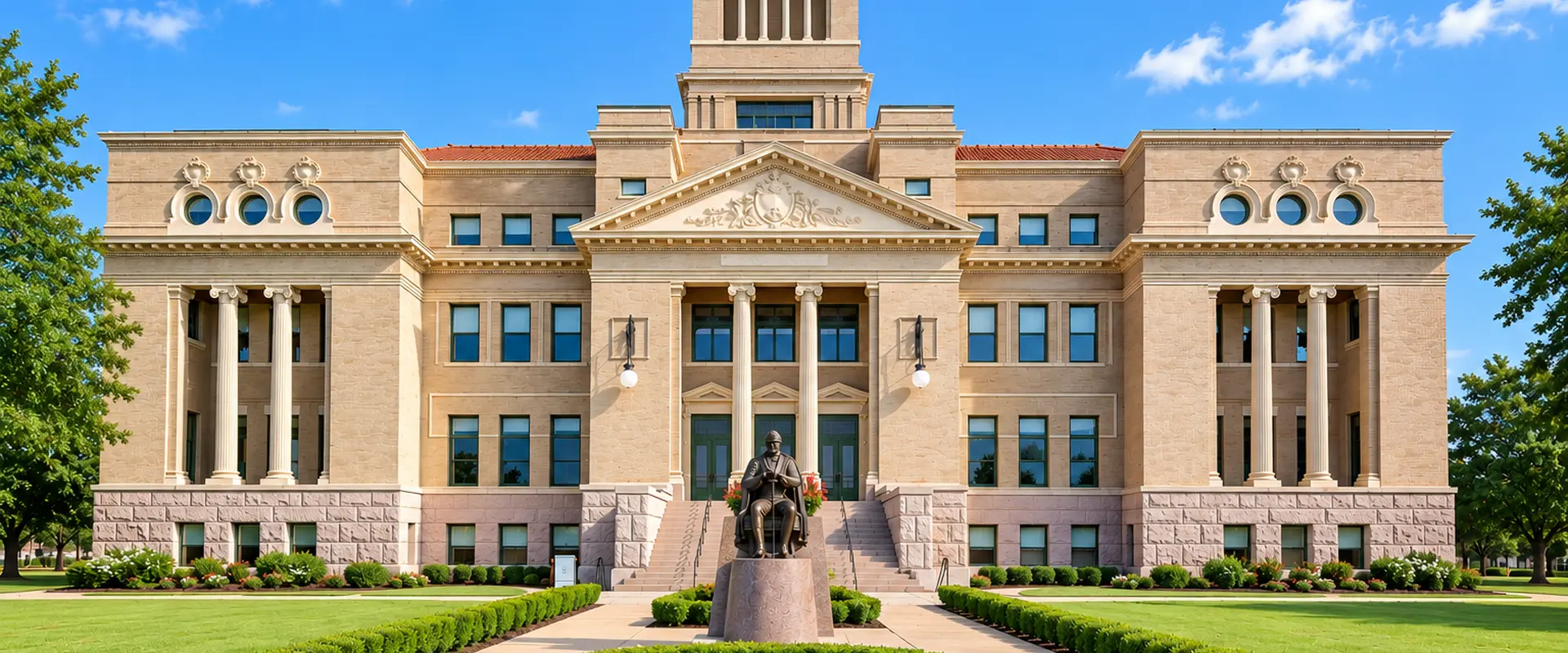
Fast forward to the present day, Navarro County has established its place with a stable government, led by state and local laws. Corsicana, with its population of around 25,000, is the county seat, and rightfully, where the county's courthouse is built. Like other counties in Texas, the legal system in Navarro is solid, making sure that justice always prevails. The courthouses hear different cases daily, from minor offenses to major ones with serious consequences. Be it traffic violations, debt claims, or civil disputes, Navarro County courts are ready to serve the people.
Overview of the Navarro County Court System
Navarro County's legal system is guided by the state. The Texas Judiciary largely influences how the courts work and how the people interact with them. Instead of a unified legal system, Texas courts take a layered design. This means that there are multiple courts, but each operates within its own jurisdiction. They handle unique cases, with some taking on major ones, while others are more accessible to the locals. So if you are interacting with the Navarro County courts, knowing this framework is the first important thing.
Most cases in Navarro are heard at the county courthouse, which is located in the county seat, Corsicana. This is the center of all matters of the Navarro judiciary. The distinction remains intact, in that each court still has its own matters to address. It is only in rare cases where the jurisdiction overlaps, as the top-level courts sometimes hear the same cases. The 13th District Court and the County Court at Law are at the top. Sometimes they share jurisdiction, but with the exception of capital murder cases. The Justice Courts and the Municipal Courts are at the local level, which makes them more accessible to the public. Here is where residents turn to for cases like small claims, evictions, traffic violations, and other minor offenses.
Types of Courts in Navarro County, Texas

You may not be sure of where to start if this is your first time interacting with the Navarro County Courts. They are distinct, and each operates according to its own jurisdiction. Here is how to tell them apart.
 District Court
The 13th District Court serves Navarro County, standing in as one of the major courts considering the types of cases brought here. It handles the following cases:
- Felonies
- Civil law
- Juvenile cases
- Family matters
- Appeals from lower courts
The chambers hear and solve civil disputes, felonies, and similar serious charges. Such matters usually carry heavy financial and legal impact. Losing a lengthy court battle over a large estate could mean a massive financial setback, and on the other hand, being found guilty in a felony case could mean years in jail.
 County Court at Law
The Navarro County Court at Law serves according to the jurisdiction that is specified by the county. Most of the cases that are handled here are the following:
- Probate matters
- Civil cases
- Family law
- Juvenile cases
- Class A misdemeanors (theft of services/ property, assault)
- Class B misdemeanors (indecent exposure, driving under the influence, theft of property worth less than $750)
The outstanding feature is that routinely, this court shares jurisdiction with the 13th District Court when it comes to certain cases. It is only capital murder that is exclusively tried at the 13th District Court, not the Court at Law.
 Justice of the Peace Courts
There are four Justice of the Peace Courts in Navarro County, serving in four precincts. They usually handle the following cases:
- Small claims
- Evictions
- Minor Traffic Violations
- Class C misdemeanors (violations of alcohol, health, education, and wildlife)
These courts work together to solve various issues at the grassroots levels, thereby maintaining the peace. They are particularly famous among the locals because they solve simple matters like small claims. Even people living in the rural communities of Navarro turn to them, and interestingly, the presiding judges also handle ceremonies like weddings, among other administrative duties.
 Municipal Courts
There are six Municipal Courts in Navarro County. These courts are found in the cities of Blooming Grove, Dawson, Corsicana, Frost, Rice, and Kerens and are tasked with the following duties:
- Violations of a particular city's ordinances
- Minor traffic violations that take place within particular city limits
- Municipal misdemeanors
Like the Justice of the Peace Courts, these also operate at the local level, but the difference is that the cases here are bound by the city, so offenders are charged for violating the particular city's codes.
How to Access Navarro County Court Records

You may want to access Navarro County court records as a legal professional, business, group, or individual. The Texas Public Information Act makes it possible for anyone in Navarro County to preview and access court records and to do so without being questioned about them. The County Clerk is mandated to help you access these records, especially since the office is the county's database, where all the records are collected and secured. Here is also where filing takes place, so the clerk will be your guide whenever you are interacting with the Navarro County courts.
 Online Access
Requests have been made easier thanks to the digitization of records. Before you visit the County Clerk's office in person when you need particular files, you can conveniently access them from the state-wide portal called re:SearchTX. This is an invaluable source of information for all the people living in Texas because you can search through various types of cases from the different courts on a single site.
 Alternative Online Options
There is another platform that works conveniently, providing you with access to various court records. CourtCaseFinder not only works in Texas, but also in other states, compiling the court case records from across multiple jurisdictions so you get all the information you need in one place. It works from wherever you are in the country, in any state and county. It only requires that you narrow down the search by entering the name and the state.
 In-Person Requests
Another way to go when searching for court records is to go directly to the source. The County Clerk is the custodian of all government records in the county, so the office is a great place to find particular files. If they have not been digitized yet or are missing from online databases, the County Clerk will gladly help. Provided that you go with the correct details, the staff will help you retrieve the files you need.
 Archived Records
Sometimes the records you need are in older databases that you cannot access online or from the County Clerk's office. If you really need them for work, research, tracing family history, or to solve property cases, then you can track them down at the Texas State Library and Archives Commission (TSLAC). This is where you can find files as old as 200 years, but if they are still not available, you can find other records at the Texas Supreme Court Archives. The only difference is that for these old records, you must first write a formal letter of request, which means you can only access the files once the request is approved.
For Attorneys and Legal Professionals
Online search saves you a lot of time and effort if you are a legal professional with a case in Navarro County. Searching online conveniently offers access to probate, family, civil, and juvenile cases, so you have a point of reference or access to important records for your case. Remember that Navarro County has laid out procedures for its courts, while at the same time, the local courts also have their own guidelines.
The 13th District and County Court at Law require legal professionals to adhere to Navarro County Local Rules when it comes to decorum, conduct, scheduling, dismissal, and other guidelines. There are also more rules to follow at the court level. Professionals are also guided by particular courts, like Navarro County Court at Law Procedures, and Local Rules of Procedure and Rules of Decorum for the Justice of the Peace Courts.
Getting familiar with these rules ensures that you are always on the right side of the law, so you can avoid issues that could interfere with your case. Carefully read through the directives, and check that you meet all the court's expectations. This should go a long way to help build your case.
How to File a Case in Navarro County

Filing a case correctly means that the process runs smoothly. You don't have to worry about delays and will not make mistakes that could risk the success of your case. If this is your first time filing a case in the Navarro County courts, here are the steps to follow so you get it right.
Step 1: Choose the Correct Court
What case are you filing? Each court has its jurisdiction, and it's only in the 13th District Court and the Navarro Court at Law where the jurisdiction sometimes overlaps, except for cases where the charge is capital murder. Make sure you understand which court handles your matter so you file at the right place. The general rule is that the Justice Courts and Municipal Courts take care of minor cases and small claims, while the other courts take over major civil and criminal charges.
 Step 2: Complete Required Forms
There are forms to fill out, obtained from the court clerk's offices or online through the Texas Judicial Branch. This is how you present your case to the court, so you must fill in the required fields with accurate details. These forms are important for any type of case you file, so make sure that you carefully read the instructions and fill in the blanks, then submit. Remember that incomplete and incorrect files may lead to unwanted delays, so if you are not sure about a section, you can always go to the County Clerk's office for guidance.
 Step 3: File Your Case
All legal professionals should file at the state-provided site, eFile Texas, which works all across the state and in all counties. It is used for all cases and is quite convenient, because even if you get stuck, there are training videos that will guide you. Non-professionals who self-file are also encouraged to use the site, but they can also file in person.
 Step 4: Pay Filing Fees
The next step is to pay filing fees as outlined in the Navarro County fee schedule. Usually, the fee you pay will depend on the type of case, although sometimes you are required to pay extra. It is also expected that the fees may pile up, for which some people may not be able to fully pay. If that affects you, the good news is that you can get the fee waived by filing the Statement of Inability to Afford Payment of Court Costs. If approved, you can get the much-needed relief for your case to proceed.
 Step 5: Serve the Other Party
Texas requires that you complete the "Service of Process", which is where you formally notify the other party that you are filing a case against them. This process is done by the constable or sheriff, through mail, or by certified server in the county. You will also report to the court, so they know that you have followed through with this mandatory step. You won't be allowed to proceed with your case unless you serve the opposing party.
 Step 6: Monitor Your Case
You must be up to speed with your case because it is the only way to access important information like hearing dates, mentions, and schedules. These details may abruptly change, and the last thing you want is to be caught off guard. You can avoid the surprises and stay calm and organized, which is what your case needs. Check your case's status with the Navarro County courts portal or by calling the relevant court clerk.
Navarro County Courthouse Directory
Here is how to contact the various courts operating in Navarro County if you have questions or concerns.
Municipal Courts: These also operate at the local level, enforcing Navarro's cities' ordinances.
13th District Court
This court takes on felonies, family matters, juvenile cases, and other serious charges.
Corsicana
Address: P.O Box 333, Corsicana, Texas 75151
Phone: (903) 654-3020
Website: Navarro District Court
County Court at Law
This court also tackles several cases in Navarro and sometimes shares jurisdiction with the 13th District Court.
Corsicana
Address: 300 W. 3rd Ave. Suite 103, Corsicana, TX 75110
Phone: (903) 875-3322
Website: Navarro County Court at Law
Justice of the Peace Courts
These operate in four precincts, helping the local people of Navarro with the resolution of their minor cases.
Precinct 1
312 W 2nd Ave, Corsicana, TX 75110
(903) 654-3055
Precinct 2
312 W 2nd Ave, Corsicana, TX 75110
(903) 654-3058
Precinct 3
312 W 2nd Ave, Corsicana, TX 75110
(903) 654-3063
Precinct 4
312 W 2nd Ave, Corsicana, TX 75110
(903) 654-3060
Municipal Courts
These also operate at the local level, enforcing Navarro's cities' ordinances.
Blooming Grove
Address: 200 S Fordyce, Blooming Grove, TX 76626
Phone: (903) 695-2711
Website: Link
Corsicana
Address: 200 N 12th St, Corsicana, TX 75110
Phone: (903) 654-4856
Website: Link
Dawson
Address: P.O Box 400, Dawson, TX 76639
Phone: (254) 578-1515
Website: Link
Frost
Address: P.O Box 300, Frost, TX 76641
Phone: (903) 682-3861
Website: Link
Kerens
Address: 200 S Colket Ave, P.O Box 160, Kerens, TX 75144
Phone: (903) 396-2971
Website: Link
Rice
Address: 205 E Calhoun, P.O Box 97, Rice, TX 75155
Phone: (903) 326-7511
Website: Link
Legal Help and Self-Help Resources
Many residents of Navarro County struggle to find legal representation, especially affordable licensed attorneys. If you are part of the marginalized communities in the county, there are organizations ready to help, with some even offering free services.
 Free Legal Assistance
If you are a low-income Texan and don't know where to start with your case, Lone Star Legal Aid can help. It provides Navarro residents with free legal help in various cases, from housing to civil and family charges. Legal Hospice of Texas is another organization offering free legal representation, particularly for low-income residents who are living with terminal illnesses. If you have a civil matter related to your illness, they will step in and help you get the justice you deserve.
 Local Legal Support
If you are trying to find an affordable attorney for your case, you can find one from the State Bar of Texas Lawyer Referral Service. This site will help you access representation, especially when dealing with serious cases like felonies, child custody, and other matters that hold serious legal or financial consequences. On the other hand, if you are living with disabilities, you can also get assistance from groups like Disability Rights Texas, which usually focuses on matters like unemployment and housing for the disadvantaged communities.
FAQs
What is the structure of the courts in Navarro County?
The Courts in Navarro County follow the Texas Judicial System, where the courts are arranged hierarchically. The Municipal Courts and Justice of the Peace Courts are at the local level, while the 13th District Court and County Court at Law are of higher levels, handling major cases in the county.
Do the 13th District Court and County Court at Law share jurisdiction?
Many cases that go to the 13th District Court also go to the County Court at Law since the two are both upper-level courts in Navarro County. The only exception is capital murder hearings, which are exclusively tried at the 13th District Court and not at any other court in the county.
What types of cases does the Justice of the Peace Courts handle?
The Justice of the Peace Courts are tasked with hearing cases at the local level, meaning that they try matters like small claims, evictions, minor traffic violations, and class C misdemeanors. If the parties are not satisfied with this decision, then they can appeal to the higher-level courts, like the 13th District Court.
How do I search for a court case in Navarro County?
You can access records from court cases in Navarro County at the state-provided website, re:SearchTX, with information from the counties in Texas, but if you are looking for court records in other states, you can use CourtCaseFinder.
What do I do if I cannot find the case online?
If you have searched for the case online without success, then the next step is to make an in-person request at the County Clerk's office. Here is where files are compiled and secured, so you should get assistance with finding records that are older or have not been digitized. It's also possible that the case is new and not yet uploaded into the court's system.
How do I find archived court records?
If the records you seek are over a hundred years old and unavailable through online searches, you can go to the Texas State Library and Archives Commission, which keeps very old records, even the ones from the 1800s. You will, however, have to make a formal request and then wait for approval before you access them.
Other Counties in Texas
- Anderson
- Andrews
- Angelina
- Aransas
- Archer
- Armstrong
- Atascosa
- Austin
- Bailey
- Bandera
- Bastrop
- Baylor
- Bee
- Bell
- Bexar
- Blanco
- Borden
- Bosque
- Bowie
- Brazoria
- Brazos
- Brewster
- Briscoe
- Brooks
- Brown
- Burleson
- Burnet
- Caldwell
- Calhoun
- Callahan
- Cameron
- Camp
- Carson
- Cass
- Castro
- Chambers
- Cherokee
- Childress
- Clay
- Cochran
- Coke
- Coleman
- Collin
- Colorado
- Comal
- Comanche
- Concho
- Cooke
- Coryell
- Crockett
- Crosby
- Culberson
- Dallam
- Dallas
- Dawson
- De Witt
- Deaf Smith
- Delta
- Denton
- Dimmit
- Duval
- Eastland
- Ector
- Edwards
- El Paso
- Ellis
- Erath
- Falls
- Fannin
- Fayette
- Fisher
- Foard
- Fort Bend
- Franklin
- Freestone
- Frio
- Gaines
- Galveston
- Garza
- Gillespie
- Glasscock
- Goliad
- Gonzales
- Gray
- Grayson
- Gregg
- Grimes
- Guadalupe
- Hale
- Hamilton
- Hansford
- Hardin
- Harris
- Harrison
- Hartley
- Haskell
- Hays
- Henderson
- Hidalgo
- Hill
- Hockley
- Hood
- Hopkins
- Houston
- Howard
- Hunt
- Hutchinson
- Jack
- Jackson
- Jasper
- Jefferson
- Jim Wells
- Johnson
- Jones
- Karnes
- Kaufman
- Kendall
- Kenedy
- Kerr
- Kinney
- Kleberg
- Lamar
- Lamb
- Lampasas
- Lavaca
- Lee
- Leon
- Liberty
- Limestone
- Live Oak
- Llano
- Loving
- Lubbock
- Madison
- Marion
- Matagorda
- Maverick
- Mcculloch
- Mclennan
- Medina
- Midland
- Milam
- Mitchell
- Montague
- Montgomery
- Moore
- Morris
- Nacogdoches
- Newton
- Nolan
- Nueces
- Ochiltree
- Orange
- Palo Pinto
- Panola
- Parker
- Parmer
- Pecos
- Polk
- Potter
- Rains
- Randall
- Red River
- Reeves
- Robertson
- Rockwall
- Runnels
- Rusk
- Sabine
- San Augustine
- San Jacinto
- San Patricio
- Scurry
- Shelby
- Sherman
- Smith
- Somervell
- Starr
- Stephens
- Tarrant
- Taylor
- Terrell
- Terry
- Titus
- Tom Green
- Travis
- Trinity
- Tyler
- Upshur
- Uvalde
- Val Verde
- Van Zandt
- Victoria
- Walker
- Waller
- Ward
- Washington
- Webb
- Wharton
- Wichita
- Wilbarger
- Willacy
- Williamson
- Wilson
- Wise
- Wood
- Yoakum
- Young
- Zapata
- Zavala
Table of Contents
