Table of Contents
Montague County Courts, TX *

Montague County is a sparsely populated rural area with 20,000 people living within 931 square miles. The leading municipalities of Montague County include Bowie, Nocona, and Saint Jo. Annually, the courts in Montague County handle a wide variety of cases from traffic citations to probate, civil litigation, eviction, and felonies.
Overview of the Montague County Court System
The Texas Judicial Branch is the administrative authority for courts in Montague County. The courts are set in segments to represent the types of cases they handle. The district courts are at the top of the hierarchy and handle the most serious cases, such as serious felonies and family law matters. Constitutional county courts cover probate, guardianship, misdemeanors, and smaller civil claims. The lower segment has Justice of the Peace courts. These handle minor civil and criminal matters. Then there are Municipal courts that handle local ordinance violations and traffic citations issued inside city limits.
Montague County is in the 97th Judicial District, which it shares with Archer and Clay Counties. That means the district court in Montague covers all three counties, with the judge rotating among them. Locally, the county has one Constitutional County Court, two Justice of the Peace precincts, and municipal courts in Bowie, Nocona, and Saint Jo.
Appeals from the district and county courts of Montague go to the Second Court of Appeals in Fort Worth. This Court of Appeals covers 12 other North Texas counties. Cases involving capital murder skip the intermediate appellate court and head directly to the Texas Court of Criminal Appeals in Austin.
Types of Courts in Montague County, Texas

Every one of these courts has jurisdiction over different types of cases, separate fees, and a different clerk. Understanding which court contains the needed court records will be essential even before filling out a form.
 District Court
The 97th District Court is where all major court cases are tried. The court's jurisdiction includes the following cases:
- Felony criminal action, ranging from state jail felonies to capital felonies
- Civil litigation that usually exceeds the sum of $250
- Family law, such as divorce
- Juvenile delinquency, parental termination, and adoption
- Hearings on mental health commitment
- Appeals from Justice of the Peace courts
The stakes in this court are usually higher, and most people will want an attorney. However, the District Clerk's office can point researchers and self-represented litigants toward self-help resources.
Primary Location: Montague County Courthouse
 Constitutional County Court
The Constitutional County Court has an elected County Judge who serves as judicial officer and chief county administrator. On the judicial side, this court fills the gap between the Justice of the Peace courts and the District Court.
Jurisdiction here spans a range of cases, including:
- Class A and B misdemeanors
- Civil disputes ($200-$20,000)
- Probate of wills and administration of estates
- Guardianship for minors or adults unable to care for themselves
- Mental health and involuntary commitment cases
The County Clerk's office maintains the records of the Constitutional County Court.
Primary Location: Montague County Administrative Complex
 Justice of the Peace Courts
Justice of the Peace (JP) courts handle a broad range of lower-level matters, and their court records are maintained separately by each precinct. Case types here include:
- Class C misdemeanors, such as traffic offenses and petty larceny
- Suits and claims involving property damage/loss less than $20,000
- Evictions and child truancy
- Arranging bail/bond amounts and issuing warrants/searches
- Civil marriages and protective orders
Both precincts maintain self-help packets for common case types, including evictions and small claims. Payment for fines or traffic citations may be made through the JP 1 and JP 2 websites.
Primary Location: Montague County Courthouse
 Commissioners Court
The Commissioners Court is not a trial court. It does not produce the kind of court records found in civil or criminal proceedings. It is the county's legislative body. Its chair is the County Judge alongside four Commissioners. Each elected from their respective precinct. The court sets policy and oversees county services.
The court carries out other duties such as reviewing the county budget, approving tax rates, and supervising road, bridge, and facility maintenance. It also plans funding to support the Office of the Sheriff, provides fire services in rural areas, and manages county contracts. Meeting agendas and minutes are posted publicly on the county website.
Primary Location: Montague County Administrative Complex
 Municipal Courts
Three incorporated cities in Montague County each operate their own municipal court: Bowie, Nocona, and Saint Jo. Their municipal courts handle:
- Class C misdemeanors
- Traffic violations
- Zoning violations
- Leash laws
- Drunk and disorderly conduct
- Enforcement of local ordinances
Appeals from these municipal courts go to the Constitutional County Court and are heard de novo, meaning the case starts over from scratch.
How to Access Montague County Court Records

Under Rule 12 and the Texas Public Information Act, many court records in Texas are public. There is restricted access to mental health records and family violence records. Juvenile records, sealed records, and expunged records are also restricted. Records that most researchers, background checkers, and legal professionals need fall well within the public category.
 Online Access
The Office of Court Administration provides re:SearchTX, which allows access to an online repository of court case information powered by the courts of Texas. A free online account is all that is needed to search all 254 Texas counties. Downloading full documents requires a subscription.
For Montague County specifically, the District Clerk's online case search portal is the most direct route to district court records. It lets users search by name, case number, or filing date. The County Clerk provides a separate online records search. This is for probate, county-court, and real property records.
 Alternative Online Options
Tools such as CourtCaseFinder pull case data from counties throughout the state. It is useful when it is unclear which court handled a matter, when only a person's name is available, or when a case may have moved between counties. As with any aggregator, results should be confirmed with the appropriate clerk's office before acting on them in any legal proceeding.
 In-Person Requests
Some court records require an in-person or mailed request. For each specific case, a request should be made in the following order:
- District Clerk's Office for cases at the 97th District Court (felony, civil, family, and juvenile cases).
- County Clerk's Office for probate, county court misdemeanor, civil cases, marriage licenses, and property records.
- Justice of the Peace 1 and Justice of the Peace 2 for small claims, evictions, and Class C misdemeanors at the Justice of the Peace level.
- Municipal Court Clerks for city ordinances, including traffic tickets, at Bowie, Nocona, and Saint Jo.
A photo ID is required. A $15 research fee is payable to the District Clerk per name searched, copying fees per page, and a certification fee.
 Archived Records
The District Clerk and County Clerk are still the best first stop for archived records. Both offices can clarify whether older files have been transferred off-site. When a file cannot be located locally, the Texas State Library and Archives Commission has long-term retention copies of district and county court records. Genealogy researchers often find probate, marriage, and civil case material there. Another source is the University of North Texas's Portal to Texas History. Hosted there is a 1975 inventory of historic Montague County records that helps locate hard-copy files.
For Attorneys and Legal Professionals
Texas-licensed attorneys must file their case materials via eFile Texas. Electronic filing is for criminal, family, and civil matters in district and county courts. The system links with re:SearchTX. Filings go live almost immediately. Attorneys of record can view documents in their own cases at no cost. Everything else costs per page.
The Second Court of Appeals in Fort Worth has appellate jurisdiction over the 97th District Court and the Constitutional County Court. The District Clerk posts Standing Orders for Family Law Cases and Standing Discovery Orders for Criminal Matters on the county's website.
How to File a Case in Montague County

 Step 1: Choose the Correct Court
The 97th District Court handles felony charges, divorces, and large civil claims, as well as family law matters, including child custody and parental termination. The Constitutional County Court handles probate, guardianship, and Class A and B misdemeanors, alongside civil disputes between $200 and $20,000. Justice of the Peace courts handle evictions, small claims under $20,000, debt collection, and Class C misdemeanors. For traffic citations or ordinance violations issued inside a city's limits, municipal courts of Bowie, Nocona, or Saint Jo, depending on where the citation was issued, handle them.
 Step 2: Complete Required Forms
Forms are available for download from TexasLawHelp, the Office of Court Administration, the county's District Clerk forms page, and the County Clerk forms page. The Justice of the Peace Courts have their own self-help packets. Forms need to be completed in full. Partially filled forms lead to delays.
 Step 3: File the Case
For attorneys, e-filing through eFile Texas is mandatory in all district and county courts for civil, family, probate, and criminal cases. E-filing is not mandatory for self-represented parties. Self-represented parties can e-file through eFile Texas for civil, family, and probate filings in the 97th District Court and the Constitutional County Court. Property documents recorded with the County Clerk still require original signatures and must be submitted in person or by mail. After any filing is accepted, the clerk assigns a case number. That number tracks docket entries and payments to court records requests.
 Step 4: Pay Filing Fees
Fee schedules are available on the District Clerk fees page and the County Clerk fees page. Those who cannot afford the fees may file a Statement of Inability to Afford Payment of Court Costs. The judge will review the sworn financial affidavit and determine whether to reduce or waive the fees.
 Step 5: Serve the Other Party
Texas law requires that the opposing party be formally served. Courts rely on this record as proof of service when granting default judgments or proceeding without the other party present. Service may be completed by certified mail, a sheriff's deputy, a constable, or a certified private process server. After the service is completed, the return of service must be forwarded to the court.
 Step 6: Monitor the Case
After service, the court schedules hearings and internal deadlines. Checking re:SearchTX regularly keeps all the parties informed of developments on the docket. If updates or clarifications are needed, the court clerks can be contacted for direct confirmations.
Montague County Courthouse Directory
Montague County's courts and clerk's offices are split between two locations in the city of Montague. Municipal courts operate independently in each of the three incorporated cities.
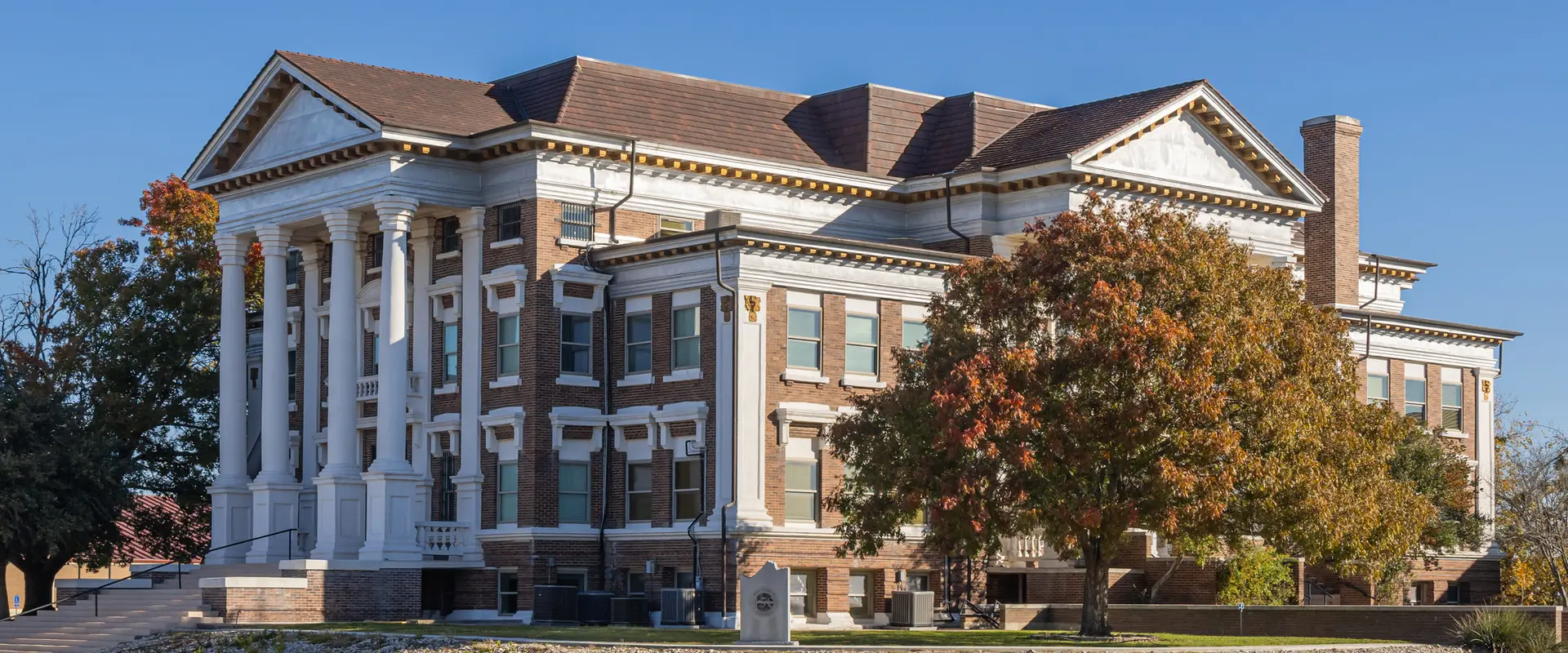
Montague County Courthouse
Home to the 97th District Court and both Justice of the Peace precincts at 101 E Franklin Street, Montague, TX 76251.
District Court
Phone: (940) 894-2571
Website: co.montague.tx.us/page/montague.District.Clerk
Justice of the Peace, Precinct 1
Phone: (940) 894-2541
Website: co.montague.tx.us/page/montague.JP1
Justice of the Peace, Precinct 2
Phone: (940) 894-2542
Website: co.montague.tx.us/page/montague.JP2
Montague County Administrative Complex
Houses the Constitutional County Court, County Clerk, and Commissioners Court at 11339 State Highway 59, Montague, TX 76251.
Constitutional County Court
Phone: (940) 894-2461
Website: co.montague.tx.us/page/montague.County.Clerk
Commissioners Court
Phone: (940) 894-2401
Website: co.montague.tx.us/page/montague.Commissioners.Court
Municipal Courts
Operated and funded by their respective cities and handle class C misdemeanors and city ordinance violations arising within their city limits.
Bowie Municipal Court
Address: 304 Lindsey St, Bowie, TX 76230
Phone: (940) 872-4392
Website: Bowie Municipal Court
Nocona Municipal Court
Address: 102 Clay Street, Nocona, TX 76255
Phone: (940) 825-3283
Website: Nocona Municipal Court
Saint Jo Municipal Court
Address: 220 E Howell St, St Jo, TX 76265, USA
Phone: (940) 995-2337
Legal Help and Self-Help Resources
Residents of Montague County can take advantage of many options for free and low-cost help.
 Free Legal Assistance
Legal Aid of NorthWest Texas provides free civil legal services to eligible applicants based on their income. Their attorneys handle a wide range of matters, including representation in housing disputes, family law cases, and all other areas of civil law. Residents who do not qualify for legal aid but still need help finding an attorney can contact the State Bar of Texas Lawyer Referral & Information Service. They assist with finding a participating attorney and scheduling an initial consultation at a reduced rate. Another source for legal assistance is TexasLawHelp. They have created simple guides for legal topics such as divorce, child custody, evictions, debt, expungements, and other various legal subjects, along with downloadable forms for those same topics.
 Local Legal Support
The Texas Judicial Branch's Court Help section details guidance for self-represented litigants in any Texas court, covering how to file, how to prepare for hearings, and what to expect at each stage. Criminal defendants who cannot afford an attorney may petition the court to appoint them counsel through the county's indigent defense process. The Texas State Law Library Ask a Librarian offers free legal research help by phone, email, or chat for Texans. Librarians cannot give legal advice, but they can explain what the law actually says. There is also the Texas Legal Services Center, which provides statewide hotlines and pro bono programs focused on veterans, seniors, the disabled, and crime victims.
FAQs
Can anyone request public access to a case?
Yes, public court documents in Texas are accessible to anyone who makes a request. A valid photo identification document will be requested. In addition, copy fees will be paid. Court documents that cannot be accessed by members of the general public include juvenile court documents, sealed documents, and expunged documents.
Is there any way to locate a case without knowing the court that heard it?
CourtCaseFinder enables users to conduct a search in several Texas jurisdictions simultaneously. After searching, it would be prudent to confirm the details with the clerk's office before acting on them.
Are probate records accessible?
Limited index information from probate filings can be found on re:SearchTX and in the County Clerk's online records search. A complete probate file, however, requires a visit to the County Clerk's office. The staff there can help explain what's available online and what requires an in-person visit or a formal written request.
How does someone file a small claims case in Montague County?
Small claims cases are filed at the Justice of the Peace court in the area where the defendant lives or where the dispute happened. Both Precinct 1 and Precinct 2 have these self-help packets that have guides on the process step by step. The claim limit in Texas Justice of the Peace courts is $20,000.
What options are available when someone cannot pay the filing fee?
A Statement of Inability to Afford Payment of Court Costs may be filed alongside the case paperwork. A judge reviews the sworn financial information provided and decides whether to waive or lower the filing and service fees. This option is available in district, county, and Justice of the Peace courts all across Texas.
Where do appeals from Montague County courts go?
Appeals from the 97th District Court and the Constitutional County Court are heard by the Second Court of Appeals in Fort Worth. Capital murder cases skip the intermediate appellate level entirely and go directly to the Texas Court of Criminal Appeals in Austin. Appeals from municipal courts go to the Constitutional County Court and are retried de novo.
Other Counties in Texas
- Anderson
- Andrews
- Angelina
- Aransas
- Archer
- Armstrong
- Atascosa
- Austin
- Bailey
- Bandera
- Bastrop
- Baylor
- Bee
- Bell
- Bexar
- Blanco
- Borden
- Bosque
- Bowie
- Brazoria
- Brazos
- Brewster
- Briscoe
- Brooks
- Brown
- Burleson
- Burnet
- Caldwell
- Calhoun
- Callahan
- Cameron
- Camp
- Carson
- Cass
- Castro
- Chambers
- Cherokee
- Childress
- Clay
- Cochran
- Coke
- Coleman
- Collin
- Colorado
- Comal
- Comanche
- Concho
- Cooke
- Coryell
- Crockett
- Crosby
- Culberson
- Dallam
- Dallas
- Dawson
- De Witt
- Deaf Smith
- Delta
- Denton
- Dimmit
- Duval
- Eastland
- Ector
- Edwards
- El Paso
- Ellis
- Erath
- Falls
- Fannin
- Fayette
- Fisher
- Foard
- Fort Bend
- Franklin
- Freestone
- Frio
- Gaines
- Galveston
- Garza
- Gillespie
- Glasscock
- Goliad
- Gonzales
- Gray
- Grayson
- Gregg
- Grimes
- Guadalupe
- Hale
- Hamilton
- Hansford
- Hardin
- Harris
- Harrison
- Hartley
- Haskell
- Hays
- Henderson
- Hidalgo
- Hill
- Hockley
- Hood
- Hopkins
- Houston
- Howard
- Hunt
- Hutchinson
- Jack
- Jackson
- Jasper
- Jefferson
- Jim Wells
- Johnson
- Jones
- Karnes
- Kaufman
- Kendall
- Kenedy
- Kerr
- Kinney
- Kleberg
- Lamar
- Lamb
- Lampasas
- Lavaca
- Lee
- Leon
- Liberty
- Limestone
- Live Oak
- Llano
- Loving
- Lubbock
- Madison
- Marion
- Matagorda
- Maverick
- Mcculloch
- Mclennan
- Medina
- Midland
- Milam
- Mitchell
- Montgomery
- Moore
- Morris
- Nacogdoches
- Navarro
- Newton
- Nolan
- Nueces
- Ochiltree
- Orange
- Palo Pinto
- Panola
- Parker
- Parmer
- Pecos
- Polk
- Potter
- Rains
- Randall
- Red River
- Reeves
- Robertson
- Rockwall
- Runnels
- Rusk
- Sabine
- San Augustine
- San Jacinto
- San Patricio
- Scurry
- Shelby
- Sherman
- Smith
- Somervell
- Starr
- Stephens
- Tarrant
- Taylor
- Terrell
- Terry
- Titus
- Tom Green
- Travis
- Trinity
- Tyler
- Upshur
- Uvalde
- Val Verde
- Van Zandt
- Victoria
- Walker
- Waller
- Ward
- Washington
- Webb
- Wharton
- Wichita
- Wilbarger
- Willacy
- Williamson
- Wilson
- Wise
- Wood
- Yoakum
- Young
- Zapata
- Zavala
Table of Contents
