Table of Contents
Llano County Courts, TX *

Llano County is located about 75 miles northwest of Austin, and it has a small population of just over 22,000. Despite the small number of people, the county has a full court system that handles everything from minor traffic infractions to serious felony cases. The court is tiered with separate courts, with each one operating within its own jurisdiction. Understanding the court system will help you navigate the court process easily if you or someone close to you has a legal issue.
Overview of the Llano County Court System
Texas operates a layered system where different courts have different jurisdictions. Being that Llano County is in Texas, it follows the same multi-layered structure, which has courts in different levels of operation. Llano County has two District Courts (the 33rd and the 424th), a Constitutional County Court, four Justice of the Peace precincts, and three Municipal Courts. The county lacks a County Court at Law or Statutory Probate Court. The County Judge handles probate and misdemeanor matters, which are normally handled at the County Court at Law in the state.
The district court handles serious felonies, major civil disputes, and family law. Mid-level issues are handled by the Constitutional County Courts, and lower-level criminal matters, small civil claims, and local ordinance violations are heard at the Justice of the Peace courts, or Municipal Courts, depending on where in the county the incident occurred.
Types of Courts in Llano County, Texas

Llano County operates under the multi-level court system, which has different courts operating at different levels. When filing a case or searching for records, it is important to understand the court that has the power to handle your specific issue. The section below describes the different courts, highlighting their specific roles.
 District Courts
The 33rd and 424th District Courts are the highest trial courts in the county that deal with serious felony, civil, and family law cases. The 424th was added to the 33rd District Court to help manage the growing workload. The courts share jurisdiction over Llano County, Burnet, and other surrounding counties in the region.
The courts handle:
- Felony-level criminal cases
- Civil cases whose claim is $200 and above
- Family law matters
- Juvenile cases
- Mental health commitment hearings
Some court hearings for the 33rd and 424th District Courts are streamed publicly and posted online. One can track the dockets and courts on the Courts' page.
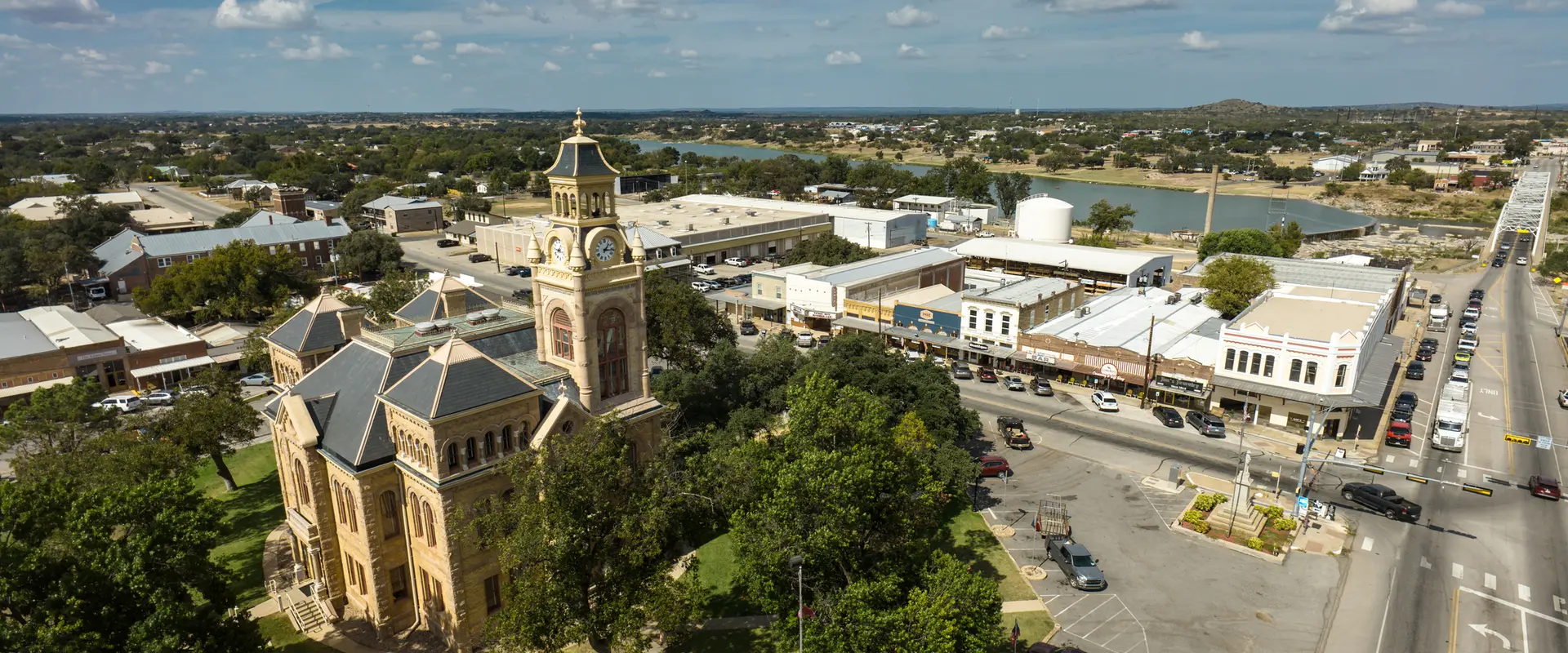
Primary Location: Llano County Courthouse
 Constitutional County Court
Llano County has a Constitutional County Court, which is different from those of other large counties in Texas because it has broader responsibilities. Instead of focusing on administrative responsibilities and support to the County Court at Law, it handles all the mid-level responsibilities of the courts. These include:
- Misdemeanor criminal cases (Class A and B)
- Civil cases involving amounts between roughly $200 and $20,000
- Probate and estate matters
- Mental health hearings
- Appeals from the Justice of the Peace courts
The County Clerk's office is in charge of records and filing in the court. Since July 2025, the county has adopted re:SearchTX as the main online record access portal. Probate records specifically are still not fully available online, so calling ahead is recommended if that is your focus.
Primary Location: Llano County Courthouse
 Justice of the Peace Courts
Llano County has four precincts spread across the county's geography, with each one of them having a Justice of the Peace (JP) court. The courts are at the entry-level, and they handle a wide range of minor matters. They have jurisdiction over:
- Class C misdemeanors (fine-only offenses)
- Civil cases involving amounts up to $20,000
- Small claims
- Evictions
- Debt claim cases
- Magistrate duties include bail setting, issuing warrants, and performing the wedding ceremonies
JP courts' fines and fees can be paid online through a certified payment portal using each precinct's bureau code. Magistrate court hearings are also livestreamed on the Llano County YouTube channel, making it easier to observe proceedings without being present.
Primary Locations: JP Precinct 1 (Horseshoe Bay), JP Precinct 2 (Buchanan Dam), JP Precinct 3 (Kingsland Area), JP Precinct 4 (Llano)
 Commissioners Court
Unlike other courts, the Commissioners Court is not a trial court, but the main governing body of the county. Its responsibilities include:
- Budget adopting and managing
- Property tax rate setting
- County infrastructure maintenance
- Funding law enforcement and public safety operations
- Development and Support of community programs and initiatives
Primary Location: Llano County Courthouse
 Municipal Courts
Llano County Municipal Courts operate within the city borders and are managed by the city and not the county. The court handles:
- Class C misdemeanors occurring within the city limits of Llano
- Traffic violations
- City code issues
- Public safety matters
- Magistrates' responsibilities include issuing arrest warrants, setting bail, issuing emergency protection orders, and conducting preliminary hearings
Primary Locations: Llano Municipal Court, Horseshoe Bay Municipal Court, Sunrise Beach Village Municipal Court
How to Access Llana County Court Records

In Texas, court records are generally public information with a few exceptions. Below are methods you can use to access your records.
 Online Access
The most accessible way to Llano County court records is re:SearchTX. It is the official state court records search system that has index information for civil cases from district, county, and probate courts across participating counties. You can find case information and preview some documents for free, though full document access may require a paid subscription.
 Alternative Online Options
Third-party platforms like CourtCaseFinder are a good starting point when you are not sure which court handled a specific case. They aggregate court records from different court databases, making it easier to locate them. As much as the information is thoroughly researched, it is important to verify the most recent information with the respective court.
 In-Person Requests
Records like juvenile cases and other sealed cases are restricted and cannot be accessed online. To access such records, you will need a valid reason and an in-person visit or to send a mail request to the appropriate clerk. The District Clerk's office manages records from district courts, the County Clerk's office for those of cases in County court, and the JP clerk handles the cases filed at the Justice of the Peace court. Ensure you carry your ID for verification, and keep in mind that you will have to pay per copy for any certified copies.
 Archived Records
Retention of court records in Texas varies depending on the court and case type. Some records are kept permanently, like the felony cases, while others, like civil cases, have a time limit after case closure. You can get a retention schedule at the Texas State Library and Archives (TSLAC) that can give you an understanding of how long different courts are expected to keep their files. You can access the record in person from the respective clerk's office. Also, historical records that may have been transferred out of local custody may be accessible through the TSLAC.
For Attorneys and Legal Professionals
Licensed attorneys and legal professionals must file electronically through eFile Texas. The e-filing system covers probate, civil, and criminal filings. Also, you can check the District Clerk's office for a Standing Discovery Order for criminal cases and a Standing Order for divorces and family cases, which are downloadable on the county website.
The Third Court of Appeals, which serves Llano County, handles appellate matters. For general questions on local court practices and procedures, contact the relevant court clerk.
How to File a Case in Llano County

Filing a case can be complicated, especially if you are doing it without a lawyer. Having a basic understanding of the general steps to follow can make the process easier.
 Step 1: Choose the Correct Court
Your case type and the complexity of the matter will determine the court in which you will file your case. Felonies, divorces, custody disputes, and large civil claims go to the District Court. The mid-level cases between the Justice of the Peace courts and the District Courts are handled at the County Constitutional Court. Small civil disputes under $20,000, evictions, and minor criminal matters go to the Justice of the Peace Court or County Court. Traffic tickets and city ordinance violations go to the Municipal Court. In case you are not sure, contact the District Clerk's office to verify.
 Step 2: Complete Required Forms
Each case type has its own form that one is required to fill out while filing a case. Standard civil and family law forms are available at the District Clerk's office, and probate-specific forms can be accessed at the County Clerk's office. Also, Justice of the Peace, Precinct 4, maintains self-help legal packets for evictions, small claims, debt claims, and occupational driver's licenses. If you cannot find what you need, you can check with Texas Law Help, which has downloadable court forms covering family law, housing, debt, and more. Make sure the forms are filled out accurately and completely to avoid rejection.
 Step 3: File Your Case
After completing the paperwork, you can either file in person at the relevant clerk's office or electronically through eFile Texas. For in-person filing of property-related documents with the County Clerk, you will need original signatures. For electronic filing, follow the instructions on the e-file portal, and any technical issues complaints should be directed to the portal managers and not the clerk's office.
 Step 4: Pay Filing Fees
Filing fees vary depending on the case type and the court. You can access current fees on the courts' website. Clerks can be contacted for fee schedules as well. In case you cannot afford the fees, you can apply for a waiver by filing a Statement of Inability to Pay.
 Step 5: Serve the Other Party
Once the case is filed and fees paid, you are required to legally inform the other party of the lawsuit against them. In Texas, the clerk issues the citation and the documents, and service of the process is done with a constable, a sheriff, or a private process server. Not doing the process well might lead to case dismissal, so file proof of service with the court.
 Step 6: Monitor Your Case
Once both parties are aware of the case, the judge sets court dates that are to be followed. You can monitor your case online using re:SearchTX, which is an official state court records search system that has index information for cases from district, county, and probate courts across participating counties. Missing a court date can lead to negative consequences, including a judge issuing a warrant of arrest for criminal cases or a default judgment against you for civil cases.
Llano County Courthouse Directory
Llana County Commissioners Court. Oversees and governs the county's administrative procedures.
Llana County District Courts (33rd & 424th Judicial District Courts)
Deals with serious felony criminal cases and civil matters.
Llano
Address: 832 Ford Street, Llano, TX 78643
Phone: (325) 247-5036
Email: districtclerk@co.llano.tx.us
Llana County Constitutional County Court
Handles criminal and civil cases that are higher than the JP courts and lower than the district courts.
Llano
Address: 801 Ford Street, Llano, TX 78643
Phone: (325) 247-7730
Email: countyjudge@co.llano.tx.us
Website: llanocounty.gov/page/County.Judge
Llana County Justice of the Peace courts
The most local courts that most people have the possibility of dealing with. They handle the minor criminal and civil cases, which result in a fine and not a jail sentence.
JP Precinct 1
Address: 101 Ferguson Road, Horseshoe Bay, TX 78657
Phone: (830) 598-2296
Website: llanocounty.gov/page/Justice
JP Precinct 2
Address: 8347 Ranch Road 1431, Buchanan Dam, TX 78609
Phone: (512) 793-2332
Website: llanocounty.gov/page/Justice
JP Precinct 3
Address: 8347 RR 1431 Buchanan Dam, TX 78609 (Operation in Kingsland Area)
Phone: (512) 793-2016
Website: llanocounty.gov/page/Justice
JP Precinct 4
Address: 752 Andy Taylor Drive, Suite B, Llano, TX 78643
Phone: (325) 247-3178
Website: llanocounty.gov/page/Justice
Municipal Courts
Managed by the city and have the responsibility of handling minor issues and violations against city ordinances within city borders
Horseshoe Bay Municipal Court
Address: 1 Community Drive, 9101 W. FM 2147, Horseshoe Bay, TX 78657
Phone: (830) 598-8741
Website: horseshoe-bay-tx.gov/764/Municipal-Court
Llano Municipal Court
Address: 301 W. Main Street, 1st Floor, Llano, TX 78643
Phone: (325) 247-1928
Website: cityofllano.com/161/Municipal-Court
Sunrise Beach Village Municipal Court
Address: 124 Sunrise Drive, Sunrise Beach Village, TX 78643
Phone: (325) 388-6438
Website: sunrisebeachtx.gov/municipal-court/
Legal Help and Self-Help Resources
If you cannot afford a lawyer or your case does not need one, you might face some complications when trying to access justice. Free and legal resources can be helpful in the process.
 Free Legal Assistance
Some free legal assistance includes:
- Texas Legal Services Center: Can connect you with an attorney based on your income.
- State Bar of Texas: Maintains Certified Lawyer Referral Service directory, which can help you find an attorney who may offer reduced-fee consultations.
- Texas Law Help: Has plain-language guides on family law, landlord-tenant disputes, consumer debt, expunctions, and more.
 Local Legal Support
Llano County has some local legal support, including:
- Llano County Public Defenders Office: Serves individuals who qualify for appointed counsel in criminal matters.
- Texas Judicature's Court Help platform: Provides guidance that has been designed for people navigating courts without a lawyer.
FAQs
Are Llano County court records public?
To some extent, yes. Texas court records are public under Rule 12 of the Texas Rules of Judicial Administration. But some records are exempt, including juvenile records, sealed cases, domestic violence victim information, and mental health filings.
How do I look for a case record online?
You can use re:SearchTX, which is a statewide portal that has information on civil cases across multiple court types in participating counties. Criminal case records can be accessed through the district court docket, which has important information on your case's progress. If you are not sure of the court in which a case was filed, you can consider using a third-party tool like CourtCaseFinder, which can conduct a search across multiple sources to help identify where a case may be filed.
Can I access probate records online?
Currently, you cannot access probate records online. In July 2025, County Court records generally became searchable on re:SearchTX, but the County Clerk's office notes that probate records are not available online. To access them, you need to visit the County Clerk's office and pay $5.00 per name searched.
What is the difference between the 33rd and 424th District Courts?
The two courts share the same jurisdiction and serve the same geographical area. If one judge recuses from a case or the docket gets backed up, a matter can be transferred between the two courts. The only difference is that they each have their own judge.
What if I cannot afford to pay court filing fees?
In case you cannot afford the fees, you can apply for a waiver by filing a Statement of Inability to Pay. A judge will review your financial statement and then decide according to your current income. If you qualify, you can file the case without paying the fee.
Other Counties in Texas
- Anderson
- Andrews
- Angelina
- Aransas
- Archer
- Armstrong
- Atascosa
- Austin
- Bailey
- Bandera
- Bastrop
- Baylor
- Bee
- Bell
- Bexar
- Blanco
- Borden
- Bosque
- Bowie
- Brazoria
- Brazos
- Brewster
- Briscoe
- Brooks
- Brown
- Burleson
- Burnet
- Caldwell
- Calhoun
- Callahan
- Cameron
- Camp
- Carson
- Cass
- Castro
- Chambers
- Cherokee
- Childress
- Clay
- Cochran
- Coke
- Coleman
- Collin
- Colorado
- Comal
- Comanche
- Concho
- Cooke
- Coryell
- Crockett
- Crosby
- Culberson
- Dallam
- Dallas
- Dawson
- De Witt
- Deaf Smith
- Delta
- Denton
- Dimmit
- Duval
- Eastland
- Ector
- Edwards
- El Paso
- Ellis
- Erath
- Falls
- Fannin
- Fayette
- Fisher
- Foard
- Fort Bend
- Franklin
- Freestone
- Frio
- Gaines
- Galveston
- Garza
- Gillespie
- Glasscock
- Goliad
- Gonzales
- Gray
- Grayson
- Gregg
- Grimes
- Guadalupe
- Hale
- Hamilton
- Hansford
- Hardin
- Harris
- Harrison
- Hartley
- Haskell
- Hays
- Henderson
- Hidalgo
- Hill
- Hockley
- Hood
- Hopkins
- Houston
- Howard
- Hunt
- Hutchinson
- Jack
- Jackson
- Jasper
- Jefferson
- Jim Wells
- Johnson
- Jones
- Karnes
- Kaufman
- Kendall
- Kenedy
- Kerr
- Kinney
- Kleberg
- Lamar
- Lamb
- Lampasas
- Lavaca
- Lee
- Leon
- Liberty
- Limestone
- Live Oak
- Loving
- Lubbock
- Madison
- Marion
- Matagorda
- Maverick
- Mcculloch
- Mclennan
- Medina
- Midland
- Milam
- Mitchell
- Montague
- Montgomery
- Moore
- Morris
- Nacogdoches
- Navarro
- Newton
- Nolan
- Nueces
- Ochiltree
- Orange
- Palo Pinto
- Panola
- Parker
- Parmer
- Pecos
- Polk
- Potter
- Rains
- Randall
- Red River
- Reeves
- Robertson
- Rockwall
- Runnels
- Rusk
- Sabine
- San Augustine
- San Jacinto
- San Patricio
- Scurry
- Shelby
- Sherman
- Smith
- Somervell
- Starr
- Stephens
- Tarrant
- Taylor
- Terrell
- Terry
- Titus
- Tom Green
- Travis
- Trinity
- Tyler
- Upshur
- Uvalde
- Val Verde
- Van Zandt
- Victoria
- Walker
- Waller
- Ward
- Washington
- Webb
- Wharton
- Wichita
- Wilbarger
- Willacy
- Williamson
- Wilson
- Wise
- Wood
- Yoakum
- Young
- Zapata
- Zavala
Table of Contents
