Table of Contents
Houston County Courts, TX *

Houston County was founded on June 12, 1837, which makes it one of the oldest counties in Texas, with archived court records dating back to this time. Its court system handles cases ranging from civil disputes and criminal cases to family matters and probate issues within the county. The county seat is located in Crockett, with the courts operating under Texas law within the 3rd Judicial District.
The case types that go through the court system in the county include property disputes, landlord-tenant issues, divorce and child custody, and criminal matters ranging from traffic tickets to felonies. Because the county is rural, many cases involve land boundaries, agricultural contracts, timber rights, and hunting violations.
Overview of the Houston County Court System
Being part of the 3rd Judicial District, Houston County also covers Henderson and Anderson counties. This arrangement means that scheduling cases can sometimes be less predictable compared to other counties that have a full-time resident judge. Since the main courthouse sits in Crockett, most cases, including family law, probate, or criminal matters, are all heard under one roof. This structure is simple and efficient for navigation through the court system, especially for self-represented litigants.
Types of Courts in Houston County, Texas

The first step before visiting the courthouse is to determine the case type and the court that handles it. Moreover, litigants should ensure they collect all the necessary information for their case, including signatures and files.
 District Court
The 3rd District Court is the highest trial court in Houston County. While the 349th District Court serves both Houston County and Anderson County, the 3rd District Court serves Anderson, Henderson, and Houston Counties.
District courts handle:
- Major civil disputes involving serious personal injury
- Felony criminal cases
- Divorces
- Child custody and support matters
- Tax collection lawsuits
District Court procedures tend to be more strict than those of lower courts, so most people hire an attorney for this level because the rules of evidence and civil procedure are strictly enforced.
Primary Location: Houston County Courthouse
 County Court at Law
The Constitutional County Court is presided over by the Houston County Judge. This is an elected official, meaning they serve a dual role in the county, both as the head of county government and as the presiding judge of the County Court, covering cases like:
- DWI first offense
- Minor assault
- Drug possession charges below the felony threshold
- Cases where the amount in controversy generally falls below the district court threshold, for civil matters
- Some family law matters
- Certain probate filings, depending on local rules
In short, one's case is likely to land here if it is too serious for a Justice of the Peace court but does not meet the higher jurisdiction threshold of the District Court.
Primary Location: Houston County Courthouse
 Justice of the Peace Courts
Houston County has two Justice of the Peace precincts to help resolve cases quickly and inexpensively since litigants do not require attorneys.
- Civil cases where the claim is $20,000 or less
- Eviction proceedings (forcible entry and detainer)
- Debt collection suits
- Repair and remedy cases related to residential tenancies
One must begin by determining the defendant's location and address before selecting the Justice of the Peace (JP) precinct that will handle their case, as courts follow this requirement strictly. Both Precincts offer live video magistration via Zoom, which is useful for situations where an in-person appearance at odd hours would otherwise be required.
Primary Location: Justice of the Peace, Precincts 1 and 2
 Municipal Court
As part of the court system in Houston County, each city within its boundaries operates and maintains its own court record, meaning they handle their city ordinance violations. If one's citation occurs within the Crockett, Grapeland, Lovelady, Kennard, and Latexo city limits, the city's municipal court will handle it. Punishment is limited to a fine and city ordinance violations, such as:
- Noise complaints
- Dogs running loose
- Illegal dumping
- Parking tickets
As a rule, if one's citation occurs in any one of these cities, then the municipal court handles that case. So, check the citation carefully to see the listed court.
Primary Locations: Municipal Court of Crockett, Municipal Court of Grapeland, Municipal Court of Lovelady, Municipal Court of Kennard, Municipal Court of Latexo
How to Access Houston County Court Records

It is vital to collect all the information and documents one will need for each case type to avoid delays and frustrations. Below are some of the alternative options available to litigants.
 Online Access
Residents can perform online searches of criminal and civil records through Houston County's records portal. Litigants can use information such as name, case number, and date to search their case records and updates. For most cases, the portals do not show the actual documents, nor will litigants see petitions, orders, and judgments in full. One can only obtain full access or certified copies by contacting the clerk directly, who will explain all the steps one must take in order to obtain these copies. The County Clerk provides access to real property and vital records accessible via eRecording for qualified filers such as title companies and law firms. Typically, citizens can request records by either visiting the court in person or by mailing the court's clerk.
 Alternative Online Options
If one is unsure which Texas county holds the record they need, then they can use commercial sites like CourtCaseFinder. These sites aggregate records from county and state records departments and compile them into one report. Because official county portals only search and access Houston County records, this will help when searching across multiple counties at once or when one doesn't know which court holds the records.
 In-Person Requests
Those searching for certified documents or older documents should visit the courthouse and speak with the clerk who handles their specific case type. They should carry their ID and any fees for document copies. Additional fees may apply depending on the record type requested.
 Archived Records
Houston County was founded in 1837, meaning that records from its earliest decades exist only as paper or microfilm. The courts have not yet digitized probate files, land deeds, and naturalization papers from the 1800s. Therefore, those who need to access these records should send a formal request to the courthouse. Some of the oldest records may be held by the Texas State Library and Archives Commission in Austin. The State Archives has a searchable database of many early Texas county records. In case one requires an archived record from the clerk, they should present a written request that describes the document as much as possible. Make sure to include all necessary information, such as case numbers, names, and dates. The clerk will locate the file or advise if the court transferred it to the State Archives.
For Attorneys and Legal Professionals
The District Clerk manages jury selection for District Court, County Court at Law, and Justice of the Peace Courts. Licensed attorneys are mandated to file documents electronically through the statewide e-filing system at eFile Texas. Most civil filings in Texas district and county courts are required to go through this platform.
Legal professionals looking to connect with local practitioners familiar with Houston County court practices can visit the State Bar of Texas Lawyer Referral Service. Law enforcement agencies or government entities searching for records will find that the government-specific login credentials required by other counties will not work in Houston County, given its smaller scale. However, the clerk's office can coordinate directly for agency requests.
How to File a Case in Houston County

Texas law allows litigants to represent themselves in court, but they should carefully consider the nature and complexity of their case. Most residents can file straightforward cases, such as small claims, without the need for an attorney. Below is a general walk-through of the filing process.
Step 1: Choose the Correct Court
Filing in the wrong court will result in the court dismissing the case or transferring it, so to avoid this, litigants should make sure they are filing in the right court before filling out any form. Claims up to $20,000 can go to the Justice of the Peace court, while those between that threshold and around $250,000 typically go to the County Court at Law. Larger civil disputes, and any family law matter like divorce or child custody, go to the District Court. Felony criminal charges are filed by the District Attorney's office in district court. If one is unsure which court has what jurisdiction, they can ask at the clerk's windows.
 Step 2: Complete Required Forms
Different case filing requires filing out specific standardized forms available through the Texas Law Help website, as well as through the self-help resources list posted by the District Clerk's Office. It is required that the forms be filled out accurately and completely to avoid case filing rejection. In case one is not sure of the form, they may contact the District or County Clerk's office, and the staff will point them in the right direction.
 Step 3: File The Case
While filing with eFile Texas is mandatory for attorneys, self-filers may also use this method. Filing may be done in person at the Houston County Courthouse, where one will be required to carry their ID and any other document deemed necessary for their case. Once the clerk verifies that everything checks out, they will stamp the file copies with the filing date and case number on them, which one will need to keep for future reference and for personal records. In case the litigant cannot meet the filing window, they can do so via mail by sending the original documents plus copies to each party named in the case. They should include self-addressed envelopes in the parcel so that the clerk can mail the stamped copies back to them.
 Step 4: Pay Filing Fees
Under Texas law, the filing fees will depend on the case type. Typically, the fees range between $250 and $400, with the filing fees for small claims being much lower, between $50 and $100. If a litigant cannot afford fees, a Statement of Inability to Afford Payment of Court Costs can be submitted, and then the judge will decide if they need to pay any fees.
 Step 5: Serve the Other Party
Part of the filing process under the Texas law is the service of process, which requires that litigants notify the other party before their case can proceed. Houston County litigants have the following alternatives when serving the other party: A constable, sheriff, or private process server delivers the papers to the other party. Proof of service must be filed with the court.
 Step 6: Monitor The Case
Houston County residents can track their case through the District Clerk's portal or by calling the clerk's office. One can also sign up to re:SearchTX, a platform that will provide one with automatic emails on the dates and progress of their case. Be sure to note any scheduled hearing dates and respond to any court orders within the deadlines specified; otherwise, missing a deadline can result in a default judgment against you or dismissal of your case.
Houston County Courthouse Directory
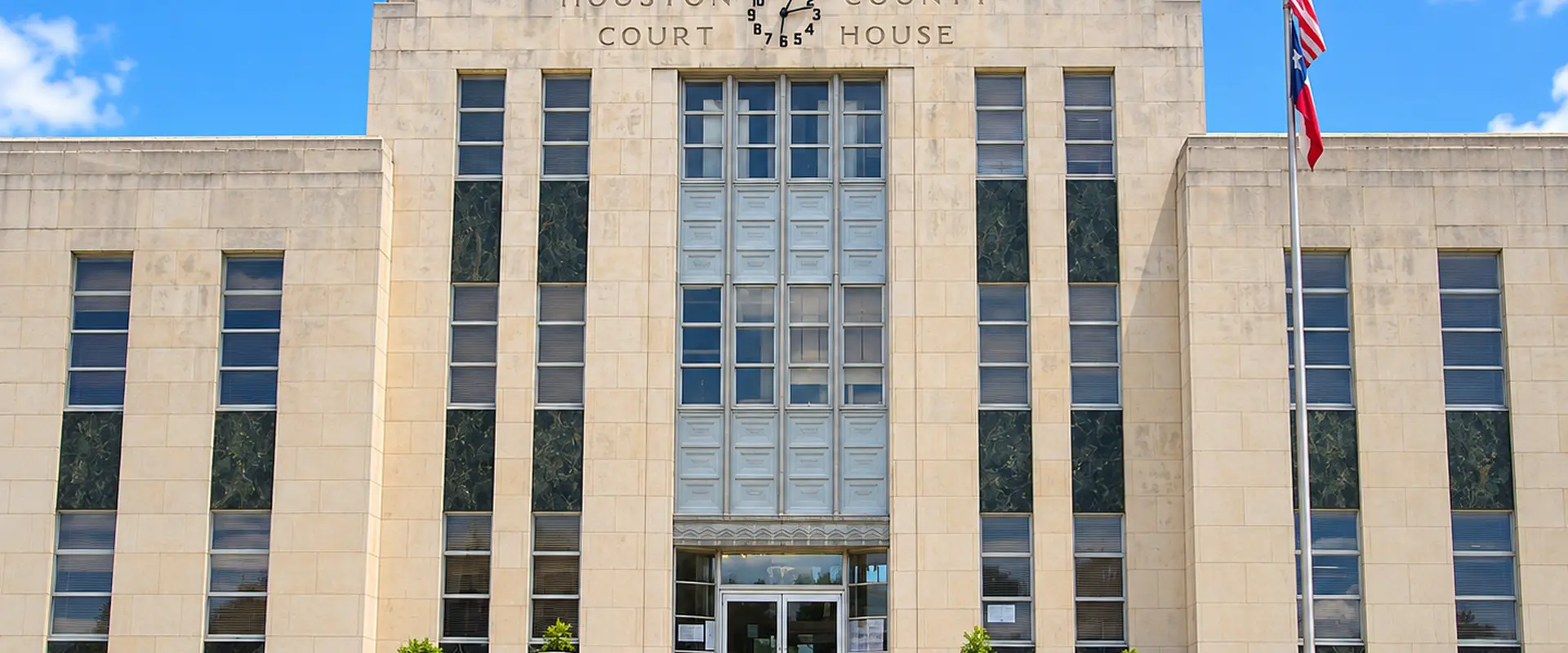
Houston County Courthouse
Houses the 3rd and 349th Judicial District Courts, the Constitutional County Court, and the County Court at Law.
Crockett
Address: 401 East Houston Avenue, Crockett, TX 75835
Phone: (936) 544-3255
Website: co.houston.tx.us
Justice of the Peace
Houston County has two Justice of the Peace precincts, each with its own elected judge.
Precinct 1
Address: 700B South 4th Street, Crockett, TX 75835
Phone: (936) 544-2564
Website: co.houston.tx.us
Precinct 2
Address: 110 East Houston Avenue, Crockett, TX 75835
Phone: (936) 544-3255 ext. 269
Website: co.houston.tx.us
Municipal Courts
Serve residents at the city level rather than the county level
Crockett Municipal Court
Address: 400 E. Houston St., Crockett, TX 75835
Phone: (936) 544-3101
Website: Link
Grapeland Municipal Court
Address: 126 South Oak St., Grapeland, TX 75844
Phone: 936-687-5141
Website: Link
Kennard Municipal Court
Address: 203 E. Main St., Kennard, TX 75847
Phone: (936) 655-3211
Website: Link
Latexo Municipal Court
Address: 14371 TX-19, Latexo, TX 75849
Phone: (936) 687-2415
Lovelady Municipal Court
Address: 174 E. Main St., Lovelady, TX 75851
Phone: (936) 636-7330
Legal Help and Self-Help Resources
Due to limited resources in the rural county, accessing legal sources can be challenging for some of the county's residents, meaning some litigants may not be able to hire attorneys; hence, they may seek free legal assistance listed below.
 Free Legal Assistance
The Texas State Law Library, operated by the Texas Office of Court Administration, provides free remote access, which includes case law from Texas courts and federal courts. This is useful if you are trying to understand how a legal issue has been decided in your jurisdiction. Due to the rural nature of the county, services may be provided remotely or via travel clinics. Call ahead to schedule an appointment with one of these legal services.
 Local Legal Support
The State Bar of Texas Lawyer Referral Service connects people with licensed attorneys in the relevant practice area. Many attorneys offer a discounted or free initial consultation, which can be enough to get pointed in the right direction even if one ultimately handles the case themselves. Texas Law Help provides free forms, instructions, and video guides for self-represented litigants. The website includes step-by-step guides for divorce, custody, eviction, small claims, and protective orders. Jurors can get reporting updates through the County District Clerk's automated telephone system. In the case of domestic violence incidents, low-income residents, including veterans, the elderly, and people with disabilities, Lone Star Legal Aid provides free civil legal services with eligibility based on income.
FAQs
Can I e-record real property documents in Houston County?
Yes. Houston County now accepts eRecording for real property documents. However, litigants must use a submitter that is affiliated with Houston County. Contact the County Clerk's office for the list of approved submitters or filers. Typically, unapproved residents record documents in person rather than using eRecording, meaning the tool is mostly useful for law firms and title companies.
Which clerk handles divorce records in Houston County?
The District Clerk handles all divorce and child custody records in Houston County. Contact the District Clerk at the courthouse. According to Texas law, divorce records are public unless sealed by the presiding judge. Litigants who want to access these records and need copies for their case should visit the clerk's office and allow one week for mailed requests.
How do I get a certified copy of a court record in Houston County?
Certified copies must be obtained through the relevant clerk's office, either in person or by mail. The District Clerk handles district court records, and the County Clerk handles county court and probate records. There are per-page fees and a certification fee. Contact the District Clerk to confirm current fees and procedure before sending payment.
Where can I search for case information if I don't know the court that handled it?
Civil records across multiple Texas court types in Houston County can be found in the re:SearchTX portal. For a multi-court, multi-county, or multi-state search option, CourtCaseFinder can help you identify which court has your case on file before you start making calls.
Can I file a small claims case in Houston County myself without a lawyer?
It is possible because the Justice of the Peace courts are specifically designed to be accessible to people without legal representation. Texas Law Help also has step-by-step guides for filing in the Justice of the Peace court. For claims up to $20,000, this is the right venue.
Other Counties in Texas
- Anderson
- Andrews
- Angelina
- Aransas
- Archer
- Armstrong
- Atascosa
- Austin
- Bailey
- Bandera
- Bastrop
- Baylor
- Bee
- Bell
- Bexar
- Blanco
- Borden
- Bosque
- Bowie
- Brazoria
- Brazos
- Brewster
- Briscoe
- Brooks
- Brown
- Burleson
- Burnet
- Caldwell
- Calhoun
- Callahan
- Cameron
- Camp
- Carson
- Cass
- Castro
- Chambers
- Cherokee
- Childress
- Clay
- Cochran
- Coke
- Coleman
- Collin
- Colorado
- Comal
- Comanche
- Concho
- Cooke
- Coryell
- Crockett
- Crosby
- Culberson
- Dallam
- Dallas
- Dawson
- De Witt
- Deaf Smith
- Delta
- Denton
- Dimmit
- Duval
- Eastland
- Ector
- Edwards
- El Paso
- Ellis
- Erath
- Falls
- Fannin
- Fayette
- Fisher
- Foard
- Fort Bend
- Franklin
- Freestone
- Frio
- Gaines
- Galveston
- Garza
- Gillespie
- Glasscock
- Goliad
- Gonzales
- Gray
- Grayson
- Gregg
- Grimes
- Guadalupe
- Hale
- Hamilton
- Hansford
- Hardin
- Harris
- Harrison
- Hartley
- Haskell
- Hays
- Henderson
- Hidalgo
- Hill
- Hockley
- Hood
- Hopkins
- Howard
- Hunt
- Hutchinson
- Jack
- Jackson
- Jasper
- Jefferson
- Jim Wells
- Johnson
- Jones
- Karnes
- Kaufman
- Kendall
- Kenedy
- Kerr
- Kinney
- Kleberg
- Lamar
- Lamb
- Lampasas
- Lavaca
- Lee
- Leon
- Liberty
- Limestone
- Live Oak
- Llano
- Loving
- Lubbock
- Madison
- Marion
- Matagorda
- Maverick
- Mcculloch
- Mclennan
- Medina
- Midland
- Milam
- Mitchell
- Montague
- Montgomery
- Moore
- Morris
- Nacogdoches
- Navarro
- Newton
- Nolan
- Nueces
- Ochiltree
- Orange
- Palo Pinto
- Panola
- Parker
- Parmer
- Pecos
- Polk
- Potter
- Rains
- Randall
- Red River
- Reeves
- Robertson
- Rockwall
- Runnels
- Rusk
- Sabine
- San Augustine
- San Jacinto
- San Patricio
- Scurry
- Shelby
- Sherman
- Smith
- Somervell
- Starr
- Stephens
- Tarrant
- Taylor
- Terrell
- Terry
- Titus
- Tom Green
- Travis
- Trinity
- Tyler
- Upshur
- Uvalde
- Val Verde
- Van Zandt
- Victoria
- Walker
- Waller
- Ward
- Washington
- Webb
- Wharton
- Wichita
- Wilbarger
- Willacy
- Williamson
- Wilson
- Wise
- Wood
- Yoakum
- Young
- Zapata
- Zavala
Table of Contents
