Table of Contents
Gillespie County Courts, TX *

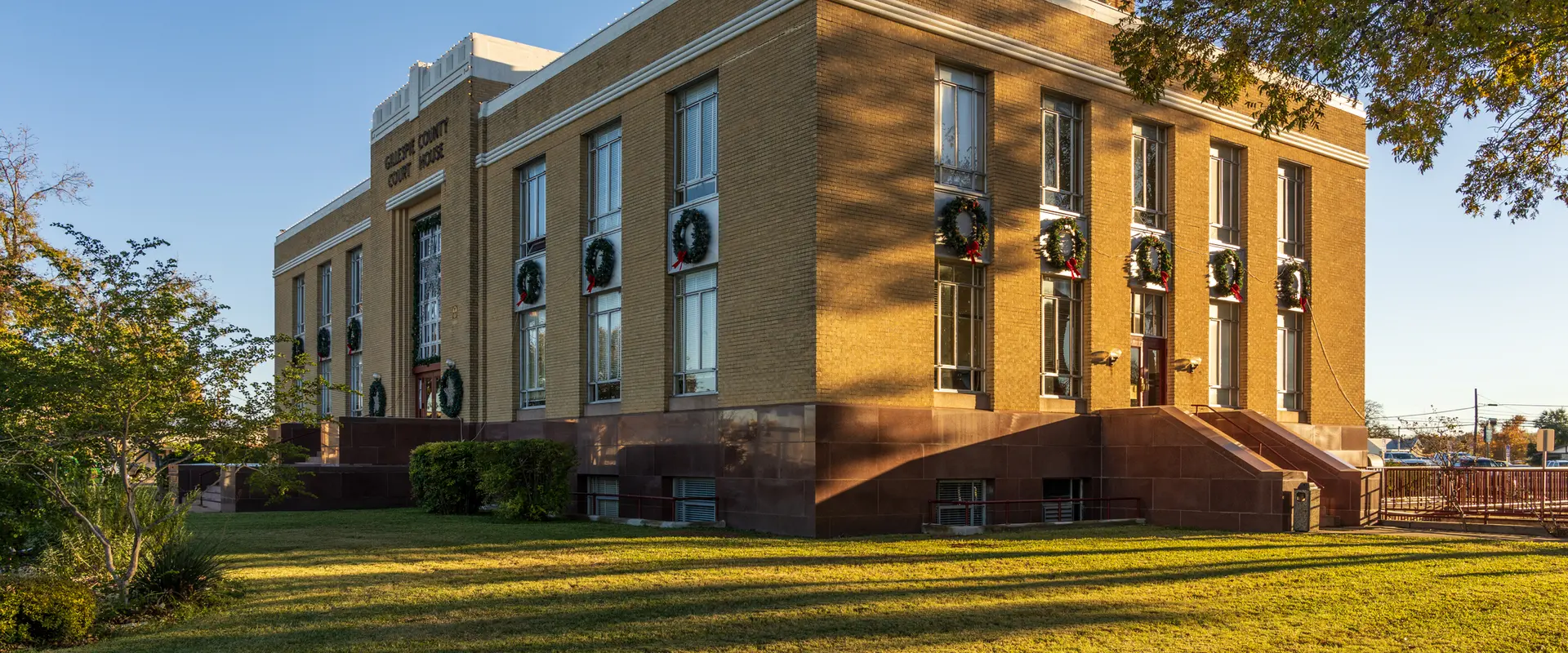
Gillespie County lies in the western part of Central Texas and was named in 1848 after Captain Robert A. Gillespie, who was a Mexican War hero. It occupies around 1,061 sq miles and is home to more than 24,000 residents. Fredericksburg is the county's biggest town and doubles up as the county seat. This county is famous for its several historical sites, from the Lyndon B. Johnson State Park to the national War museums. Among the many landmarks in the region is the Gillespie County Courthouse, a monument that was built in 1939.
The building houses several of the most important offices in the County, including those of the auditor, clerk, county commissioners, county court at law, county judge, and more. This goes to show that Gillespie County has an organized judicial system. Legal professionals, residents, employers, landlords, and other parties turn to the court systems for support in small and major matters. The courts handle civil disputes, probate, traffic violations, assault cases, estate administrations, and other matters.
Overview of the Gillespie County Court System
Gillespie County operates under the larger Texas Judicial system but maintains its ground as a law-and-order jurisdiction. The courts are created such that there are higher levels handling more serious cases and lower levels that serve more people and handle minor hearings. Most cases are heard at the Gillespie County Courthouse situated in Fredericksburg. This building is famous for being at the very center of the local Gillespie judicial system.
The courts are divided into levels, each with its specified jurisdiction. There are rare cases where the jurisdiction overlaps when it comes to the upper-level courts, so it is important to understand which court will be handling your case. The District Courts and County Courts are at the top level, taking care of major cases that have a serious legal and financial impact. The Justice Courts and Municipal Courts are at the lower levels and are usually more accessible to the public. Here is where they turn to for small claims, traffic violations, and other minor charges.
Types of Courts in Gillespie County, Texas

When interacting with the Gillespie County Courts for the first time, it may be overwhelming to tell them apart. Each court has its presiding judges and its laid-out functions. Below is a breakdown of the courts in Gillespie County.
 District Court
The 216th District Court serves Gilles County, helping the region tackle civil matters, felony charges, and other serious cases. It also has jurisdiction over the neighboring Kerr County. The residents and prosecutors take criminal charges seriously, and the juries are known to assess huge sentences when it comes to felony charges. For first-time offenders, though, they can have their misdemeanor and felony charges diverted. The court generally handles the following cases:
- Criminal charges
- Civil litigation
- Family law
- Child protection
 Constitutional Court
Just like the 216th District Court, the County Constitutional Court is also of a high level. The presiding judge hears serious cases, including those that have been appealed from the Justice and Municipal Courts. Some of the cases in this court's jurisdiction include:
- Child support
- Probate
- Family law
- Mental health cases
 County Court at Law
The Gillespie County Court at Law only has legal jurisdiction specified by the county. Each Court at Law in Texas has special jurisdiction as specified by the particular court. So, for Gilles County, expect the following cases to be tried in its Court at Law:
- Class A misdemeanors (assault, theft of services or property, burglary, other charges punishable by up to one year of jail term or fines of up to $4,000)
- Class B misdemeanors (driving while intoxicated, criminal trespass, indecent exposure, theft of goods worth $100-$750)
 Justice of the Peace Courts
The Justice of the Peace Courts are tasked with handling smaller cases, unlike the courts above. There are judges presiding over four precincts, hearing various cases, and performing other administrative and ceremonial duties. These judges are particularly important to the Gillespie rural community because they are more accessible and handle more duties. Their functions include:
- Small claims of up to $20,000
- Traffic violations
- Evictions
- Class C misdemeanors (penal, education, health, alcohol, and wildlife code violations)
How to Access Gillespie County Court Records

The District Clerk's office is one of the most important in Gillespie County when it comes to the keeping of court records. Here is where all the court records are indexed and secured, filing fees are collected, and funds that are held in litigation are handled here before being awarded to respective parties. On the other hand, the County Clerk is known as the official keeper of the records in the County Court, County Court at Law, and other vital files. However, since 2015, the County Clerk has stopped performing probate and criminal searches for the public, and instead, individuals were asked to use the following methods to find the details they need.
 Online Access
Businesses, legal professionals, residents, and the general public can access records from the Gillespie County Website. This site allows access to court records, agendas and minutes, employment details, online payment guidance, and other files related to the courthouses in the county. You can even buy records from the site after registering as a user.
 Alternative Online Options
Another convenient online tool that you can use to access court records is CourtCaseFinder. The difference is that this platform provides access to various files from all the states and counties, which widens your perspective and makes online searching more convenient. You only need to enter details like the full name, then the state, and the site will bring up the files you seek.
 In-Person Requests
Although the County Clerk's office stopped performing criminal and probate searches, you can still search for them in person. Sometimes, you won't find all the records in Texas in a single database, since counties are tasked with keeping their own files. Gillespie makes the records available online through their website, but if files are missing, you may have to go to the Clerk's office and search for them in person.
 Archived Records
If you seek older records for research, work, or estate disputes, Gillespie County may be keeping older records. However, if files are missing, they may already have been transferred to the Texas State Library and Archives Commission (TSLAC). If you still can't find them there, try checking the Texas Supreme Court Archives. These sites keep records dating as far back as the 1800s.
For Attorneys and Legal Professionals
Every state has its own procedures that legal professionals are asked to follow. You want to be on the right side of the law when it comes to filing, researching, and requesting a hearing. This means following the Texas Rules of Procedure and Evidence as well as the local laws. You should be familiar with the Texas Supreme Court Rules and Standards, Texas Rules of Civil Procedure, and Texas Rules of Evidence.
When it comes to Gillespie County, it also has its rules of procedure. For instance, the Rules for Gillespie County Court at Law give you direction when it comes to conduct and encourage you to contact the Court Coordinator when you need help. You can also go through the Rules of Practice in the 216th District Court to make sure that you are up to speed. Not following these rules could mean losing important hearing dates or losing your case.
How to File a Case in Gillespie County

Based on the Supreme Court Ruling, Gillespie County made e-filing mandatory for cases across various courts. Since January 2016, filing in the county has become more convenient, and these are the steps to follow to get started.
Step 1: Choose the Correct Court
What type of case are you handling? The best place to file would be in the court that will try the case. Each court has its unique functions, and it's only in a few cases where the jurisdiction overlaps. Take massive civil and legal cases like felonies to the District Court and the minor ones to lower chambers like Justice of the Peace Courts. If you're not sure, you can contact the clerk's office for guidance.
 Step 2: Complete Required Forms
Expect some forms when filing your case, regardless of the nature. The forms will be handy for civil law, family, probate, misdemeanors, and other charges, and it is important that you fill out all the fields accurately. Carefully go through the instructions and make sure that you submit to the proper place. If running into problems, the County Clerk, who is the custodian of records in Gillespie County, will gladly help. This will save you a lot of time since you get to receive professional assistance.
 Step 3: File Your Case
eFile Texas comes in handy when you want to make filings across any court. Any legal professional is mandated to use them regardless of the case they are handling, and you realize that it is quite simple to navigate. If not, the site offers training videos for all filers. You can perform several tasks, including starting a case, filing into a case, exporting filings, and more. There are also separate sections for independent users and professionals who work in a firm.
 Step 4: Pay FIling fees
The next step is to pay the required filing fees, which include a local consolidated amount and additional fees based on the task you are performing. The amount may vary based on the type of case and whether additional services are included. In some cases, you will have to pay amounts in addition to the base fees. If the fees keep adding up and you are unable to pay, you can fill out the Statement of Inability to Afford Payment of Court Costs, which could get the fee waived to make the court more accessible for you.
 Step 5: Serve the Other Party
You must notify the other party about the case; otherwise, it puts your case at risk. Process servers are available to deliver subpoenas, summonses, and legal notices. The process must meet the local and state laws, making sure that the documentation is delivered and recognized by the court. Make sure that you use an authorized process server in Gillespie County, whether you are serving an individual or a business.
 Step 6: Monitor Your Case
To always stay ahead, it helps to monitor your case. This way, you are up to date when it comes to mentions and changes in timelines and hearing dates. You don't want to be caught off guard and unprepared. Tracking important dates means that you always know when to appear in court and which documents are required, which gives you an added advantage. You can check your case's status at the Gillespie County Public Access Site or re:SearchTX.
Gillespie County Courthouse Directory
Most of the legal proceedings in Gillespie County take place at the courthouse, so many courts are found in the same building. Here is how to contact the various courts and officials when you need help.
216th District Court
Civil, felony, and family hearings are done here, making this one of the highest courts in Gillespie County.
Fredericksburg
Address: 101 W Main St, #109, Fredericksburg, TX 78624
Phone: (830) 997-6515
Website: Gillespie 216th District Court
Constitutional County Court
This mostly handles civil cases, family law, mental health cases, and appeals from the lower-level courts.
Fredericksburg
Address: 101 W Main St, #109, Fredericksburg, TX 78624
Phone: (830) 997-6515
County Court at Law
This court is mainly tasked with handling class A and B misdemeanors in Gillespie County.
Fredericksburg
Address: 101 W Main St. Mail Unit 1, Room 208, Fredericksburg, TX 78624
Phone: (830) 307-3766
Justice of the Peace Courts
They are regarded as the most accessible courts in Gillespie County, especially handling minor violations and Class C misdemeanors.
Precinct 1
125 W Main St. Lower Level Office, Fredericksburg, TX 78624
(830) 307-3737
Precinct 2
125 W Main St. Suite 140, Fredericksburg, TX 78624
(830) 307-3737
Precinct 3
125 West Main St. Fredericksburg, TX 78624
(830) 307-3737
Precinct 4
125 West Main St. Fredericksburg, TX 78624
(830) 307-3737
Legal Help and Self-Help Resources
What if this is your first time interacting with the court system of Gillespie County, or you are from one of the marginalized communities in the region? The great news is that there are several agencies and organizations that offer assistance for all your civil, family, and probate matters.
 Free Legal Assistance
Justice For Our Neighbors is one such body that offers residents free legal aid, especially when it comes to immigration services. It also conducts public sensitization and offers a licensed immigration professional who stays with you until a resolution is reached. Legal Aid for Survivors of Sexual Assault (LASSA) also assists with free legal assistance, but specifically for sexual assault survivors.
 Local Legal Support
If you are a low-income veteran in Gillespie or in active or reserve duty, Austin Bar Foundation's Veterans Legal Assistance can help you and your family with your civil issues. You will find volunteer attorneys to offer advice on various cases, including housing, employment, education, family, estate planning, and more. You can always call to see if you are available or apply online. The Catholic Charities Archdiocese of San Antonio also serves Gillespie County, providing affordable legal assistance in probate, estate planning, guardianship, and immigration matters.
FAQs
How do I look up court cases online in Gillespie County?
You can find cases and court records online from the county's website or in person at the county Clerk's office. Alternatively, you can use CourtCaseFinder to search for records in any state and county in the country.
What court records are accessible in Gillespie County?
Most case files are available in Gillespie, and you can access court records, trial dates, docket sheets, and more. However, remember that the courts may charge a small service fee before allowing you to retrieve them.
Which court records are not accessible in Gillespie County?
There are instances where the court records are sealed, unobtainable by the general public, like some family cases, matters involving minors, and other confidential files. Sometimes, some criminal records will be sealed after nondisclosure orders or even completely removed.
What do I do if I cannot find the records online?
There are several reasons to explain why you may have trouble accessing records online. Maybe the name or details you entered are wrong, or the files you need have been deliberately sealed or expunged. There are also cases where the records predate digital filing, which means that you can only find them from the Texas State Library and Archives Commission.
Are court records in Gillespie County free to access?
While you can find some records from the Gillespie County website, in many cases, you will have to pay a small fee to access the files. It may be a standard amount, or you will be asked to pay extra based on the types of records you seek. If you are not sure, you can always contact the County Clerk's office for more details about the access fees.
Can I get legal assistance as a veteran in Gillespie County?
If you are a veteran or in active duty, there are organizations in the area that are ready to help with your civil matters. Austin Bar Foundation's Veterans' Legal Assistance has helped many people just like you find free help thanks to their volunteer legal professionals.
What do I do if I cannot afford court fees?
If you cannot afford to pay the mandatory court fees during the filing process, you can apply for a waiver by submitting the Statement of Inability to Afford Payment of Court Costs. If approved, then you can go ahead with the rest of the process without worrying about high filing fees.
Other Counties in Texas
- Anderson
- Andrews
- Angelina
- Aransas
- Archer
- Armstrong
- Atascosa
- Austin
- Bailey
- Bandera
- Bastrop
- Baylor
- Bee
- Bell
- Bexar
- Blanco
- Borden
- Bosque
- Bowie
- Brazoria
- Brazos
- Brewster
- Briscoe
- Brooks
- Brown
- Burleson
- Burnet
- Caldwell
- Calhoun
- Callahan
- Cameron
- Camp
- Carson
- Cass
- Castro
- Chambers
- Cherokee
- Childress
- Clay
- Cochran
- Coke
- Coleman
- Collin
- Colorado
- Comal
- Comanche
- Concho
- Cooke
- Coryell
- Crockett
- Crosby
- Culberson
- Dallam
- Dallas
- Dawson
- De Witt
- Deaf Smith
- Delta
- Denton
- Dimmit
- Duval
- Eastland
- Ector
- Edwards
- El Paso
- Ellis
- Erath
- Falls
- Fannin
- Fayette
- Fisher
- Foard
- Fort Bend
- Franklin
- Freestone
- Frio
- Gaines
- Galveston
- Garza
- Glasscock
- Goliad
- Gonzales
- Gray
- Grayson
- Gregg
- Grimes
- Guadalupe
- Hale
- Hamilton
- Hansford
- Hardin
- Harris
- Harrison
- Hartley
- Haskell
- Hays
- Henderson
- Hidalgo
- Hill
- Hockley
- Hood
- Hopkins
- Houston
- Howard
- Hunt
- Hutchinson
- Jack
- Jackson
- Jasper
- Jefferson
- Jim Wells
- Johnson
- Jones
- Karnes
- Kaufman
- Kendall
- Kenedy
- Kerr
- Kinney
- Kleberg
- Lamar
- Lamb
- Lampasas
- Lavaca
- Lee
- Leon
- Liberty
- Limestone
- Live Oak
- Llano
- Loving
- Lubbock
- Madison
- Marion
- Matagorda
- Maverick
- Mcculloch
- Mclennan
- Medina
- Midland
- Milam
- Mitchell
- Montague
- Montgomery
- Moore
- Morris
- Nacogdoches
- Navarro
- Newton
- Nolan
- Nueces
- Ochiltree
- Orange
- Palo Pinto
- Panola
- Parker
- Parmer
- Pecos
- Polk
- Potter
- Rains
- Randall
- Red River
- Reeves
- Robertson
- Rockwall
- Runnels
- Rusk
- Sabine
- San Augustine
- San Jacinto
- San Patricio
- Scurry
- Shelby
- Sherman
- Smith
- Somervell
- Starr
- Stephens
- Tarrant
- Taylor
- Terrell
- Terry
- Titus
- Tom Green
- Travis
- Trinity
- Tyler
- Upshur
- Uvalde
- Val Verde
- Van Zandt
- Victoria
- Walker
- Waller
- Ward
- Washington
- Webb
- Wharton
- Wichita
- Wilbarger
- Willacy
- Williamson
- Wilson
- Wise
- Wood
- Yoakum
- Young
- Zapata
- Zavala
Table of Contents
