Table of Contents
Delta County Courts, TX *

Delta County is a small and rural county in northeast Texas. Despite its size, its court system handles a lot of legal responsibilities. As a resident in Delta County, there may come a time when you or a person close to you might need to navigate the court system.
Texas's court system uses a multi-level structure that encompasses several courts at different levels, with each one operating within its jurisdiction. Understanding how the courts work can make your work easier when dealing with a criminal charge, a civil dispute, a divorce, or trying to pull up an old case record.
Overview of the Delta County Court System
Delta County operates under a multiple-level court system that handles legal matters depending on the nature of the case. The county is served by two District Courts that deal with serious criminal matters and major civil disputes. Below the District Courts are the County Court, the Justice of the Peace, and the Cooper Municipal Court.
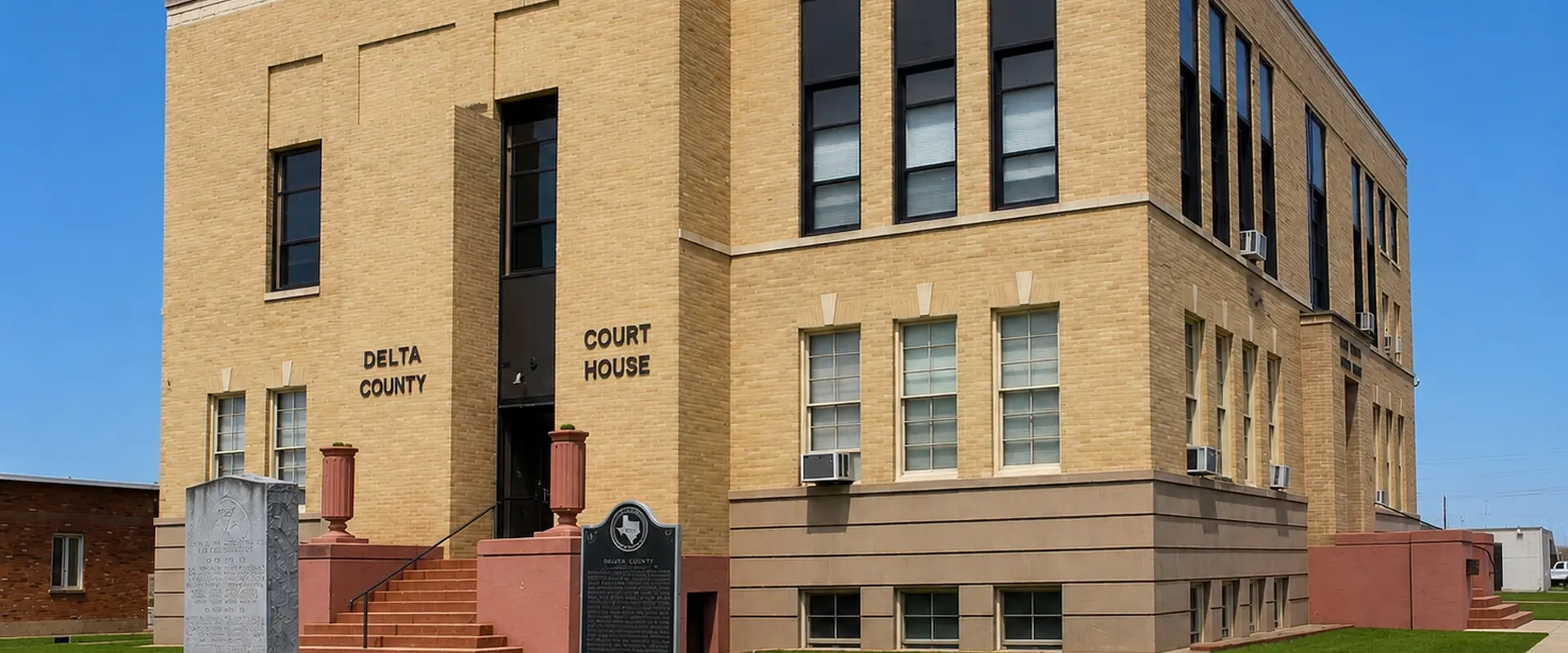
The Texas Office of Court Administration (OCA) oversees reporting, administration, and records management for trial courts statewide, and no courts in Delta County are exempt. The County Clerk's office and District Clerk's office are located in the Delta County Courthouse in Cooper. Because of the small population, the office of the county and district clerk is served by just one person. In most cases, the court interaction from filing to judgment is routed through this office, making it the main point of contact with the courts.
Types of Courts in Delta County, Texas

Delta County has six courts across four functional levels, with each one having a defined scope. For people navigating the court system without a legal expert, filing in the wrong court has become a common problem. Below is a clear description of the different courts, clarifying their function.
 District Court (Criminal)
The 8th Judicial District Court is also referred to as Delta County's felony criminal court. Its major responsibility is to handle the most serious criminal cases filed in the county. The 8th Judicial District Court deals with high-stakes criminal proceedings. Some of the cases include:
- Aggravated assault
- Drug trafficking
- Felony DWI
- Robbery
- Any other charges that carry potential prison sentences
In Texas, district courts have original jurisdiction over all felony criminal cases, meaning the cases start at this court and are not transferred from the lower courts. Also, the court handles the procedural side of things, like:
- Arraignments
- Motions
- Plea hearings
- Jury trials, when applicable
- Sentencing
Bi-weekly, the Court dockets for the 8th Judicial District are published on the Delta County website to help you get information on the specific felony case schedule.
Primary Location: Delta County Courthouse
 District Court (Civil)
The 62nd Judicial District Court is a district-level court that handles civil legal issues within Delta County. The court's main role is to handle civil lawsuits, which claim a dollar amount of $200 or more, which means most civil cases end up here.
The 62nd also handles:
- Divorce proceedings
- Cases involving title to land
- Election contests
- Family law matters.
- Attorney General cases, including child support enforcement actions.
In this court, the District Clerk is responsible for filing and maintaining all records related to the 62nd's docket. The 62nd Judicial District is a shared court between Delta County and Lamar County, so the Judge rotates between both counties, which can affect scheduling and availability.
Primary Location: Delta County Combined Court
 County Constitutional Court
The Constitutional County Court acts as the middle tier between the District Courts and the Justice of the Peace Court, alongside its administrative roles. In Delta County, it handles Class A and Class B misdemeanor criminal cases. These cases include:
- First-offense DWI
- Possession of marijuana (under certain thresholds)
- Criminal trespass
- Theft below certain dollar amounts
- Tampering with government records
- On the civil side, the County Court handles:
- Probate matters, which cover wills, estates, and inheritance disputes
- Guardianship cases
- Mental health commitments also fall under this court's jurisdiction
Primary Location: Delta County Combined Court
 Justice of the Peace Court
The Justice of the Peace (JP) Court handles the lower end of the civil and criminal cases, making it the court that the residents interact with the most. For civil matters, it handles disputes involving smaller dollar amounts capped at $20,000 in Texas.
Also, JP handles Class C misdemeanors, including offenses that carry fines but no jail time, like traffic tickets, minor noise violations, and certain code violations. The court presides over magisterial functions such as issuing warrants and conducting initial appearances for people who have been arrested.
Primary Location: Delta Justice of the Peace Court
 Municipal Court
The Cooper Municipal Court is the city-level court that handles violations of city ordinances and Class C misdemeanors that occur within the Cooper city limits. The court lacks civil jurisdiction, hence it cannot handle Class B or higher misdemeanors. Any case that is appealed at this court is transferred to the county court for a new trial.
Primary Location: Cooper Municipal Court
 County Commissioners Court
The Delta County Commissioners Court is the governing body for the county. Its main responsibility is to set local policies, manage the county budget, and oversee public services such as roads, law enforcement funding, and county facilities.
The court is made up of the county judge and four commissioners, each representing a specific precinct. The goal is for them to make decisions on issues that affect residents across the county, including infrastructure projects, tax rates, and community programs.
In addition to its administrative role, the Commissioners Court also holds regular public meetings where residents can stay informed, raise concerns, or follow how decisions are made.
Primary Location: Delta County Combined Court
How to Access Delta County Court Records

According to the Texas Public Information Act, court records are generally public records, but with exceptions, including juvenile and other sealed records. Delta County's online infrastructure is limited compared to other urban counties.
 Online Access
The residents of Delta County can use re:SearchTX to access court records online. The portal serves the entire state of Texas and is operated by the Texas Office of Court Administration. It provides access to case index information and documents that were submitted through the state's electronic filing system. The site maintains information on cases filed online, and searching for a document is free. The site limitation is that one may not find older cases or cases filed before e-filing.
 Alternative Online Options
For a broader search, third-party tools such as CourtCaseFinder can be a useful starting point. It aggregates records across Texas counties and provides access to available court records across the state's court system. The platform is helpful when one is not sure of the court that handled the case. As much as it gives well-researched information, it is important to confirm the most recent information from the court's official website.
 In-Person Requests
Apart from the online options, records can also be retrieved in person from the office of the District and County clerk. The District Clerk's office manages records from the district courts, while the County Clerk's office manages those from the lower courts and critical documents like birth and death certificates. The documents can also be accessed via mail. To avoid delays, your request should include the name of the party, enough case information, and the record search fee.
 Archived Records
A record retention schedule determines how long a record can be stored. Once a record surpasses its retention period, the Delta County Courts transfer it to the Texas State Library and Archives Commission (TSLAC).
Different courts and case types determine the retention time. In most cases, the District Court's records are stored permanently or longer than those of lower courts according to the record retention schedule. It is important to visit or contact the clerk's office first before checking the statewide options.
For Attorneys and Legal Professionals
As a practicing attorney in Delta County, it is a must that you file civil cases electronically through eFile Texas, which requires you to register with an e-filing service provider approved by OCA before submitting documents.
For case research, e-filed records can be accessed through re:SearchTX. Attorneys can only access certified copies of documents or official case records by requesting them from the clerk's office, either in person or by mail. Certification fees are separate from search fees and vary by document type.
How to File a Case in Delta County

Filing a case in Delta County requires one to follow a process that differs in specifics depending on the case type and the court in which it is filed. Below is a general process to help you navigate the process.
 Step 1: Choose the Correct Court
Delta County has a multi-layered court system that has different courts that operate under their own jurisdiction. Where you file your case depends on the type of case, its complexity, and the dollar amount in question. The Justice of the Peace (JP) is the most local court handling small claims under $20,000. The 8th Judicial District Court handles felony-level criminal cases, and the 62nd Judicial District Court takes care of the civil and family law cases. The constitutional County court acts as the middle tier, handling cases above the JP courts and below the district courts. Choosing the right court will save you time and avoid rejection.
 Step 2: Complete Required Forms
Filing a case requires one to fill out specific forms. The state of Texas has standardized court forms that are used for case filing and can be accessed at the official Texas Courts website. Also, you can find family law forms and guides at the Texas State Law Library, which breaks down how to complete the forms accurately. Incomplete and wrongly filled out forms can lead to filing rejection or delays.
 Step 3: File Your Case
Filing the case can be done either online or in person. Texas law requires that civil cases represented by a lawyer be filed online through the eFile Texas platform. Self-represented litigants can file in person at the clerk's office. The District Clerk's office handles serious cases to be filed at the district court, while the county clerk offices handle cases for the lower courts. In case you are not sure of how to progress, the staff at the clerk's office will help point you in the right direction.
 Step 4: Pay Filing Fees
Filing fees vary with the type of case and court you are filing in. Cases filed at the district court are more expensive compared to those of lower courts. The clerk's office has an updated fee schedule showing the fee for each case. If you cannot afford the filing fee, you can request a waiver by filing a Statement of Inability to Afford Payment of Court Costs.
 Step 5: Serve the Other Party
After filing the case, you need to let the other party know that a case has been filed against them. In Texas, the clerk's office issues the citation, and then the process is done by a licensed process server, a constable, or by certified mail.
 Step 6: Monitor Your Case
Once the case is filed and the other party is aware, the judge sets the court hearing dates. It is expected that each party will appear without fail. You can monitor your case through re:SearchTX if filed using the eFile Texas platform. Missing a court date may lead to the issuance of a warrant of arrest for criminal cases or a default judgment for civil cases.
Delta County Courthouse Directory
Below is a contact list of the various courts at the Delta County Courthouse.
8th Judicial District Court
Major felony-level criminal cases.
Cooper
Address: 200 W. Dallas Ave, Cooper, TX 75432
Phone: (903) 438-4022
62nd Judicial District Court
Major civil cases.
Cooper
Address: 200 W. Dallas Ave, Cooper, TX 75432
Phone: (903) 737-2433
Website: deltacountytx.com/62nd-judicial-district-court
Delta County Constitutional Court
Mid-level criminal and civil cases.
Cooper
Address: 200 W. Dallas Ave, Cooper, TX 75432
Phone: (903) 395-4400 ext. 222
Website: deltacountytx.com/county-court
Delta County Justice of the Peace
Lower-level criminal and civil cases.
Cooper
Address: 200 W. Dallas Ave, Cooper, TX 75432
Phone: (903) 395-4400 ext. 232
Website: deltacountytx.com/justice-peace
Delta Commissioners Court. Handles the administrative roles
Cooper
Address: 200 W. Dallas Ave, Cooper, TX 75432
Phone: (903) 395-4400 ext. 9301
Website: https://www.deltacountytx.com/commissioners
Cooper Municipal Court
Handles lower-level cases within Cooper City.
Cooper
Address: 91 N Side Square, Cooper, TX 75432
Phone: (903) 395-2217
Website: cityofcooper.com
Legal Help and Self-Help Resources
Delta County, being a rural county, lacks an established local legal infrastructure. Because of this, the people of Delta County rely on the statewide resources. Below are a few:
 Free Legal Assistance
The free legal resources include:
- Lone Star Legal Aid: Offers free civil legal services to residents of northeast Texas Counties, including Delta County.
- The Texas State Law Library: Provides free legal research guides and self-help resources covering a wide range of topics, including divorce, landlord-tenant law, small claims procedures, and court record access.
- Texas Law Help: Offers simple language legal information and downloadable forms for a variety of civil legal situations.
 Local Legal Support
The local services include:
- The State Bar of Texas has a Lawyer Referral Service that can connect residents with a licensed attorney in the appropriate practice area.
- The Texas Judicial Branch offers a Self-Help Center directory to guide the self-represented litigants through the legal process.
FAQs
How much does it cost to get a copy of a court record in Delta County?
At the clerk's office, you will pay $5.00 per name per court for record searches with copying fees and certification fees that are separate and vary by document type. If you want to view a document, you can do so for a fee at re:SearchTX, but certified copies are only obtained at the clerk's office at a fee.
How do I search for a court case online in Delta County?
The first place is the re:SearchTX, which is the official Texas court records portal. If you are not sure of the court that handled your case, tools likeCourtCaseFinder will help you. It aggregates available court data across Texas, giving you a good starting point.
How long does Delta County keep court records?
It depends on the case type and the court in which the case was filed. The Texas State Library and Archives Commission publishes a retention schedule that determines the retention time. In most cases, felony cases at the district court are stored permanently or for a longer period compared to those of lower courts, which have a shorter retention time.
What happens if I miss a court date in Delta County?
Missing a case date in Delta County can have very serious consequences. In case it happens and you have a valid reason, contact your lawyer or the courts immediately to explain yourself. Ignoring can lead to a default judgment with a judge for civil cases and the issuance of a warrant of arrest for criminal cases.
What is the difference between the 8th and 62nd Judicial District Courts?
Both the 8th and 62nd courts are district-level courts that serve Delta County. The main difference is that the 8th Judicial District Court handles felony-level criminal cases, and the 62nd Judicial District Court handles civil cases.
How do I find out if someone has an active warrant in Delta County?
If you want to know if someone has a warrant in Delta County, you can contact the county clerk's office or the sheriff's office directly for the most accurate and up-to-date information. Also, a warrant tied to a district or county court case can be viewed at re:SearchTX.
Other Counties in Texas
- Anderson
- Andrews
- Angelina
- Aransas
- Archer
- Armstrong
- Atascosa
- Austin
- Bailey
- Bandera
- Bastrop
- Baylor
- Bee
- Bell
- Bexar
- Blanco
- Borden
- Bosque
- Bowie
- Brazoria
- Brazos
- Brewster
- Briscoe
- Brooks
- Brown
- Burleson
- Burnet
- Caldwell
- Calhoun
- Callahan
- Cameron
- Camp
- Carson
- Cass
- Castro
- Chambers
- Cherokee
- Childress
- Clay
- Cochran
- Coke
- Coleman
- Collin
- Colorado
- Comal
- Comanche
- Concho
- Cooke
- Coryell
- Crockett
- Crosby
- Culberson
- Dallam
- Dallas
- Dawson
- De Witt
- Deaf Smith
- Denton
- Dimmit
- Duval
- Eastland
- Ector
- Edwards
- El Paso
- Ellis
- Erath
- Falls
- Fannin
- Fayette
- Fisher
- Foard
- Fort Bend
- Franklin
- Freestone
- Frio
- Gaines
- Galveston
- Garza
- Gillespie
- Glasscock
- Goliad
- Gonzales
- Gray
- Grayson
- Gregg
- Grimes
- Guadalupe
- Hale
- Hamilton
- Hansford
- Hardin
- Harris
- Harrison
- Hartley
- Haskell
- Hays
- Henderson
- Hidalgo
- Hill
- Hockley
- Hood
- Hopkins
- Houston
- Howard
- Hunt
- Hutchinson
- Jack
- Jackson
- Jasper
- Jefferson
- Jim Wells
- Johnson
- Jones
- Karnes
- Kaufman
- Kendall
- Kenedy
- Kerr
- Kinney
- Kleberg
- Lamar
- Lamb
- Lampasas
- Lavaca
- Lee
- Leon
- Liberty
- Limestone
- Live Oak
- Llano
- Loving
- Lubbock
- Madison
- Marion
- Matagorda
- Maverick
- Mcculloch
- Mclennan
- Medina
- Midland
- Milam
- Mitchell
- Montague
- Montgomery
- Moore
- Morris
- Nacogdoches
- Navarro
- Newton
- Nolan
- Nueces
- Ochiltree
- Orange
- Palo Pinto
- Panola
- Parker
- Parmer
- Pecos
- Polk
- Potter
- Rains
- Randall
- Red River
- Reeves
- Robertson
- Rockwall
- Runnels
- Rusk
- Sabine
- San Augustine
- San Jacinto
- San Patricio
- Scurry
- Shelby
- Sherman
- Smith
- Somervell
- Starr
- Stephens
- Tarrant
- Taylor
- Terrell
- Terry
- Titus
- Tom Green
- Travis
- Trinity
- Tyler
- Upshur
- Uvalde
- Val Verde
- Van Zandt
- Victoria
- Walker
- Waller
- Ward
- Washington
- Webb
- Wharton
- Wichita
- Wilbarger
- Willacy
- Williamson
- Wilson
- Wise
- Wood
- Yoakum
- Young
- Zapata
- Zavala
Table of Contents
