Table of Contents
Childress County Courts, TX *

If you live and work in Childress County, Texas, you should have a good understanding of the way its courts operate. The county was named for George Campbell Childress, the author of the Texas Declaration of Independence. The county is small for Texas, covering 710 square miles and containing a population of just over 6,800 residents. The legal issues that affect county residents are just as complex and time-sensitive as those faced by individuals in larger cities and towns across the country. In the Childress County Court system, as in other counties throughout Texas, different courts have different responsibilities.
Overview of the Childress County Court System
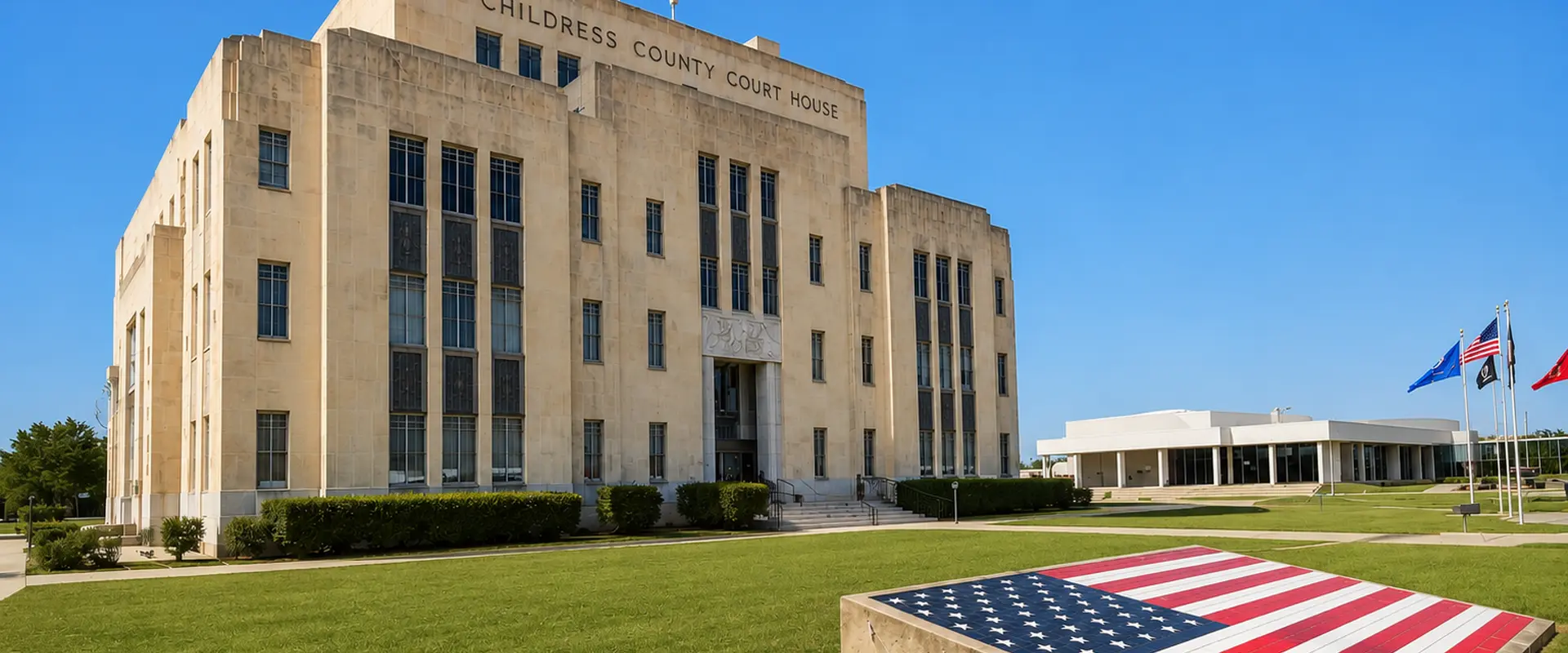
Texas organizes its trial courts into several layers, and in Childress County, those layers manifest at a single address: 100 Avenue E NW. That is where the main courthouse is located, serving as home to the district court, county court, and justice court, as well as the County Clerk's Office, which serves all of the courts. All operations are consolidated at one convenient address, segregated by court and by function.
A filing sent to the wrong office can be rejected, which is already a pain. Given that the combined clerk's office has limited staff due to its county status, any delay could be particularly egregious.
Types of Courts in Chidress County, Texas

Most of Childress County's courts are housed in the Childress County Courthouse at 100 Avenue E NW. The exception is the Municipal Court, which operates out of a separate city building. Here's a rundown of each court, what it handles, and where to find it.
 District Court
The 100th Judicial District Court is the felony court and typically handles major civil cases, family law cases, and juvenile matters. Most Texas districts have three district court judges who hear cases in the district's five counties on a rotating basis.
Jurisdiction includes:
- Felony criminal charges
- Major civil disputes
- Divorce and legal separation
- Child custody and visitation
- Child and spousal support
- Juvenile delinquency and dependency
- Termination of parental rights
Felony cases have very serious consequences, and most people charged with felonies hire an attorney. Even in less serious cases of divorce, custody disputes can take a long time to resolve and become complicated.
 County Court
Located one level below the district court, the County Court hears middle-level criminal and civil cases. It also hears appeals from the Justice of the Peace courts.
Jurisdiction includes:
- Class A and Class B misdemeanor criminal cases
- Civil disputes within the county court's statutory range
- Probate: Wills, estate administration, guardianships
- Mental health commitment proceedings
- Appeals from Justice of the Peace courts
Probate cases are handled in the Childress County Court. They are initiated when a loved one has died, whether or not they left a will. These also include designating care for a minor or incapacitated adult.
 Justice of the Peace Courts
 handle the routine cases below the level of the district or county court. There are two precincts in total, located in the main courthouse. These courts are typically where you will find self-represented individuals.
Jurisdiction includes:
- Small claims cases up to $20,000
- Class A and B Misdemeanor cases at the justice court level
- Traffic citations and violations
- Evictions (forcible entry and detainer)
- Civil cases within justice court jurisdiction
- Magistrate duties: Probable cause hearings, setting bail
Most cases brought to this court involve the issuance of traffic citations. In addition, disputes over debt, property damage, or failure to receive payment for goods and services are the norm here.
Municipal Court
The Childress Municipal Court handles cases arising from violations of city ordinances, things like local traffic offenses, code enforcement citations, and other misdemeanor-level matters that fall within city limits. It operates as a city court rather than a county court, so its jurisdiction is limited to offenses that occur within Childress city boundaries. Its location is 315 Commerce St., Childress, TX 79201.
Jurisdiction includes:
- Class C misdemeanor offenses under the city ordinance
- City traffic citations and violations
- Code enforcement matters
- Fine-only offenses within municipal jurisdiction
All pleas must be submitted in person or in writing. Juveniles must be accompanied by an adult. Citations can also be paid by phone at 1-800-690-5417 (have your citation number and payment amount ready).
How to Access Childress County Court Records

Texas law generally considers most court records to be public records. Criminal case files, civil judgments, probate files, and divorce decrees are a few examples of the many types of court records that are available for review. However, records related to juvenile matters and sealed records are generally not public. Additionally, some types of sensitive or protected information are not considered public records.
Certified copies of documents have a per-page charge. An informal review of the case index is on a no-charge basis. The type of research needed and the amount of time you have to accomplish your goals will determine whether an informal review of the case index or a certified copy would be more beneficial.
 Online Access
The Childress County Clerk's office maintains an online records portal. If you know the case number or the names of the parties involved, the clerk's website provides additional ways to search court records. Statewide searching for civil cases in district, county, and probate courts across various Texas counties is available through the re:SearchTX, a free database search that can be used to access records by name or case number. Include the full legal name and approximate filing date for any search term performed on a search site.
 Alternative Online Options
The official clerk portal works well when you know exactly what you're looking for. Uncertainty about which court handled a matter or whether it was filed in Childress County at all is where it gets harder. Commercial platforms like CourtCaseFinder aggregate public records across multiple counties and court types at once, which is useful when you're cross-checking criminal history, civil judgments, divorces, or other filings without already knowing the right county or division.
 In-Person Requests
The old physical records, documents that have not been scanned, and certified copies are available by appointment in the office of the clerk. Please come with as many identification factors as you can, such as complete legal names, approximate time frames, and case numbers where available. Usually, on the same day, current files are returned to you. The files that are older might take some time before the required records are accessed. The district court and county court records are both kept in the office of the clerk.
 Archived Records
Records older than the digital era are kept in paper form in remote offices and libraries. The fragile ones are kept offsite. Before improvements in computer technology, the court computerized many of the forms and methods of filing used for the Court's contemporary records. Contact the Clerk's Office for information on available historical records, cost, and retrieval time before placing your request. The retrieval time may be longer for older documents. Many older records are located in off-site storage and require an extra time to retrieve the document before copying.
When the clerk's online index is not sufficient for searching long-past real property and deed records, the Texas State Library archives can provide scanned indexes to Childress County court records, including the indexes to old documents. Older vital records, including birth certificates, death certificates, and marriage licenses, may require a written request with specific identifying information and applicable costs.
For Attorneys and Legal Professionals
All proceedings in the 100th Judicial District Court and Childress County Courts (justices of the peace and constables' law enforcement proceedings) must be conducted in accordance with Texas statutes and proceedings as governed by Texas-licensed attorneys. In addition to these statewide rules, proceedings in these two courts are governed by local rules and practices. All filings in the district and county courts are done through the Texas e-filing platform and cannot be paper filed at the clerk's window for regular filings. Check the division's requirements and any local forms needed for the first filing.
Lawyers traveling to the 100th Judicial District Court from outside this district should be aware that its dockets rotate among five counties, Carson, Childress, Collingsworth, Donley, and Hall, so session dates in Childress may have changed and should be verified before informing your clients of upcoming hearing dates.
The Clerk's staff can answer any procedural questions you may have. Depending on the type of record and whether it is current or certified/archived, there may be a brief delay in obtaining the record from the combined clerk staff.
How to File a Case in Childress County

Filing the first time matters correctly. A missing signature, wrong form, or incorrect filing fee sends you back to start, and in a rural county where the drive isn't short, that's a real cost.
 Step 1: Choose the Correct Court
Getting it right the first time is important. Losing a signature, improper form, or inappropriate filing fee gets you back to square one, or in a rural community where you don't have to travel far to do it, that is a real expense. All cases in Childress County lead to the courthouse, but the appropriate office varies depending on what you are filing. The 100th District Court takes felony charges and family law cases. Probate and Misdemeanors s in the County Court. Traffic cases, evictions, and small claims are referred to one of the Justice of the Peace precincts. You might not be sure what court your case falls under, so before you appear, call (940) 937-6143 and ask the clerk to make certain.
 Step 2: Complete Required Forms
Most types of cases have standardized court forms in Texas. You can find a list of and access most of the court-recommended forms at the official self-help portal. These forms guide you through an online interview to assist self-represented litigants in completing the forms to create the necessary documents when filing as a first-time user. Information and forms for small claims cases, including plain language instructions, can be found on the webpage of the Texas Justice Court Training Center. Please make sure to complete ALL fields and attach ALL required documents. Incomplete forms will be returned.
 Step 3: File Your Case
Self-represented litigants can appear in person at the window payment area with payment or send the documents by mail. Electronic filing is also available and recommended at the self-help portal. It is quicker, gets a timestamped confirmation, and allows you to check on the filing without having to call. Attorneys filing in District or County Court are required to e-file. Pro se filers (self-represented) are under no obligation to eFile, but may if they choose.
 Step 4: Pay Filing Fees
Fees charged by type of case. Small claims fees are $30 to $100 dependent on the amount of the claim. Other civil filings in the district and county courts are based on the statewide cost schedule. Applications for a waiver of costs where the expense of the case truly presents a hardship to the party may be submitted to the Court with the petition. Each application will be reviewed on a case-by-case basis.
 Step 5: Serve the Other Party
Before either a defendant or a plaintiff may bring a case, the other party must be notified of the lawsuit. You cannot personally hand the complaint and answer to the other party. These papers must be served by an adult (someone over 18) other than one of the parties, a sheriff deputy, or a licensed process server. Alternatively, certified mail with a return receipt requested may be used where local rules permit it. Be sure to include evidence of service in the records before the hearing date.
 Step 6: Monitor Your Case
Check in after filing. Check case status on the county clerk's online portal or reach out via phone at (940) 937-6143. You can also use the official statewide system, re:SearchTX, to search court records. Being aware of your case number and reviewing it periodically helps avoid missing key updates that could affect your case.
Childress County Courthouse Directory
Childress County's courts are divided between two locations. Most are housed in the County Courthouse, with the Municipal Court operating separately out of a city building.
Childress County Courthouse
The courthouse is the central location for most of the county's court functions, housing the 100th Judicial District Court, the County Court, and the Justice of the Peace Courts.
Childress
Address: 100 Avenue E NW, Childress, TX 79201
100th Judicial District Court
Childress
Address: 100 Ave E NW, Box 3, Childress, TX 79201
Phone: (940) 937-7070
County Court
Childress
Address: 100 Avenue E NW, Childress, TX 79201
Phone: (940) 937-2221
Website: childresstx.us/pages/county-judge
Justice of the Peace Courts (Precincts 1-2)
Childress
Address: 100 Avenue E NW, Box 6, Childress, TX 79201
Phone: (940) 937-6145
Childress Municipal Court
This court handles city ordinance violations, traffic offenses, and minor misdemeanors within Childress city limits.
Childress
Address: 315 Commerce St., Childress, TX 79201
Phone: (940) 937-6943
Website: cityofchildress.com/municipal-court
Legal Help and Self-Help Resources
Representing yourself in court is allowed, but it is often more complicated than it seems. Simple mistakes on forms or missing a deadline can delay your case for months. Whether you are facing an eviction, navigating probate, trying to resolve a debt through small claims, or preparing for a hearing with little time to spare, free and low-cost resources can help you understand the process and protect your rights. These services focus on providing forms, clear explanations, and procedural guidance. They cannot offer the full legal advice that an experienced attorney can provide.
 Free Legal Assistance
The official website for the Texas Judicial Branch's self-help efforts is an excellent tool. This site includes numerous self-help tools such as forms, procedural guides, English and Spanish video tutorials on court processes, and lists of required information for various types of courts. For anyone about to file a lawsuit, this is where to start.
In addition, the District Clerk's office and County Clerk's office in Childress can point you toward other local and statewide self-help programs. For family law matters, support calculation tools and basic form assistance are often available through various court-sponsored programs. These resources focus on providing practical guidance and tools to help you move forward.
 Local Legal Support
Self-help tools work well for straightforward matters such as small claims, uncontested divorces, or simple probate filings. However, more complicated cases like contested child custody disputes, serious criminal charges, or contested estate matters usually go more smoothly with professional help. The State Bar of Texas lawyer referral service can connect you with attorneys practicing in Childress County and surrounding areas. Some lawyers offer initial consultations at reduced rates or flexible payment arrangements. Whether you are dealing with a difficult family situation, protecting your rights as a tenant, or trying to resolve a significant debt, combining self-help resources with expert advice when needed often leads to better outcomes.
Childress County residents can access legal support through statewide and regional civil assistance programs instead of relying only on private attorneys. Key options include Legal Aid of NorthWest Texas, which provides free help for eligible low-income individuals in civil matters such as housing, family law, and probate.
FAQs
How do I look up a court case in Childress County?
Start your search at the online records portal. Type in the full legal names of the parties involved (or the case number if you know it). The vast majority of cases are instantaneous and will appear in the online search results. Older cases or cases that are not currently online can be searched by contacting the Clerk's office.
Are Childress County court records public?
Most of them, yes. Texas law opens criminal case records, civil judgments, probate records, and most other court records to the public. There are some exceptions for juvenile cases and certain sealed documents, as well as some items that are restricted by law for privacy reasons. If you are searching online and do not find what you are looking for, please contact the clerk's office, as older records may not be available in our online portal and can be requested in person or by mail for review.
How do I find eviction records in Childress County?
The Justice of the Peace courts deal with eviction cases, which are known as forcible entry and detainer actions in Texas. The simplest case details can be searched via the online portal of a clerk. All documents filed in the case would have to be physically present, or a formal written request would be required in order to access the full case files. These records are used by landlords to verify rental histories; tenants occasionally draw their own records before seeking housing.
How long does it take to get court records in Childress County?
Open files are usually returned the same day when requested in person. Those requested via the clerk's portal are usually available immediately for electronic files. Certified copies take longer to process. Older records that haven't been digitized require extra time, so call ahead to get an estimate before making the trip.
What's the difference between the District Clerk and the County Clerk in Childress County?
In Childress County, one office handles both functions. The combined District and County Clerk's office at Box 4 maintains records for the 100th District Court and the County Court alike: criminal files, civil case records, probate filings, vital records, and real property documents. One phone number, one address, one office. That simplifies things in a county this size.
Other Counties in Texas
- Anderson
- Andrews
- Angelina
- Aransas
- Archer
- Armstrong
- Atascosa
- Austin
- Bailey
- Bandera
- Bastrop
- Baylor
- Bee
- Bell
- Bexar
- Blanco
- Borden
- Bosque
- Bowie
- Brazoria
- Brazos
- Brewster
- Briscoe
- Brooks
- Brown
- Burleson
- Burnet
- Caldwell
- Calhoun
- Callahan
- Cameron
- Camp
- Carson
- Cass
- Castro
- Chambers
- Cherokee
- Clay
- Cochran
- Coke
- Coleman
- Collin
- Colorado
- Comal
- Comanche
- Concho
- Cooke
- Coryell
- Crockett
- Crosby
- Culberson
- Dallam
- Dallas
- Dawson
- De Witt
- Deaf Smith
- Delta
- Denton
- Dimmit
- Duval
- Eastland
- Ector
- Edwards
- El Paso
- Ellis
- Erath
- Falls
- Fannin
- Fayette
- Fisher
- Foard
- Fort Bend
- Franklin
- Freestone
- Frio
- Gaines
- Galveston
- Garza
- Gillespie
- Glasscock
- Goliad
- Gonzales
- Gray
- Grayson
- Gregg
- Grimes
- Guadalupe
- Hale
- Hamilton
- Hansford
- Hardin
- Harris
- Harrison
- Hartley
- Haskell
- Hays
- Henderson
- Hidalgo
- Hill
- Hockley
- Hood
- Hopkins
- Houston
- Howard
- Hunt
- Hutchinson
- Jack
- Jackson
- Jasper
- Jefferson
- Jim Wells
- Johnson
- Jones
- Karnes
- Kaufman
- Kendall
- Kenedy
- Kerr
- Kinney
- Kleberg
- Lamar
- Lamb
- Lampasas
- Lavaca
- Lee
- Leon
- Liberty
- Limestone
- Live Oak
- Llano
- Loving
- Lubbock
- Madison
- Marion
- Matagorda
- Maverick
- Mcculloch
- Mclennan
- Medina
- Midland
- Milam
- Mitchell
- Montague
- Montgomery
- Moore
- Morris
- Nacogdoches
- Navarro
- Newton
- Nolan
- Nueces
- Ochiltree
- Orange
- Palo Pinto
- Panola
- Parker
- Parmer
- Pecos
- Polk
- Potter
- Rains
- Randall
- Red River
- Reeves
- Robertson
- Rockwall
- Runnels
- Rusk
- Sabine
- San Augustine
- San Jacinto
- San Patricio
- Scurry
- Shelby
- Sherman
- Smith
- Somervell
- Starr
- Stephens
- Tarrant
- Taylor
- Terrell
- Terry
- Titus
- Tom Green
- Travis
- Trinity
- Tyler
- Upshur
- Uvalde
- Val Verde
- Van Zandt
- Victoria
- Walker
- Waller
- Ward
- Washington
- Webb
- Wharton
- Wichita
- Wilbarger
- Willacy
- Williamson
- Wilson
- Wise
- Wood
- Yoakum
- Young
- Zapata
- Zavala
Table of Contents
