Table of Contents
Castro County Courts, TX *

Castro County, known for its agricultural roots, is located in the Texas Panhandle. This county depends on its local court system to handle legal matters that affect individuals, families, businesses, and property owners, with Dimmitt as the county seat. The functions of Castro County's courts consist of maintaining order, resolving disputes, and ensuring that justice is accessible to the residents.
The court system manages numerous legal issues, including civil disputes, criminal charges, family law matters, such as divorce, probate cases involving estates, traffic violations, and small claims. The courts provide a structured process to resolve them.
Overview of the Castro County Court System
The Castro County court system operates under the broader Texas Judicial Branch, which has a structure of courts with overlaying jurisdictions. This shared structure ensures that even smaller counties like Castro can access broader judicial resources.
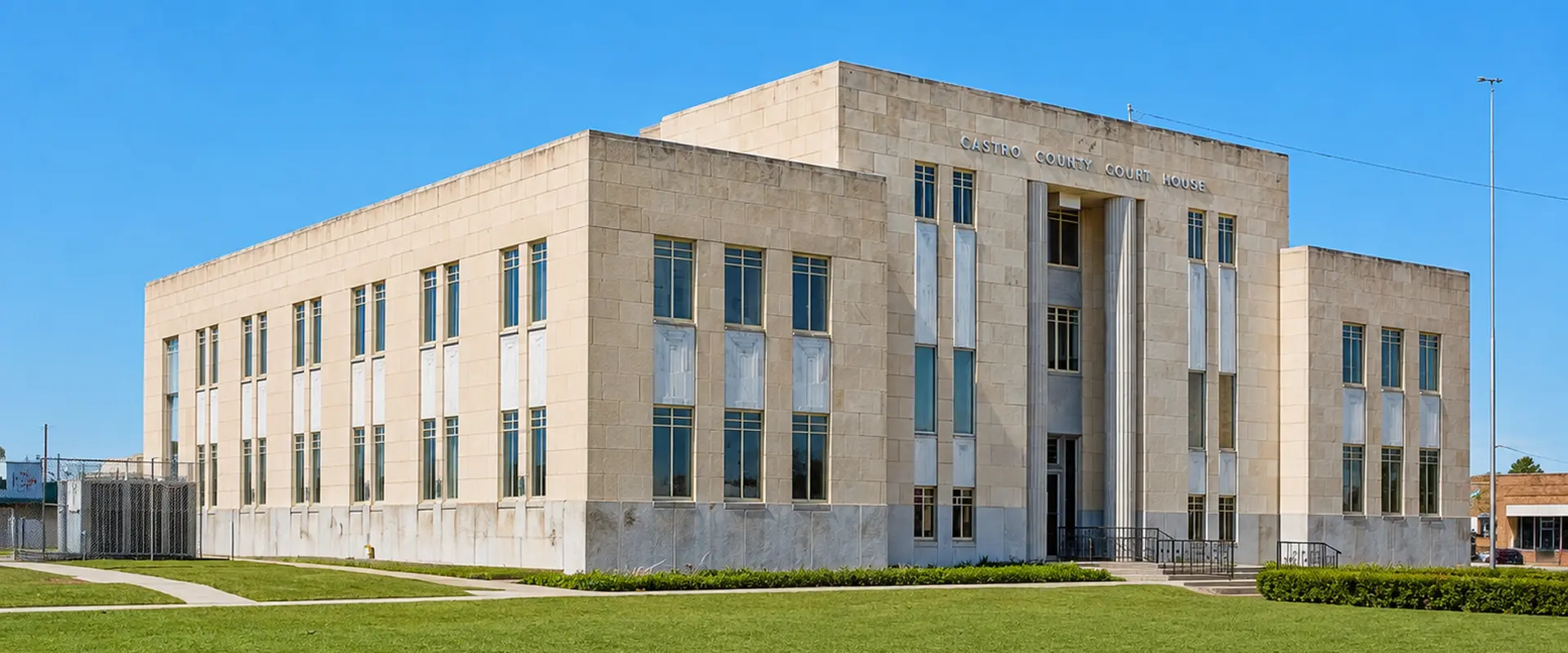
The Castro County courthouse, situated in Dimmitt, is where most court operations are centered because it houses primary courts, including the County District Courts, the County Constitutional Court, the County Courts at Law, the County Justice of the Peace courts, and the Appellate Courts.
The county's District Clerk's Office is also situated at the main courthouse, which is responsible for managing filings, maintaining records, and assisting the public with procedural questions. This central location simplifies access, especially when dealing with multiple legal matters, for the county's residents.
Additionally, there are Municipal Courts located in Dimmit, Hart, and Nazareth cities. These courts handle cases like misdemeanors and traffic offenses within the city's jurisdiction.
Types of Courts in Castro County, TX

Each court in Castro County has a defined role, and knowing these roles will help you move your case forward more efficiently or know where a case's documents were filed.
 District Courts
The County District Courts, serving Castro County, are the 64th District Court and 242nd District Court, and are part of Texas's state district court system.
Primary location: Castro County Courthouse
These courts share administrative rules and handle cases such as:
- Felony criminal cases
- Divorce and family law matters
- Civil cases involving higher monetary amounts
- Juvenile cases
- Land disputes and title issues
District Courts handle the most serious and complex cases in the county that often involve detailed procedures, multiple hearings, and strict timelines. Therefore, it is recommended to work with an attorney because of the stakes involved. District Courts play a crucial role in interpreting state law at the local level.
 Constitutional Court
The County Constitutional Court is more commonly known as the County Court. This type of court is established under the Texas Constitution and deals with specific judicial roles for Castro County, including county business and administrative responsibilities. It also acts as the Commissioners Court for county governance.
This court's jurisdiction comprises:
- Misdemeanor criminal cases
- Probate matters, including wills and estates
- Civil cases with moderate monetary limits
- Appeals from Justice of the Peace courts
This court handles a wide spectrum of legal matters that affect the county's residents. It also acts as an intermediary level between the lower courts and District Courts.
 Courts at Law
County Courts at Law, located at the county's courthouse, are referred to as statutory courts. They are created to assist with the workload of the County Constitutional Courts.
Jurisdiction includes:
- Civil cases within specific monetary limits
- Misdemeanor criminal cases
- Family law matters in some instances
- Appeals from lower courts
Where available, County Courts at Law help reduce congestion in higher courts by handling overlapping case types. The type of cases varies depending on the jurisdiction of the court they are overlapping the workload with. They often provide more specialized attention to certain matters, like probate matters, which can help cases move more efficiently through the system.
 Justice of the Peace Courts
The Castro County Justice of the Peace (JP) Courts are often the first stop for individuals handling minor legal matters. The functions of these courts are centralized at the county's courthouse.
They handle:
- Small claims disputes
- Evictions and landlord-tenant cases
- Minor traffic violations
- Minor misdemeanor offenses
JP Courts are known for their simplified procedures and quicker resolutions, and most people represent themselves in these courts; they are a practical option for resolving disputes without extensive legal involvement. Also, they have administrative duties such as performing marriage ceremonies and issuing search and arrest warrants.
 Municipal Courts
Castro County has three Municipal Courts located in Dimmitt, Hart, and Nazareth cities. These courts operate at the city level and focus on enforcing local ordinances within their respective city.
Cases include:
- City ordinance violations
- Minor traffic offenses
- Municipal misdemeanors
- Code enforcement issues
Municipal Courts handle lower-level offenses that occur within city boundaries, which are generally less complex but still important, especially when fines, penalties, or repeat violations are involved. They help maintain local order and ensure compliance with city regulations.
Appellate Courts
Castro County falls under a regional Court of Appeals in Texas with Appellate Courts that review rulings by the other courts to ensure that legal procedures and interpretations were applied appropriately. They include the Seventh Court of Appeals, located in Amarillo, which reviews appeals from the district courts and county courts. The Court of Criminal Appeals, which handles criminal appeals, and the Supreme Court of Texas responsible for civil and juvenile cases, both located in Austin, are also Appellate Courts in Castro County.
Their Jurisdiction also includes the interpretation of state law. Their decisions can affirm, reverse, or remand cases for further proceedings. For many litigants, this is an important step when challenging a court decision.
How to Access Castro County Court Records

Castro County allow public access to most court records, including records for civil, criminal, probate, and some family law cases, but certain documents, particularly those involving juveniles, sensitive family matters, or ongoing investigations, may be restricted or sealed.
The availability of online tools has made accessing court records easier over time. However, you may need to combine online searches with in-person visits for the most complete results, depending on the type of record. If you request certified copies or large documents, fees may be required.
 Online Access
Texas provides several online resources for searching court records, including statewide systems to obtain civil and criminal case records and a county-level tool, which is Castro County Clerk Record Search, to access other county court records available electronically. These platforms allow users to search by case number, party name, or filing date.
Before you start the search, gather as much information as possible, such as:
- Full legal names of parties involved
- Case number, if known
- Approximate filing date
- Type of case
Accurate case details improve the probability of locating the correct record quickly, avoiding confusion with similar names or cases.
 Alternative Online Options
Sometimes official systems can feel overwhelming and confusing to new users, especially if you're unsure which court handled your case. When this happens, use commercial platforms, for instance, CourtCaseFinder, which provides access to public records from multiple jurisdictions. These tools can help locate information on court cases, arrests, divorces, and determine which court handled a case.
 In-Person Requests
In-person requests are necessary if you are searching for certified copies or older records. These requests are made through the clerk's office at the county's courthouse. The staff at the clerk's office can assist you with locating:
- Physical case files
- Archived documents
- Certified copies
Additionally, clerks are trained to guide you through the search process, and you must bring detailed information about the case. This will make your visit more efficient and increase the probability of finding what you require.
 Archived Records
Older or historical court records in Castro County may not be available online and are stored in physical archives, and they require a formal request and additional processing time. Contact the clerk's office ahead of time if you are researching historical cases or property matters, since they will advise you on availability, retrieval times, and any related fees.
For Attorneys and Legal Professionals
Attorneys and legal professionals working in Castro County, particularly those from other regions, should be aware of the county's structure and reliance on regional district courts. You need to know which court has jurisdiction over the case you are hired for, for accurate filing and efficient case management.
As a lawyer, you can also make use of the Castro County court clerks since they can guide you on the county's court procedure, filing requirements, and record access. They can help ensure that documents are submitted correctly and on time. Ensure you allow additional processing time when requesting certified or archived documents.
How to File a Case in Castro County

Filing a case in Castro County requires submission of appropriate legal documents through the county's District Clerk if your case is handled by the district courts or County Clerk for matters managed by the county courts, hence careful preparation and attention to detail. Choosing the correct court and completing all required steps will help prevent delays and ensure your case moves forward smoothly.
 Step 1: Choose the Correct Court
The first step is to select the right court as per your case type, for example, District Courts handle serious civil and criminal matters, County Courts manage probate and misdemeanors, and JP Courts deal with smaller claims and minor offenses. Visit the Castro County Courts Official site to access information about the types of courts and their jurisdiction in the county.
 Step 2: Complete Required Forms
Secondly, fill out the filing forms accessible through Texas court websites and local clerk offices. Make sure all documents are completed accurately, signed, and include any required attachments, since incomplete paperwork can cause delays.
 Step 3: File Your Case
The next step is to file your case in person at the Castro County Courthouse. However, you can use the e-filing method managed through the Texas official filing portal for civil, criminal, family law, and probate cases. The portal must be used by attorneys, but is optional for self-represented parties. Filing in person allows clerks to review your documents and confirm that everything is in order.
 Step 4: Pay Filing Fees
The filing fees in Castro County vary depending on the type of case, such that civil cases, probate filings, and family matters each have their own fee structures. Check with the court's clerk for the most recent fee schedule. If you are unable to afford the fees, you may request a fee waiver through the Texas Law Help portal.
 Step 5: Serve the Other Party
Make sure you notify the other party through a process known as "service of process" after successfully filing your case. You can select a sheriff, constable, or private process server to complete this process, as you are not permitted to serve the other party yourself. Proper service documentation is required by the court before the case proceeds.
 Step 6: Monitor Your Case
Lastly, use the case number issued after a successful case filing to track its progress through online tools, including the county's court system or by contacting the clerk's office. This helps you stay informed about court dates, filings, updates, and avoid missing important deadlines.
Castro County Courthouse Directory
Castro County Courthouse (District and County Courts)
The courthouse serves as the central hub for the county's judicial system and houses the 64th and 242nd District Courts and the County Constitutional Court. The Clerk's Office is also located within the courthouse and deals with filings, court records, and certified document requests.
Dimmitt
Address: 100 E Bedford St, Dimmitt, TX 79027
Phone: (806) 647-4424
Website: Castro County Courthouse
County Courts at Law (Regional/As Applicable)
The courts serve the area through regional arrangements, helping the higher courts to manage civil cases, misdemeanor offenses, and certain family law matters, depending on jurisdiction.
Address: Contact the Castro County Courthouse for current jurisdiction details
Phone: (806) 647-3338
Justice of the Peace Courts (Castro County Precincts)
The JP Courts deal with small claims, evictions, minor traffic violations, and low-level misdemeanor offenses. Additionally, they perform administrative functions such as issuing warrants.
Dimmitt
Address: 100 E Bedford St, Dimmitt, TX 79027
Phone: (806) 647-2328
Municipal Courts
These courts handle violations of city ordinances, such as traffic offenses and municipal misdemeanors.
Dimmitt Municipal Court
Address: 201 E Bedford St, Dimmitt, TX 79027
Phone: (806) 647-2155
Hart Municipal Court
Address: 103 Broadway St, Hart, TX 79043
Phone: (806) 938-2171
Nazareth Municipal Court
Address: 101 First St, Nazareth, TX 79063
Phone: (806) 945-2285
Appellate Courts Serving Castro County
Appellate courts serve Castro County residents by reviewing appeals from local courts. The Seventh Court of Appeals in Amarillo hears appeals from district and county courts in the region.
Seventh Court of Appeals
Address: 501 S Fillmore St, Amarillo, TX 79101
Phone: (806) 342-2650
Court of Criminal Appeals
Address: 205 W 14th St, Austin, TX 78701
Phone: (512) 463-1551
Supreme Court of Texas
Address: 201 W 14th St, Austin, TX 78701
Phone: (512) 463-1312
Legal Help and Self-Help Resources
Navigating the legal system may require legal assistance and self-help resources. Legal assistance is not only for people who cannot afford an attorney but is also accessible to veterans, seniors, researchers, and parties with complex cases.
 Free Legal Assistance
There are various legal help resources in Castro County, including organizations such as Texas Legal Services Center and Legal Aid of Northwest Texas. They provide free services to eligible residents, depending on their financial need. The services include civil matters, housing disputes, family law issues, and consumer protection.
 Local Legal Support
Residents may also benefit from local legal clinics, such as ABA Free Legal Answers, a virtual legal advice clinic where you can post legal questions. Legal help programs include Senior Legal Assistance, a specialized program designated for residents over 60 years of age with legal problems, such as estate cases. Local law schools often provide free clinics to local residents as well.
FAQs
What are the methods for searching for a criminal case in Castro County?
You can search for a criminal case using the Texas court record systems or by contacting the Castro County Clerk's Office. Another way is by visiting the courthouse in person, where clerks can help search, provided you give them enough details about the case.
Does Castro County allow public access to court records?
Yes, you can obtain most court records. Keep in mind that special records, including juvenile cases or sensitive family law matters, are restricted or sealed. Ongoing investigations may also have limited access. It is best to contact the clerk's office before requesting records.
Where can I find eviction records?
Justice of the Peace Courts handle eviction cases. You can request records directly from the appropriate JP court website, or visiting the courthouse may be necessary.
Does Castro County allow e-filing?
Yes. There are cases you can file electronically in Castro County through Texas e-filingsystems, for example, civil and criminal cases. Note that e-filing in Castro County is mandatory for attorneys.
How long do I have to wait for my court records in Castro County?
How you requested your court records matters. The wait depends on if they are ready yet (updated in the system) and processing times. Castro County online records are available immediately when you search for them correctly. When you make in-person requests at the court, they can usually be completed the same day, but certified copies or archived records may take several days or longer.
Are online court record searches always accurate?
Online systems are a great option, but may not always be up to date since delays in updates can occur. Another issue is that you may not receive all of the documents you need if your search doesn't use the correct identifying information. It is best to verify all the details with the court directly.
When is it helpful to use a third-party records finder?
Whenever you're unsure which court holds the records or if you have to search across multiple jurisdictions, a third-party tool like CourtCaseFinder can be quite beneficial. They can simplify the process because they collect information from various sources and put them into one report.
Do I need an attorney for court in Castro County?
No, not always. The need for an attorney depends on your case type and the court that handles it. If you are going to represent yourself in a JP or small claims case, you can do that with no fuss. But for complex matters such as felony charges, contested divorces, or probate disputes, working with an attorney is a strong recommendation.
Other Counties in Texas
- Anderson
- Andrews
- Angelina
- Aransas
- Archer
- Armstrong
- Atascosa
- Austin
- Bailey
- Bandera
- Bastrop
- Baylor
- Bee
- Bell
- Bexar
- Blanco
- Borden
- Bosque
- Bowie
- Brazoria
- Brazos
- Brewster
- Briscoe
- Brooks
- Brown
- Burleson
- Burnet
- Caldwell
- Calhoun
- Callahan
- Cameron
- Camp
- Carson
- Cass
- Chambers
- Cherokee
- Childress
- Clay
- Cochran
- Coke
- Coleman
- Collin
- Colorado
- Comal
- Comanche
- Concho
- Cooke
- Coryell
- Crockett
- Crosby
- Culberson
- Dallam
- Dallas
- Dawson
- De Witt
- Deaf Smith
- Delta
- Denton
- Dimmit
- Duval
- Eastland
- Ector
- Edwards
- El Paso
- Ellis
- Erath
- Falls
- Fannin
- Fayette
- Fisher
- Foard
- Fort Bend
- Franklin
- Freestone
- Frio
- Gaines
- Galveston
- Garza
- Gillespie
- Glasscock
- Goliad
- Gonzales
- Gray
- Grayson
- Gregg
- Grimes
- Guadalupe
- Hale
- Hamilton
- Hansford
- Hardin
- Harris
- Harrison
- Hartley
- Haskell
- Hays
- Henderson
- Hidalgo
- Hill
- Hockley
- Hood
- Hopkins
- Houston
- Howard
- Hunt
- Hutchinson
- Jack
- Jackson
- Jasper
- Jefferson
- Jim Wells
- Johnson
- Jones
- Karnes
- Kaufman
- Kendall
- Kenedy
- Kerr
- Kinney
- Kleberg
- Lamar
- Lamb
- Lampasas
- Lavaca
- Lee
- Leon
- Liberty
- Limestone
- Live Oak
- Llano
- Loving
- Lubbock
- Madison
- Marion
- Matagorda
- Maverick
- Mcculloch
- Mclennan
- Medina
- Midland
- Milam
- Mitchell
- Montague
- Montgomery
- Moore
- Morris
- Nacogdoches
- Navarro
- Newton
- Nolan
- Nueces
- Ochiltree
- Orange
- Palo Pinto
- Panola
- Parker
- Parmer
- Pecos
- Polk
- Potter
- Rains
- Randall
- Red River
- Reeves
- Robertson
- Rockwall
- Runnels
- Rusk
- Sabine
- San Augustine
- San Jacinto
- San Patricio
- Scurry
- Shelby
- Sherman
- Smith
- Somervell
- Starr
- Stephens
- Tarrant
- Taylor
- Terrell
- Terry
- Titus
- Tom Green
- Travis
- Trinity
- Tyler
- Upshur
- Uvalde
- Val Verde
- Van Zandt
- Victoria
- Walker
- Waller
- Ward
- Washington
- Webb
- Wharton
- Wichita
- Wilbarger
- Willacy
- Williamson
- Wilson
- Wise
- Wood
- Yoakum
- Young
- Zapata
- Zavala
Table of Contents
