Table of Contents
Anderson County Courts, TX *

Anderson County, Texas, is located in East Texas, south of the Dallas-Fort Worth Metroplex and between Dallas and Houston. The County is known for the Piney Woods and large open spaces. Texas is unique, and so is its court system.
Overview of the Anderson County Court System
Anderson County has a complex court system with multiple levels: municipal court, justices of the peace, two county courts, and a district court. You need to understand the Texas court system to navigate it fully and to know which court system you may need.
Types of Courts in Anderson County, Texas

Texas has an extensive court system, and each county's system is a bit different. Here is an overview of the jurisdictions for each type of court in Anderson County, Texas.
 Municipal Court
There are three municipal courts in Anderson County. Palestine Municipal Court, overseeing Palestine, the largest town in the county, is held in the Palestine City Hall Complex. Elkhart Municipal Court and Frankston City Court are both held in their respective city halls.
Jurisdictions:
- Class C criminal offenses
- Minor traffic violations (tickets)
- Violations of city ordinances
- City code enforcement
- Warrants due to unpaid fines
Class C criminal offenses are the lowest level of criminal offense. They are punishable with fines up to $500, but no jail time. Examples of Class C offenses include traffic offenses, such as speeding or driving without insurance, petty theft of under $100, public intoxication, and leaving a child in a vehicle.
 Justice of the Peace Courts
In Palestine, the Justice of the Peace Court has concurrent authority with the Municipal Court. Outside Palestine, the Justice of the Peace Court has jurisdiction in the small towns and unincorporated areas of Anderson County. Anderson County has four districts for justices of the peace, and each district has its own justice of the peace. District 1 is located in Elkhart, while District 2, District 3, and District 4 are located in Palestine.
Jurisdictions:
- Civil disputes under $20,000
- Class C Misdemeanors
- Evictions
- Small Claims
- Debt Claims
- Marriages
- Death Inquests
- Issuing Warrants
While several state constitutions include a provision for justices of the peace, only nine states have active justice-of-the-peace courts. Justices of the Peace in Texas are elected, not appointed. The Texas Constitution requires each county to have between 1 and 8 justices of the peace, depending on the county's population.
 Constitutional Court
The Constitutional Court is mandated by the Texas Constitution, and there is only one county constitutional court in each county by state law. The Constitutional Court in Anderson County is located in the Anderson County Courthouse Annex.
Jurisdictions:
- Class A and B Misdemeanors
- Probate
- Civil Cases with monetary limits
- Family Law
- Child Support
- Child Abuse and Neglect
The Constitutional County Court has concurrent jurisdiction with other courts in Anderson County in family law, child support, and child abuse and neglect cases.
 Court at Law
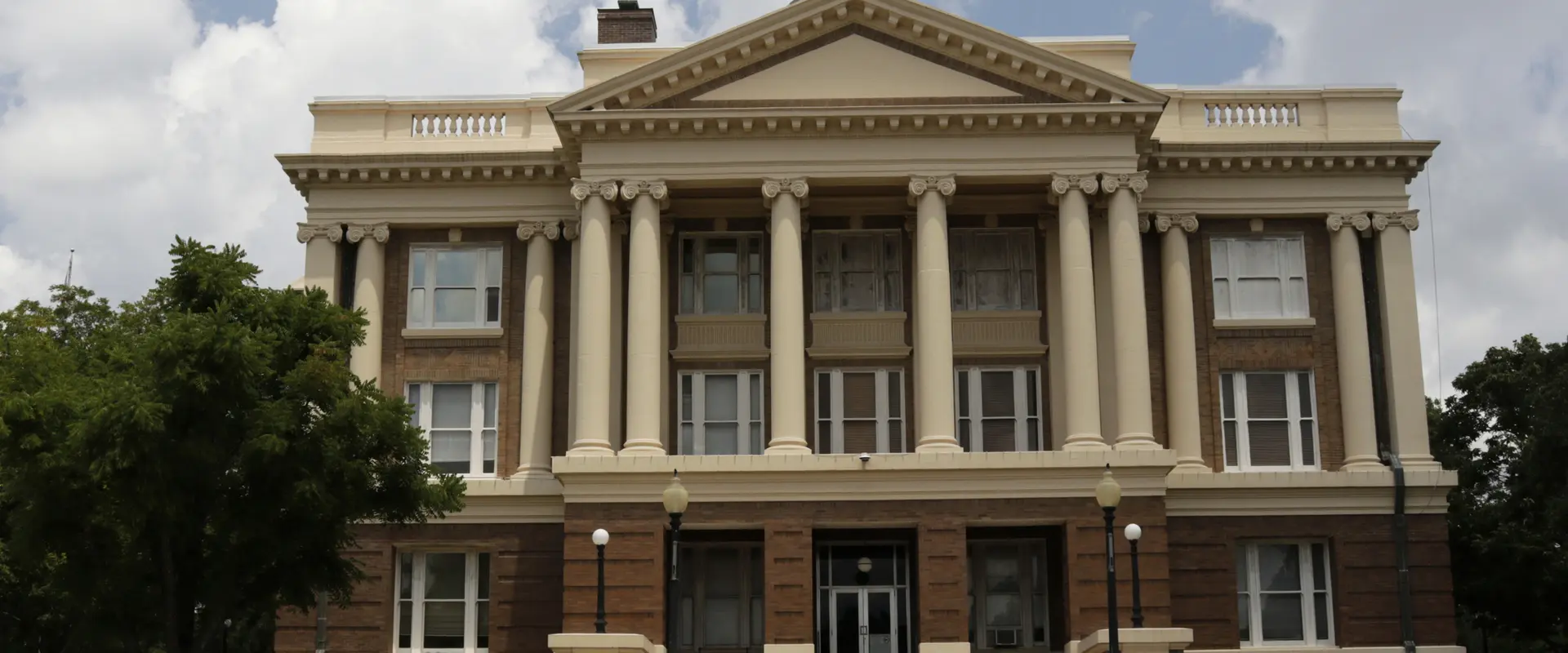
In Texas, county courts at law were created to handle some of the caseload from district and constitutional county courts. The Anderson County Court at Law is located in the Anderson County Courthouse.
Jurisdictions:
- Divorce
- Child Custody
- Child Support
- Child Abuse and Neglect
- Probate
- Trusts
- Felonies
- Civil Cases with damages between $500 and $200,000
- Guardianship
- Mental Health
- Criminal Misdemeanors
- Appeals from Justice of the Peace and Municipal Courts
 District Courts
Anderson County has four district courts: District 3, District 87, District 349, and District 369. All of these district courts handle cases involving parts of Anderson County and other surrounding counties. If you are unsure which district you are in, the Anderson County District Court page has contact information for each of the four district courts.
Jurisdictions:
- Felony criminal cases
- Divorces
- Land disputes
- Civil cases over $200
- Election disputes
- Adoptions, child custody, and child welfare
How to Access Anderson County Court Records

Given the sheer number of court systems in Anderson County, accessing them may feel a bit overwhelming. Here is some information about accessing court records in Anderson County.
 Online Access
Finding municipal records for Palestine, Texas, as well as county court records, is limited in Anderson County. You can request records online, but there is no searchable database of court records. You can find the county court docket on the County Clerk webpage. You can also send a message to the County Clerk seeking case information. There is also an online form to request municipal court information from the Palestine Municipal Court. There is no searchable database for district court cases in Texas prior to 2016. After 2016, most e-filed civil cases are available on re:SearchTexas, but what you can see is limited.
 Alternative Online Options
The Texas court system can be extremely confusing, and searching for court records online can be extremely difficult. You may have more luck searching for records online via a third-party search engine, such as CourtCaseFinder. Third-party websites allow you to search across multiple jurisdictions for case information, which can be especially helpful in Texas.
 In-Person Requests
Texas law guarantees you the right to request court records from any court in Texas, but you must follow court procedures in order to receive records. In Anderson County, you can make in-person requests for court records, but you need to make sure that you request records from the correct court. If you aren't sure which court heard the case you are searching for, it may be helpful to call the court clerk before you visit the court.
For municipal cases in Palestine, Frankston, and Elkhart, you can call or email the court directly to request information. You can request information in person, via email, by traditional mail, or by mailing a request form.
For proceedings of the Anderson County Justice of the Peace, you will need to contact each justice of the peace office directly. Each justice of the peace is responsible for keeping their own records, and each one has a separate phone, mailing address, and assistant. You can also request records by mail or in person.
The Anderson County Constitutional Court accepts requests for records and information via fax, online, or by mail for its court cases. You can also visit the court clerk in person to ask for information about court cases. Requesting records from the Anderson County Court at Law works much the same way as it does with the county constitutional court.
The District Courts of Anderson County may be the most confusing of all, because the county is divided into four different district courts. The simplest way to request information about a case within the district court system is to contact the court coordinator or the court clerk via phone or email before you visit the courts.
 Archived Records
In Anderson County, you request archived records for the three municipal courts, the justices of the peace, and the constitutional county court in the same way as you request current records. If you are unsure whether the case originated in the Palestine, Elkhart, or Frankston Municipal Court, you can check by calling the municipal court clerk. You will need to contact each justice of the peace office directly via separate phone, fax, mailing address, and assistant. Requesting archived records from the Anderson County Court of Law requires contacting the court clerk in person, by email, or by traditional mail.
Because the district court system in Anderson County is confusing, you need to make sure which district court houses the archived court case you need information on before you visit. You can contact the court clerks directly via phone or email. You can also contact the district court coordinator via phone or in writing.
For Attorneys and Legal Professionals
Visiting attorneys to Anderson County may find the legal path a bit murky. It is more important than ever to make sure you understand which court you need to file in. The most frequently argued cases by attorneys in the Anderson County Courts are not criminal, but civil. Usually, attorneys argue cases involving real estate, land disputes, and estate planning or probate. Of all the court systems in Texas, attorneys and legal professionals most often have business in the district courts, specifically the 3rd and 349th districts, due to the population density in those two districts.
How to File a Case in Anderson County

Perhaps more than any other state, filing a case in Anderson County takes a bit of practice. Here is a step-by-step guide for filing cases in Anderson County.
Step 1: Choose the Correct Court
The first step in your case-filing journey is determining which court you need to file with. Here is a great rule of thumb for filing paperwork with a court in Anderson County:
- The municipal courts in Palestine, Elkhart, and Frankston have jurisdiction over city ordinances and Class C misdemeanors committed within their jurisdictions.
- Justices of the peace have jurisdiction over small civil cases (less than $20,000), evictions, marriages, and Class C misdemeanors that occur outside a city.
- Anderson County Court at Law and the Constitutional County Court have jurisdiction over class A and B misdemeanors, probate, and small civil cases.
- Texas District Courts have jurisdiction over felony criminal cases, divorce, land disputes, contested elections, and civil cases over $500.
If you aren't sure how to pick the right court for you, it is time to call or email the court clerk.
 Step 2: Complete Required Forms
While figuring out which court to file in can be difficult, actually filling out the forms to file your case is relatively simple once you know the court you need to file in.
- Municipal court paperwork for Palestine is available on the Palestine Municipal Court page. Frankston's documents are not available online, but you can contact the court clerk to have forms sent to you. Elkhart's municipal court documents are not available online, but you can call to have the forms sent to you or mail a request.
- Justices of the peace court paperwork is available by contacting each justice of the peace office directly by phone or mail.
- County Courts paperwork can be requested by contacting the county clerk via phone or mail. You can also visit in person.
- You can find District Court paperwork by contacting the District Courts coordinator or the clerks at each court district by phone or mail.
It is important that you fill out your forms as accurately as possible. If you are confused or need help, the law clerks at each court level can be very helpful.
 Step 3: File Your Case
While figuring out which court to file in can be difficult, actually filling out the forms to file your case is relatively simple once you know the court you need to file in. Once you have your forms filled out, you can file your case through E-file Texas. E-file Texas accepts paperwork from municipal, district, county, and justice of the peace courts. You can also file your cases at the clerks' offices of the respective court system.
 Step 4: Pay Filing Fees
If you are using E-file Texas to file your case, you will need to pay the filing fees at the same time using a credit or debit card. If you file in person, most court systems accept cash, checks, and credit or debit cards.
 Step 5: Serve the Other Party
Once you have filed your paperwork and paid the filing fees, you will need to give the other party a copy of the paperwork you filed with the court. In Texas, court papers can be served by a sheriff or constable, an adult over the age of 18 with the court's permission, the clerks of court, or a process server certified by the Judicial Branch Certification Commission (JBCC). You must file an affidavit of service with the court. If a sheriff or constable serves the paperwork, they will file an officer's affidavit of service with the court.
 Step 6: Monitor Your Case
After you finish the filing process, you will want to monitor your case to make sure you don't miss an appointment or a hearing with the court. You can check the progress of your case with the clerks of court at the municipal court, the justices of the peace, the county courts, or the district courts.
Anderson County Courthouse Directory
Palestine Municipal Court
Address: 504 N Queen Street, Palestine, TX, 75801
Phone: (903) 731-8400
Elkhart Municipal Court
Elkhart
Address: 110 W. Parker St, Elkhart, TX 75839
Phone: (903) 764-5657
Website: cityofelkharttx.gov/
Frankston Municipal Court
Frankston
Address: 240 W. Main Street, Frankston, TX 75763
Phone: (903) 876-2241
Website: frankstontx.gov/court
Justices of The Peace, Anderson County
Precinct 1
Address: 120 Watkins St., Elkhart, TX 75839
Phone: (903) 876-2241
Website: co.anderson.tx.us/page/anderson.JusticePeace.One
Precinct 2
Address: 703 N. Mallard St. Ste 107, Palestine, TX 75801
Phone: (903) 723-7486
Website: co.anderson.tx.us/page/anderson.JusticePeace.Two
Precinct 3
Address: 500 N. Church Street, Suite 8, Palestine, TX 75801
Phone: (903) 723-7418
Website: co.anderson.tx.us/page/anderson.JusticePeace.Three
Precinct 4
Address: 703 N. Mallard St., Suite 106, Palestine, TX 75801
Phone: (903) 723-7419
Anderson County Court (Constitutional)
Palestine
Address: 703 N. Mallard Street, Suite. 101, Palestine, TX 75801
Phone: (903) 723-7406
Anderson County Court At Law
Palestine
Address: Historic Anderson County Courthouse, 500 North Church Street, Third Floor, Palestine, TX 75801
Phone: (903) 723-7469
Website: co.anderson.tx.us/page/anderson.CCL
District Courts (Districts 3, 87, 349, and 369)
Palestine
Address: District Court Coordinator, 500 Church Street, #43, Palestine, TX 75801
Phone: (903) 723-7403
Legal Help and Self-Help Resources
If you need help with your paperwork or understanding your court case, it is crucial to begin with the clerks of the court. However, you may also be able to access free legal assistance or local legal support to make sure you are prepared for court.
 Free Legal Assistance
One of the best free legal assistance websites in Texas is TexasLawHelp.org. TexasLawHelp provides paperwork and advice for people in the Texas legal system. You can also post for help with your civil case from lawyers with the American Bar Association at Free Legal Answers Texas.
 Local Legal Support
Legal Aid of Northwest Texas provides help for people with low or moderate incomes with civil cases such as benefits, landlord disputes, or family law. The Crisis Center of Anderson County gives referrals and free legal help to victims of domestic violence. The Texas Justice Court Training Center has self-help packets and information for the Justice of the Peace Court system.
FAQs
How do I search for a criminal case in Anderson County?
The easiest way to search for a criminal case in Anderson County is to contact the Anderson County District Clerk's Office. They will be able to help you research a case and, if necessary, direct you to a different court.
Are court records public in Anderson County?
Yes, nearly all court records in Anderson County are public under the Texas Public Information Act. Certain records may not be available because they involve juveniles or because they have been sealed by a judge.
Where can I find eviction records?
Most eviction records in Anderson County, Texas, are available through the Anderson County Clerk's office. You can request a copy of the eviction records in person or via mail.
Can I file a small claims case online?
You can file small claims cases online through the eFileTexas.gov portal. Small claims cases are usually handled through the Justice of the Peace court system.
How long does it take to get records in Anderson County?
Since most records in Anderson County must be requested in writing or in person, it may take a few minutes in person or several days by mail. Be sure that you have as much information about the case as possible.
Are online court record searches always accurate?
Most records for Anderson County are not searchable online. Since you have to request records in person or via mail, they may be more accurate than online records.
When is it helpful to use a third-party records finder?
Because many Texas records are so convoluted, using a third-party records finder such as CourtCaseFinder may save you a trip to one or more courthouses in Anderson County. Also, a third-party records finder can search across multiple jurisdictions, which may save you time.
What do I do if I can't find my case online?
Your next step, if you can't find your case online, is to call or mail a letter to the clerk of the court's office for the court you need records of your case from. You may also go in person to see if the county clerk can help you.
What kind of records can I find online?
At this time, little information about the records is available online. You should contact the clerk of the court where your case is to search the case records.
Other Counties in Texas
- Andrews
- Angelina
- Aransas
- Archer
- Armstrong
- Atascosa
- Austin
- Bailey
- Bandera
- Bastrop
- Baylor
- Bee
- Bell
- Bexar
- Blanco
- Borden
- Bosque
- Bowie
- Brazoria
- Brazos
- Brewster
- Briscoe
- Brooks
- Brown
- Burleson
- Burnet
- Caldwell
- Calhoun
- Callahan
- Cameron
- Camp
- Carson
- Cass
- Castro
- Chambers
- Cherokee
- Childress
- Clay
- Cochran
- Coke
- Coleman
- Collin
- Colorado
- Comal
- Comanche
- Concho
- Cooke
- Coryell
- Crockett
- Crosby
- Culberson
- Dallam
- Dallas
- Dawson
- De Witt
- Deaf Smith
- Delta
- Denton
- Dimmit
- Duval
- Eastland
- Ector
- Edwards
- El Paso
- Ellis
- Erath
- Falls
- Fannin
- Fayette
- Fisher
- Foard
- Fort Bend
- Franklin
- Freestone
- Frio
- Gaines
- Galveston
- Garza
- Gillespie
- Glasscock
- Goliad
- Gonzales
- Gray
- Grayson
- Gregg
- Grimes
- Guadalupe
- Hale
- Hamilton
- Hansford
- Hardin
- Harris
- Harrison
- Hartley
- Haskell
- Hays
- Henderson
- Hidalgo
- Hill
- Hockley
- Hood
- Hopkins
- Houston
- Howard
- Hunt
- Hutchinson
- Jack
- Jackson
- Jasper
- Jefferson
- Jim Wells
- Johnson
- Jones
- Karnes
- Kaufman
- Kendall
- Kenedy
- Kerr
- Kinney
- Kleberg
- Lamar
- Lamb
- Lampasas
- Lavaca
- Lee
- Leon
- Liberty
- Limestone
- Live Oak
- Llano
- Loving
- Lubbock
- Madison
- Marion
- Matagorda
- Maverick
- Mcculloch
- Mclennan
- Medina
- Midland
- Milam
- Mitchell
- Montague
- Montgomery
- Moore
- Morris
- Nacogdoches
- Navarro
- Newton
- Nolan
- Nueces
- Ochiltree
- Orange
- Palo Pinto
- Panola
- Parker
- Parmer
- Pecos
- Polk
- Potter
- Rains
- Randall
- Red River
- Reeves
- Robertson
- Rockwall
- Runnels
- Rusk
- Sabine
- San Augustine
- San Jacinto
- San Patricio
- Scurry
- Shelby
- Sherman
- Smith
- Somervell
- Starr
- Stephens
- Tarrant
- Taylor
- Terrell
- Terry
- Titus
- Tom Green
- Travis
- Trinity
- Tyler
- Upshur
- Uvalde
- Val Verde
- Van Zandt
- Victoria
- Walker
- Waller
- Ward
- Washington
- Webb
- Wharton
- Wichita
- Wilbarger
- Willacy
- Williamson
- Wilson
- Wise
- Wood
- Yoakum
- Young
- Zapata
- Zavala
Table of Contents
